
Ask the owner of a small firm where new clients come from and the usual answer is "word of mouth, mostly". That is often true, and it is often all anyone knows. Meanwhile there is a half-finished blog, a LinkedIn page last updated in spring, a stack of business cards from a conference, and a feeling that the firm should be doing more of everything.
It should not. A firm with a few hours a week for finding new clients cannot run seven channels. It can run two or three well. This article goes through the realistic options, what each one costs and what it brings, and how to choose.
Seven channels, side by side
Each channel differs in three ways that matter: how much time it takes every week, how long before it brings any work, and what kind of lead arrives. A lead who was sent by a trusted client and a lead who filled in a form after a search are both leads, but they do not behave the same way.
| Channel | What it costs in time | The kind of lead it brings |
|---|---|---|
| Referrals | Little, but steady: a few conversations a week | Few, warm and already half convinced |
| Content and a newsletter | Half a day to a day a month, every month | People who know how you think before they call |
| Website and enquiry form | A day or two to set up, then minutes per enquiry | Mixed: some ready to buy, some only researching |
| Events and speaking | Days at a time, plus the follow-up afterwards | People who have met you, in batches |
| Partnerships | Several meetings before anything happens | Clients of a firm that already trusts you |
| Short sessions several times a week | People who have watched you for a while | |
| Outbound email and calls | Regular blocks of focused time | People who were not looking, so the most work to win |
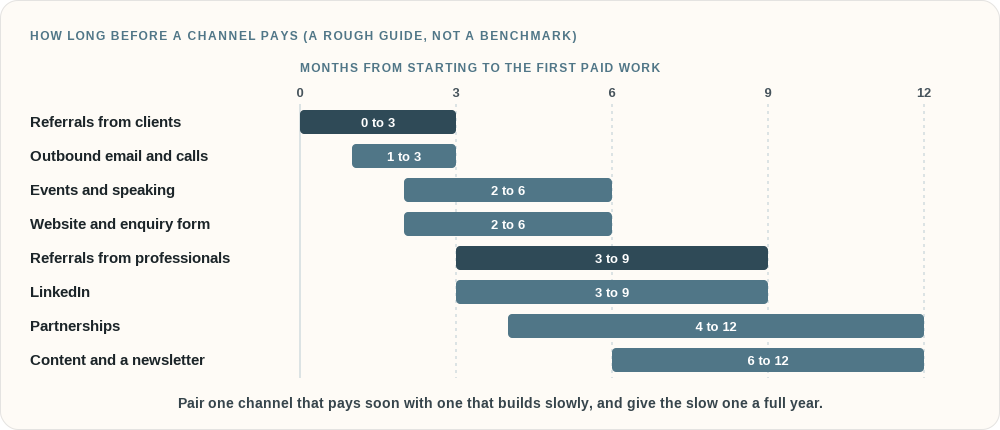
Referrals, and how to ask for them
For most professional firms, referrals are the best source and the least managed one. They come from two groups. Clients refer people like themselves. Other professionals, such as the lawyer, banker or software consultant who serves the same clients you do, refer people at the moment a need appears. The second group is slower to build and can send work for years.
Referrals rarely happen on their own. People who are happy with your work do not think about who else needs it unless you ask, and most firms never do.
- Ask at a good moment: when a project has gone well, when a client thanks you, or when they renew.
- Be specific. "Do you know anyone who needs help?" gets a shrug. "We do our best work for owner-managed builders with 10 to 50 staff. Is there one you think we should meet?" gets a name.
- Make it easy. Offer to write two sentences they can forward, and ask for an introduction, not a recommendation.
- With other professionals, give first. Send them a client, or something useful for theirs, before you ask for anything.
- Close the loop. Tell the person who referred what happened, and thank them whether or not it became work.
Useful content, a newsletter and your website
Content means answering, in writing, the questions clients ask you every month. One good article a month is enough. A newsletter then puts it in front of the people who already know you: clients, past clients, referrers and leads who were not ready. Its main job is not to bring strangers. It is to make sure that when one of those people has a need, or hears of one, your name comes to mind first. It is slow, and it only works if it keeps arriving.
The website is where every other channel sends people to check you out. It needs to say plainly who you work with and what you do for them, and it needs one obvious way to get in touch. Keep the enquiry form short: name, email, company and what they need help with. Every extra field loses some of the people who were about to write.
Events, partnerships and LinkedIn
Events put you in a room with many possible clients at once. Speaking is worth far more than attending, because the audience hears how you think. The cost is in days, not hours, and most of the value is lost in the week after, when the cards and the attendee list sit untouched. If you cannot follow up within a few days, do fewer events.
A partnership is a referral relationship made deliberate: a firm that serves the same clients with a different service agrees to work with you, through a joint talk, a shared guide or a standing introduction. It takes several meetings to set up and months to produce anything, but one good partner can match a whole channel.
LinkedIn suits firms whose buyers are active there. The useful version is small: connect with everyone you meet, post something helpful once a week, and comment on what your clients and referrers share. It costs ten or fifteen minutes on most days. It brings few direct enquiries and makes every other channel warmer.
Outbound email and calls, where you contact people who have not heard of you, is the one channel you can start on Monday and the one that takes the most persistence per client won. Prospecting has its own guide in this knowledge base, so it is not repeated here.
How to choose two or three
Seven channels done for half an hour a week each produce almost nothing, because nearly all of them reward consistency. A newsletter that appears twice and stops, or an event with no follow-up, is time spent for no return.
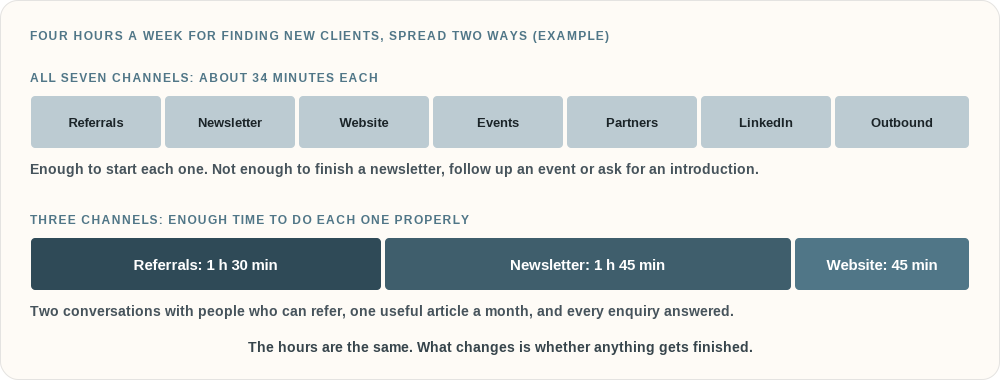
Two questions do most of the choosing.
- 1
Where did your best clients come from?
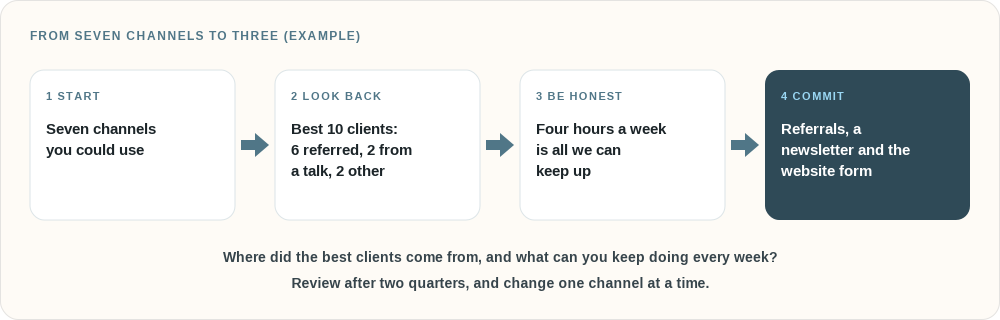
List your ten best clients, the ones you would happily have ten more of, and write next to each how they first reached you. Do it from the records, or by asking them, not from memory. Whatever appears most often is your first channel. It is already working, so the question is how to do it on purpose.
- 2
What can you keep up every week?
Be honest about hours and about temperament. Someone who dislikes writing will not keep a newsletter going. A firm with no travel budget should not build on conferences. A channel you will still be doing a year from now beats a better one you will drop in six weeks.
Keep every lead in one place
Leads arrive in different shapes: a forwarded email, a form, a card from an event, a message on LinkedIn, a name mentioned over lunch. If each stays where it landed, some will never get an answer and nobody will be able to say later which channel produced what. Decide on one list, and put every lead on it the day it arrives with three things: who owns it, what happens next, and where it came from. Agree a short fixed list of sources so that "conference", "event" and "trade show" do not become three answers.
Judge a channel by what it won
The number of leads a channel sends is the easiest thing to count and the least useful. What matters is the revenue won from those leads, set against the hours the channel took. Here is the firm from the example above after a year of 48 working weeks.
| Channel | Hours in the year | Leads | Clients won | Revenue won | Won per hour |
|---|---|---|---|---|---|
| Referrals | 72 | 12 | 6 | $86,400 | $1,200 |
| Newsletter | 84 | 9 | 3 | $25,200 | $300 |
| Website form | 36 | 20 | 2 | $14,400 | $400 |
These are example figures. Counted by leads, the website form wins. Counted by revenue for each hour spent, referrals bring in at least three times as much as either of the others. Two cautions before acting on a table like this. The numbers are small, so one large client can change the order. And channels feed each other: some of those referrals happened because the referrer had read the newsletter that month. Cut a slow channel only after it has had a full year, and only if you can say what it was supposed to do and did not.
Start this week
- 1List your ten best clients and write down how each one first reached you.
- 2Add up the hours a week you can honestly give to finding new clients, and choose two or three channels that fit inside them.
- 3Ask one happy client and one fellow professional for a specific introduction.
- 4Agree a short list of sources and record one on every new lead from today.
- 5Put a date two quarters from now in the calendar to compare the channels by revenue won.
Most small firms do not have a lead problem so much as a focus problem. A few channels, chosen from where the good clients actually came from and worked every week, will bring more than a long list of things started and left.