
Someone fills in the form on your website, or calls after a friend mentioned your name. For a few hours they are interested, they have a problem in mind, and they have probably contacted one or two other firms as well. What happens next decides whether that enquiry becomes paying work or a name in a list.
Most small firms work hard to get enquiries and give far less thought to what happens to them once they arrive. That is where the cheapest improvement usually is. You have already paid, in money or effort, for every lead that comes in. Converting a few more of them costs nothing extra to find.
What conversion means, and how to work it out
A lead converts when it stops being an enquiry and becomes an opportunity: a real person, with a need you can meet, who has agreed to a next step. The conversion rate is the number of leads that reached that point, divided by the number that arrived in the same period, shown as a percentage.
Take an example. In one quarter a firm receives 40 enquiries and qualifies 12 of them as opportunities. Twelve divided by 40 is 0.3, so the conversion rate is 30 percent. The single figure is less useful than the steps behind it, because those show where the other 28 went.
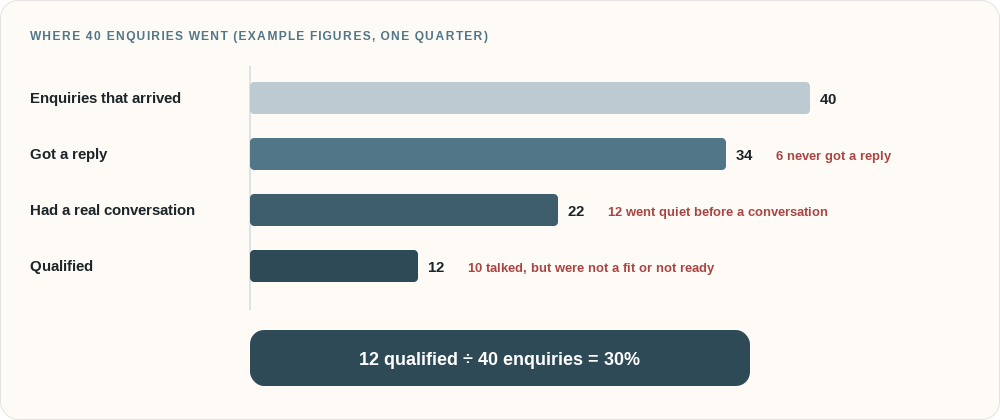
Two cautions. First, be clear what you are counting. Some people use the word conversion for leads that became paying clients. If 4 of those 12 opportunities are won, that rate is 4 out of 40, or 10 percent. Both numbers are useful. Just do not compare one with the other. Second, a lead that arrives in the last week of a quarter has not had time to convert yet, so the most recent period always looks worse than it will turn out to be.
Most leads are lost before the first conversation
Look again at the example. Only 10 leads were lost after a conversation, where your selling skill comes into it. Eighteen were lost earlier: 6 were never answered, and 12 were answered but never reached. Nobody decided to give up on them. They simply slipped away.
The reasons are ordinary ones:
- Nobody owns the enquiry. The form sends an email to a shared inbox, and everyone assumes someone else has replied.
- The reply is slow. By the time it arrives, the buyer has spoken to another firm or the urgency has passed.
- The reply asks for work. A long questionnaire or a request to "send us more details" gives the buyer a job to do before they have had anything from you.
- One attempt, then silence. A single email goes unanswered and the lead is quietly dropped.
- The lead looked small or odd, so it was put aside for later, and later never came.
Five things that decide whether a lead converts
- 1
Speed of the first reply
Interest fades quickly, and the first firm to respond properly often sets the terms for everyone else. Aim to reply the same working day, and within the hour when you can. A short personal note that offers two times to talk beats a polished reply tomorrow. Decide in advance who answers enquiries when the usual person is out.
- 2
A clear qualification test
Agree three or four questions that separate a real opportunity from a polite conversation. For most small firms they are: is there a problem we solve, is this the kind of client we serve well, can this person decide or bring in whoever can, and is there a reason to act within a few months. Write them down so everyone means the same thing by qualified.
- 3
A useful first conversation
The buyer should leave the first call knowing something they did not know before: what their options are, what the work typically involves, or what to watch for. Ask about their situation before you describe your services, and spend more of the call listening than presenting. People move forward with the firm that understood the problem.
- 4
Persistent but polite follow-up
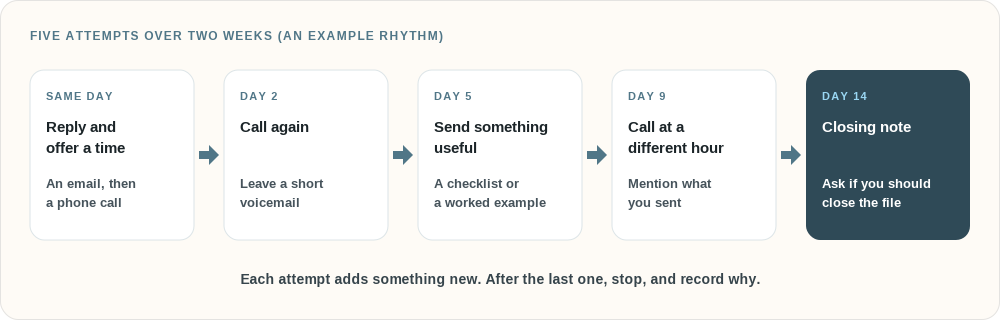
Silence rarely means no. It usually means busy. Plan several attempts over a couple of weeks, vary the channel and the time of day, and make each one worth opening. Then send a closing note and stop.
- 5
A definite next step
Every contact should end with something specific and dated: a second call on Thursday, a proposal by Friday, an introduction to the partner. "I will be in touch" is not a next step. If the buyer will not agree to any next step, that tells you something too.
Disqualify well, and learn from the reasons
A good conversion rate does not come from qualifying everyone. It comes from deciding quickly and honestly. Every lead should leave the first proper conversation with one of three labels.
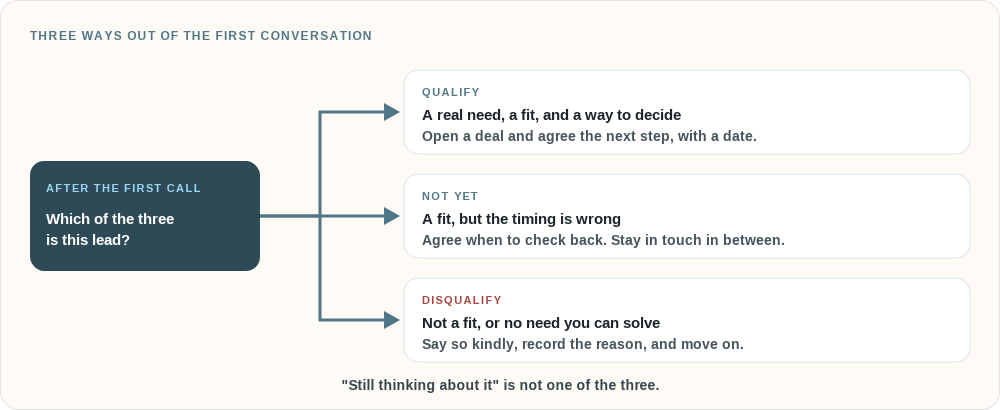
Disqualifying is not a failure. It protects your time for the leads that can become clients, and it is kinder to the buyer than weeks of vague replies. Tell them plainly that you are not the right firm, and point them somewhere better if you can. People remember that, and some of them refer others to you later.
Then record why, from a short fixed list. One reason on its own tells you nothing. Thirty of them, read together, tell you what to change.
| Reason you keep seeing | What it suggests | What to change |
|---|---|---|
| Too small, or the wrong kind of client | Your website or referrers describe you too broadly | Say who you work with, and who you do not |
| Could not reach them | First replies are slow, or follow-up stops early | Reply the same day and agree a fixed number of attempts |
| No budget | Buyers do not know roughly what the work costs | Give a price range early, on the site or in the first call |
| Only wanted information | The form attracts people who are researching | Offer a guide for them, and a separate way to ask for a call |
| Chose another firm | You were late, or the first conversation did not help | Review how recent first calls went, with a colleague |
Look after the "not yet" leads
Some leads are a good fit at the wrong time. The budget is set for the year, a contract with another supplier has months to run, or the person who must approve it is new. These are often the best future clients you have, and they are the easiest to forget, because nothing about them is urgent.
- Ask when it makes sense to talk again, and let them name the month. A date they chose is one you can call on without feeling like a nuisance.
- Put that date in as a task the same day, with a note of what was holding things up.
- Stay useful in between. A short newsletter, an article that touches their situation, or an invitation to a talk keeps your name familiar without asking for anything.
- When you call back, start from what they told you last time, not from the beginning.
- Clear the list twice a year. A lead that has said "not yet" three times is a no.
Start this week
- 1Count last quarter's enquiries and how many became real opportunities. Then count how many never got a reply, and how many never got a conversation.
- 2Name one person who answers new enquiries, and one who covers when they are away. Agree a reply time you can keep.
- 3Write your three or four qualifying questions on one page and share them.
- 4Decide your follow-up rhythm: how many attempts, over how many days, ending with a closing note.
- 5Agree a short list of disqualify reasons, and put a date in the calendar a quarter from now to read them together.
None of this needs more leads or a bigger budget. It needs someone to answer quickly, ask a few honest questions, keep trying for two weeks, and write down how it ended. Firms that do those four things reliably tend to find they had enough enquiries all along.