
Prospecting is starting conversations with people who could benefit from what you do, before they come looking for you. It sounds like a numbers game, but for a small firm it is the opposite: twenty well-chosen people you have actually thought about will do more for you than two thousand names and a template.
Start with who, not how many
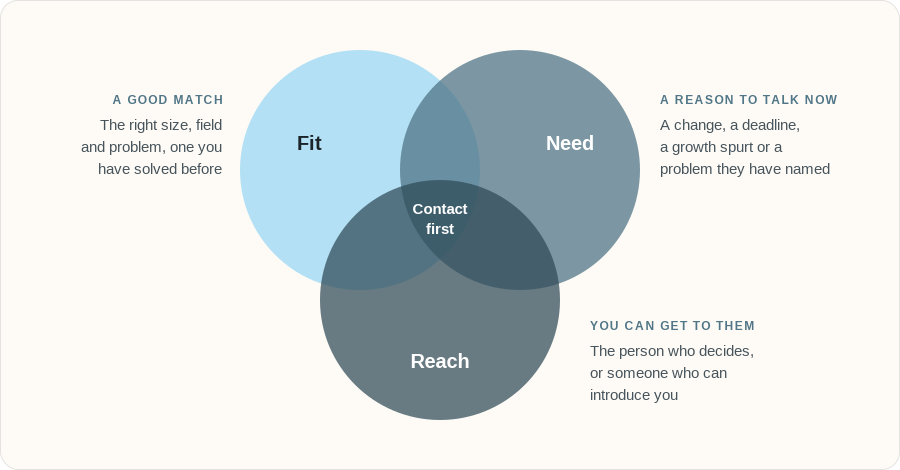
Most prospecting problems, a low reply rate, a wasted afternoon, a pipeline full of polite maybes, trace back to the list. Before you write a single message, decide who is worth a conversation. Three simple tests do most of the work.
- 1
Fit
They look like your best clients: similar size, similar field, a problem you have solved before. If you cannot name a past client they resemble, be cautious.
- 2
Need
There is a visible reason to talk now, such as a new leader, a change in rules, a growth spurt or a deadline. No reason usually means no urgency.
- 3
Reach
You can get to the person who decides, or to someone who can introduce you. A perfect fit you cannot reach is a future project, not this week's work.
A six-part routine you can repeat every week
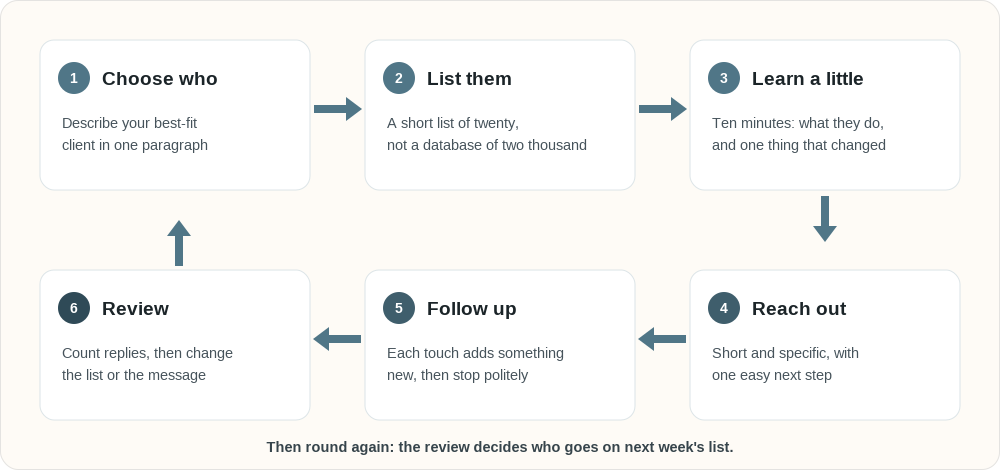
Prospecting works when it is a small routine you actually do, not a campaign you launch once and abandon. This loop fits around client work, and each pass makes the next one sharper.
- 1
Choose who
Write a paragraph describing your best-fit client: who they are, what problem they have, and what a good outcome looks like for them. Keep it where you will see it.
- 2
List them
Collect twenty names at a time. Good sources are people your clients mention, past enquiries that went quiet, people you met at events, and contacts who have moved to new firms. A short list you will work beats a long one you will not.
- 3
Learn a little
Spend about ten minutes per person. Read their site, find one recent change, and note one problem they probably have. Then try to finish the sentence "I am writing because". If you cannot, they are not ready for a message.
- 4
Reach out
Keep the first message short: one reason you are writing, one observation or idea that is useful whether or not they reply, and one easy next step, such as a fifteen minute call.
- 5
Follow up
Most replies arrive after the first message, so plan for several. Each follow-up should bring something new: a relevant article, a short question, a result for a similar client. Agree a stopping point, such as four touches over a month, then check back in a quarter.
- 6
Review
Once a week, count what you sent, what came back and what became a conversation. Change one thing, the list or the message, never both at once.
A first message that earns a reply
A good first message reads like a note from someone who did their homework, because it is. It is short enough to read on a phone, it is about them rather than you, and it asks for very little.
- It names something specific, so it cannot be mistaken for a mass email.
- It offers an easy no or a smaller yes, so replying costs the reader little.
- It is about their situation, not your list of services.
Pick the channel that fits the person
| Channel | Works best for | Watch out for |
|---|---|---|
| A short, specific note people can answer when it suits them | Long messages and attachments in a first note | |
| Phone | People you already know a little, or who have replied once | Calling with no context; open with what you noticed |
| Introduction | Anyone a client or contact is willing to vouch for | Asking before you have given the introducer something in return |
| Event follow-up | People who spent time with you in person or online | Waiting more than a few days to get in touch |
| Social message | People who share and comment publicly about their work | Pitching in the first line |
Choose one main channel per person and add a second only when the first goes quiet. Switching around too early looks like pressure.
Know who deserves more of your time
Not everyone who replies is worth pursuing. Someone who answers a question, introduces a colleague or asks about timing and price is giving you buying signals. Someone who says "send me something" and nothing else is being polite. Sorting early is not rude. It protects the time you need for the people you can actually help.
Slips that quietly sink prospecting
- 1
Contacting everyone who might conceivably buy
A broad list feels productive and trains you to write vague messages. Narrow it until the message nearly writes itself.
- 2
Automating the part that needs a human
Let tools handle timing and reminders. Keep the one specific sentence, and every reply, in your own voice.
- 3
Stopping after one message
Silence usually means busy, not no. Follow up with something new, a set number of times.
- 4
Talking about yourself
Lead with their situation. What you offer can wait until they ask what you would do about it.
- 5
Never counting
Without a tally you cannot tell a weak list from a weak message. Write the numbers down every week.
Four numbers to keep score
You do not need a dashboard to begin. A simple weekly tally shows which part of the routine to fix, because each number points at a different part.
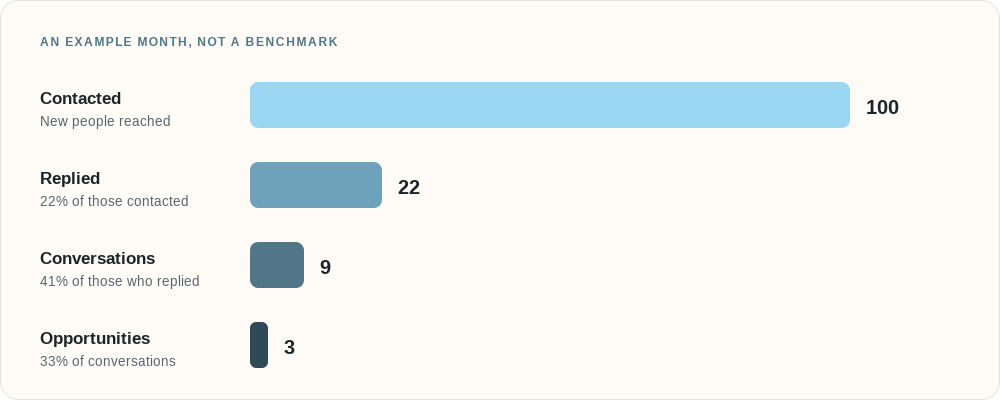
- Contacted: how many new people you reached out to.
- Replied: how many answered, even with a no. A low number points at the list or the first message.
- Conversations: how many became a real call or meeting. A low number points at the follow-up or the offer.
- Opportunities: how many became deals. A low number points at who you are talking to.
Start this week
- 1Write your best-fit client in one paragraph.
- 2Pick twenty names that pass at least two of the three tests.
- 3Spend ten minutes on each, and write the one sentence that starts "I am writing because".
- 4Send the first message to five people today, and put each follow-up in your task list.
- 5Block thirty minutes next Friday to count the numbers and change one thing.
Prospecting gets easier when it stops feeling like asking for a favor and starts feeling like being useful, a few people at a time.