
Most weekly pipeline meetings follow the same script. The manager opens the deal list and starts at the top. Each person says a few words about each deal. An hour later everyone has heard a great deal and nothing has been decided. The arithmetic explains it: as an example, a team of four with 40 open deals, at a minute and a half per deal, fills exactly 60 minutes with updates.
The fix is not a better way to get through the list. It is to stop going through the list. A good pipeline meeting covers a handful of deals, takes half an hour, and ends with a short written list of who will do what by which day.
What the meeting is for, and what it is not
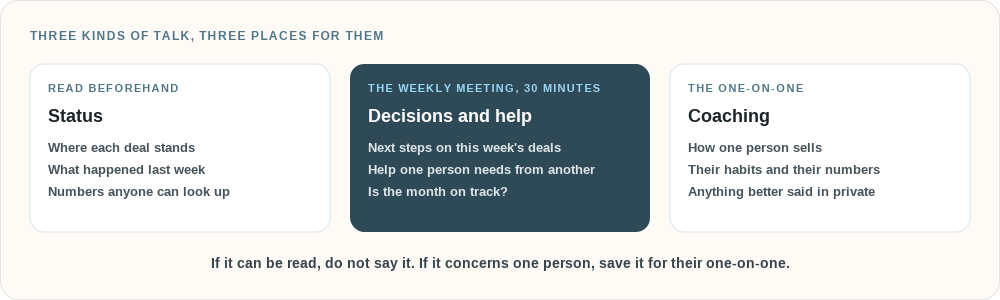
A meeting earns its place when people need each other in the same room. For a sales team, that comes down to three things.
- Decisions on the deals that matter this week. What is the next step, who has it, and is the close date still true?
- Help. One person needs an introduction, a second opinion on price, or the owner on a call. The meeting is where they ask and someone says yes.
- A shared view of the month. Everyone leaves knowing whether the team is on track and what would have to happen to get there.
Two things do not belong. The first is status that could be read. If the record says the proposal went out on Tuesday, nobody needs to hear it said. The second is individual coaching. How one person runs a discovery call, or why their deals keep stalling at the same stage, is a conversation for the two of you. Held in front of the team it embarrasses one person and bores the rest.
Who needs to be there
Everyone who owns open deals, and the person who runs the team. That is usually the whole list. Add someone from delivery or finance only for the weeks when a deal on the agenda needs their answer, and let them leave once it is given. Every extra person adds opinions and side conversations, and makes it less likely that anyone says a deal is in trouble. If the owner of the firm attends, they attend as a source of help, not as an audience to perform for.
Prepare the day before, so nobody types in the meeting
A meeting that starts with people updating records has already lost ten minutes. Move that work to the day before and make it a standing rule.
- Each salesperson brings their own deals up to date by the end of the day before: stage, amount, close date, and a next task with a date.
- The manager reads the pipeline that evening or first thing in the morning, picks the deals to discuss, and sends the short list. Nobody should be surprised to hear their deal named.
- Each person named on the list comes ready to answer one question about that deal, and to say what help they need.
The rule only holds if it has a consequence. A deal that was not updated is not discussed, and the meeting moves on. People learn quickly that an untidy record costs them their chance to ask for help.
Which deals, in which order
The manager chooses the deals, not the salespeople, and chooses them by what is at stake this week. Work in this order and stop when the time is gone.
- 1
What changed since last week
Wins, losses and deals that moved a stage, read out in two minutes. A win gets a thank you. A loss gets one sentence on why. No discussion.
- 2
Deals due to close this month
These decide whether the month lands. For each one, is the date still real, and what has to happen before it?
- 3
The deals closest to closing
Late-stage deals that are not due this month but could be lost or delayed by one missed step.
- 4
The largest deals
One large deal can be worth a month of small ones. It deserves the team's eyes even when it is early.
- 5
Anything stuck
Deals that have not moved, or where the buyer has gone quiet. The question here is different: does this deal get help, a new plan, or is it closed as lost?
Leave out everything else: deals that are moving normally, early deals with a next task booked, and small deals that need no one's help. They are not ignored. They are on the record for anyone to read, and they come up in the one-on-one. For the checks to run on a single deal, the article on why forecasts miss has a five-question weekly review that fits well here.
A 30-minute agenda
Put minutes against every part and print them on the invitation. The numbers below suit a team of three to six people. A team of two can do it in twenty.
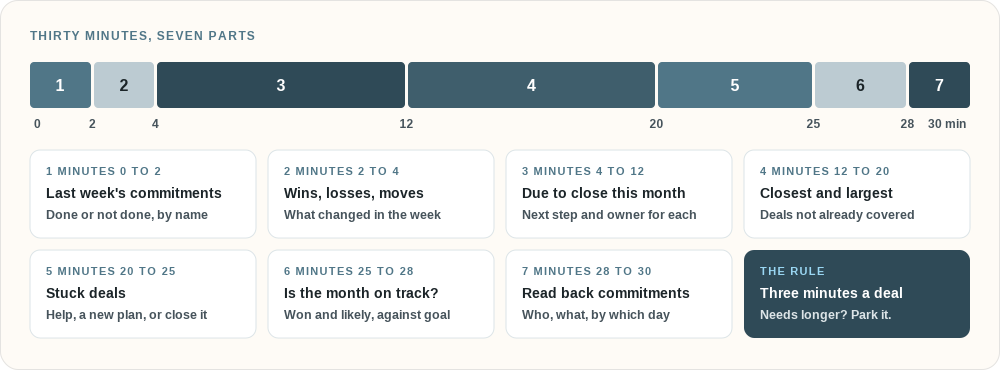
Eight minutes for the deals due this month is room for three or four deals, not twelve. If more than that are due, the manager picks the ones in doubt. That limit is the point: it forces a choice about what matters.
Keeping to time
- 1
Start on the minute, with a clock everyone can see
Start when the meeting is due to start, with whoever is there. Put a timer on the screen or the table. A visible clock does the interrupting, so the manager does not have to.
- 2
Ask one question per deal
What is the next step, and who has it? If the answer is clear and has a date, move on. If it is not, that is the discussion. The history of the deal is not needed to answer it.
- 3
Park anything that needs more than three minutes
A pricing problem or a difficult buyer will not be solved by six people in three minutes. Say "parked", write down who will meet about it and when, and go to the next deal. The two or three people who can actually help talk afterward.
- 4
Give someone else the pen
The person running the meeting should not also be taking notes. Ask one team member to keep the commitments list, and rotate the job.
End with commitments, and start with them next week
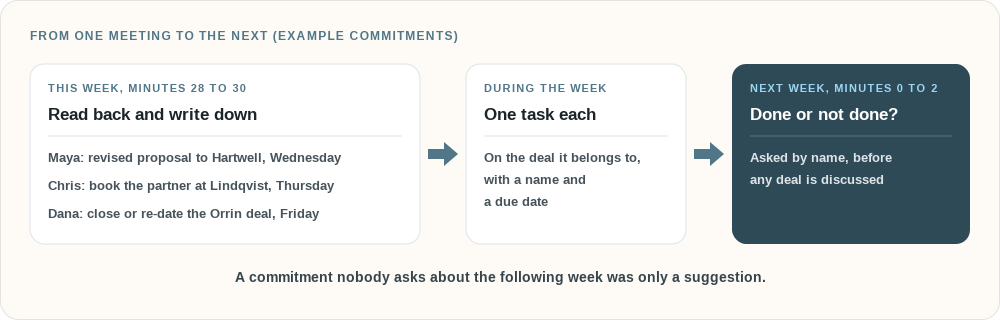
The last two minutes belong to the person with the pen. They read back every commitment made in the meeting: a name, an action and a day. "We should follow up with them" is not a commitment. "Chris books the partner by Thursday" is. If nobody will put their name to an action, it comes off the list.
Then close the loop. The first two minutes of next week's meeting are last week's list, read by name: done or not done. No explanations unless something needs help. This small habit is what makes the rest work. People keep the commitments they know will be asked about.
Four ways the meeting goes wrong
- 1
The manager talks most
If the manager is explaining, advising and summing up, the team is listening to a briefing. Ask the question, then wait. A useful check is to notice who spoke last on each deal. It should be the person who owns it, stating what they will do.
- 2
One person's deals take the whole time
The person with the most deals, or the most to say, fills the half hour. Choosing the deals in advance prevents it. So does asking the quieter people first.
- 3
Solving one person's problem while the others wait
It feels productive, and for two people it is. For everyone else it is time spent watching. Park it.
- 4
No record
Without a written list, next week starts from memory and every commitment is open to debate. If nothing was written down, assume nothing was agreed.
Start this week
- 1Shorten the meeting in the calendar to 30 minutes and put the seven parts, with their minutes, in the invitation.
- 2Tell the team that deals must be up to date by the end of the day before, and that a deal that is not will not be discussed.
- 3The evening before, pick the deals yourself and send the list.
- 4Ask one person to write down every commitment as a name, an action and a day, and to read the list back in the last two minutes.
- 5Open next week's meeting with that list.
The first shorter meeting will feel rushed, and someone will say their deal was skipped. Hold the line for a month. A team that leaves every week knowing the handful of things that must happen, and who has each one, will not ask for the hour back.
More on this from The Center for Leadership Studies: How to lead effective meetings
Also from The Center for Leadership Studies: Unlocking the secret to successful time management in team meetings