
Most sales one-on-ones go the same way. The manager opens the deal list, starts at the top, and asks about each one. Where is this? When does it close? Have you called them back? Thirty minutes later the list is finished, the salesperson has been questioned on eleven deals, and nobody has talked about how they sell.
That meeting has a use, but it is not a one-on-one. It is a pipeline review held in private. The cost is that coaching never happens, because the only slot it could happen in is taken.
Two meetings that keep getting merged
A pipeline review is about the deals. It exists so the firm knows what is likely to close and which deals need attention. A one-on-one is about the person. It exists so that one salesperson is a little better, or a little less stuck, than they were last time. Both are worth having. They need different questions, a different person doing the talking, and a different ending.
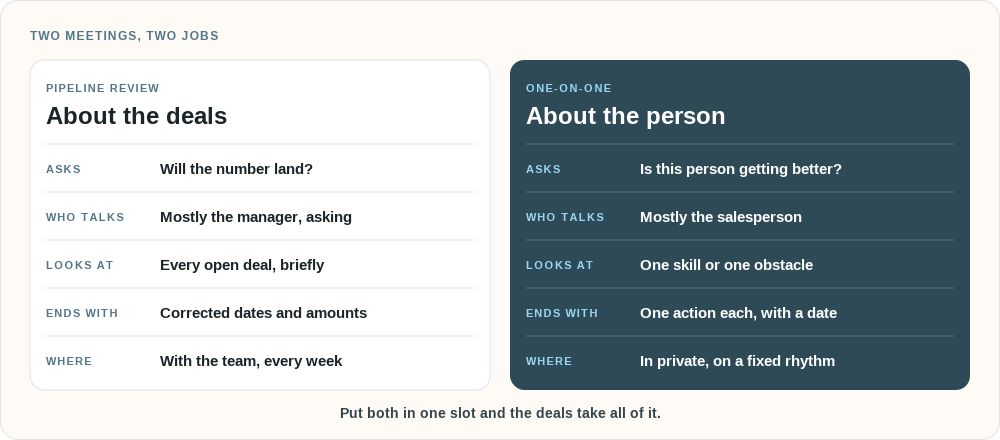
Deals win that contest for a simple reason. A deal is concrete and urgent, and asking about it feels like managing. A question such as "why do your proposals stall after the first meeting?" is slower and less comfortable for both of you. So the easy conversation crowds out the useful one, week after week.
Five questions a one-on-one should answer
You do not need a script. You need to leave the room knowing the answer to five things. Ask them in your own words, and let the salesperson do most of the talking.
- 1
How are you doing?
Not the deals, the person. Energy, workload, anything outside work that is weighing on them. Two or three minutes is enough. A salesperson who is worn out or distracted will not tell you so in a deal review, and it explains more missed follow-ups than any skill gap.
- 2
What went well, and why?
One win since last time. The why is the point: a call that went well because they asked about budget early is a habit you want repeated, and naming it is how it gets repeated. Be specific. "Good job" teaches nothing.
- 3
Where are you stuck?
One thing, chosen by them. It may be a skill, such as handling a price objection, or an obstacle, such as proposals that take a week to get out of the door. Work it through on one real deal or one real call. This is where most of the time should go.
- 4
What do you need from me?
An introduction, a decision on a discount, a second voice on a call, or simply to be left alone on something. This question turns the meeting from an inspection into a working session, and it tells you how you are doing as a manager.
- 5
Where do you want to get to?
Larger accounts, a new service line, running a client meeting alone, leading the team one day. You do not need this every time. Once a month or so, give the middle of the meeting to it instead.
How much you steer depends on the person and the task. Someone new to writing proposals needs you to show them, step by step. The same person may be excellent on the phone and need nothing there but a sounding board. Judge how able and how willing they are for the particular thing you are discussing, not how senior they are in general.
A 30-minute agenda you can copy
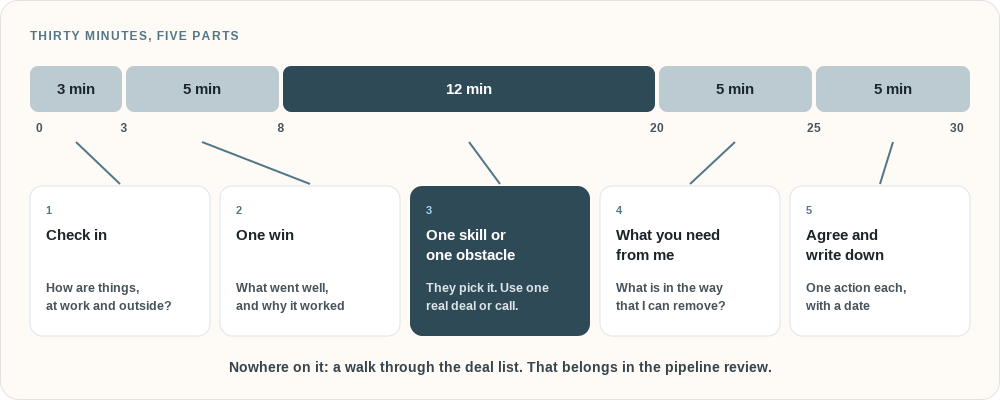
Notice what the agenda leaves out: a walk through the deal list. A deal belongs in a one-on-one only as an example of the skill or the obstacle. "Tell me about the call with the logistics firm, where did it turn?" is coaching. "What is the close date on the logistics firm?" is a status update, and the answer is already in the pipeline.
Get the numbers out of the way first
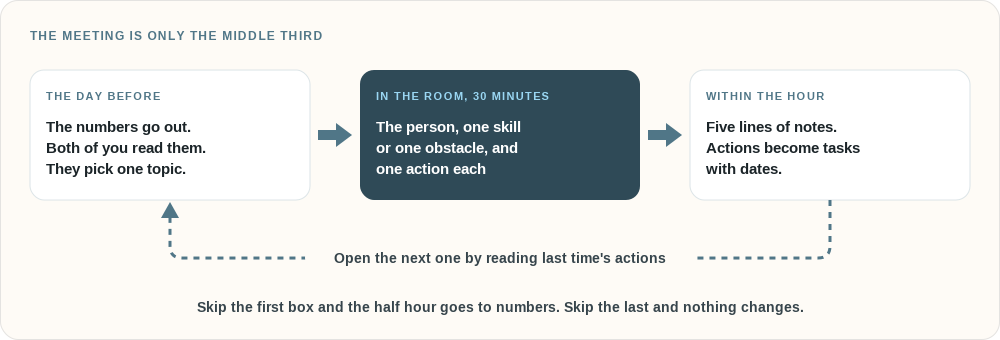
The numbers still matter. They are how you choose what to talk about. They just should not be read out in the room. Send them the day before, or agree that both of you look at the same page beforehand. Then ask the salesperson to arrive with one topic the numbers point to.
An example: over the last quarter a salesperson moved 20 deals to proposal and won 4, while the rest of the team wins about 2 in 5 at that stage. That is one clear topic. The one-on-one is not spent discovering the gap. It is spent on what happens between sending a proposal and getting an answer.
Six mistakes, and what each one costs
| Mistake | What the salesperson hears | Do this instead |
|---|---|---|
| Cancelling when you are busy | Everything else comes before me | Move it to another day in the same week. Never just drop it. |
| Doing most of the talking | This is your meeting, not mine | Ask, then wait. Aim to talk for less than a third of the time. |
| Asking for status updates | You do not trust what I put in the pipeline | Read the pipeline beforehand and ask about how, not where. |
| Taking no notes | Nothing said here will be remembered | Write five lines before you leave the room. |
| No follow-up | Agreeing to things here is free | Open the next meeting by reading out last time's actions, yours first. |
| Meeting only when something is wrong | A meeting invite means trouble | Keep a fixed rhythm, in good months and bad. |
Two smaller ones are worth a line each. Do not spring a hard topic on someone in the room: tell them the day before so they can think. And do not take calls or glance at messages. Half an hour of full attention is rare enough that people remember it.
How often
- Weekly for someone in their first few months, or someone who is struggling. Short and frequent beats long and rare.
- Every two weeks for an experienced salesperson who is on track.
- Never less than monthly, for anyone. Past that, each meeting starts from cold and turns into a catch-up.
- The same day and time each cycle, booked several meetings ahead, so it does not depend on anyone remembering.
With a team of three or four, this is two hours a week at most. If that feels like too much, compare it with the time you already spend chasing deals that a better-coached person would have handled alone.
What to write down
Five lines, written before you stand up, in a document you both can open. Anything longer will not be kept up.
- 1The topic. "Proposals going quiet after they are sent."
- 2What you both concluded. "No next meeting is booked when the proposal goes out."
- 3The salesperson's action, with a date. "Book a review call before sending the next three proposals. By the 15th."
- 4Your action, with a date. "Sit in on one review call. Decide on the shorter proposal template by Friday."
- 5What to look at next time. "How many of the three got an answer."
Line four matters as much as line three. A manager who writes down their own commitments and keeps them earns the right to ask about the salesperson's.
Start this week
- 1Put a recurring 30-minute one-on-one in the calendar for each person, and book the next four.
- 2Move deal-by-deal questions to the team pipeline review, and tell the team that is where they now live.
- 3The day before each one-on-one, send the person their numbers and ask them to bring one topic.
- 4Run the five-part agenda once as written, then adjust the minutes to fit.
- 5Write the five lines before you leave the room, and start the next meeting by reading them.
A pipeline report can tell you what is happening in the deals. Only a conversation can change how someone works them. Give each its own time, and both get better.
More on this from The Center for Leadership Studies: 5 questions every 1:1 should answer
Also from The Center for Leadership Studies: Most common mistakes managers make with 1:1s and how to avoid them