
It is Monday's pipeline review. The same deal comes up for the third week running. The salesperson says, "I'll chase them." You say, "Good, stay on it." Everyone nods, and the meeting moves on. Next Monday the deal is still there, in the same stage, with the same sentence attached.
Nobody lied and nobody was lazy. There was simply nothing to be accountable for. Accountability on a sales team is rarely lost in a showdown. It is lost in the thirty seconds where a vague promise was accepted as an answer.
Why managers rate themselves too high
Ask an owner or sales manager whether they hold their people accountable and the answer is usually yes. Ask the team whether commitments get followed up and the answer is often less sure. Both are describing the same meetings. The gap has ordinary causes.
- You count what you said. They count what happened next. You remember telling the team that close dates must be real. They remember that nothing happened when a date slipped.
- Saying it feels like doing it. Stating an expectation is the easy half. The half that makes it real is going back to check, and that half is easy to skip in a busy week.
- You judge yourself by what you meant. You fully intended to raise the stalled deal in the one-on-one. Then the one-on-one ran short.
- The awkward conversation keeps getting postponed. One missed commitment seems too small to mention. By the fourth it is too large to mention calmly.
- The title does not do the work. People do not follow through because you are the boss. They follow through on things they know will be looked at.
- Nobody tells you. Few salespeople will volunteer that their manager lets things slide, so the picture you have of yourself is never corrected.
An agreement made in advance, not a confrontation afterward
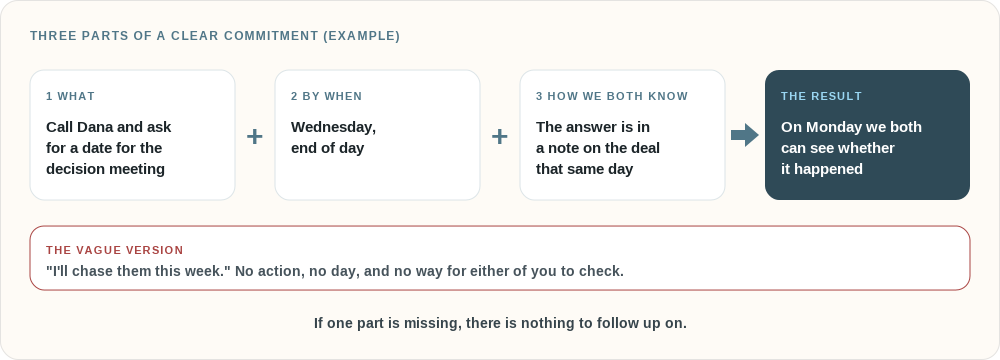
Most people picture accountability as the hard conversation after something went wrong. That is the expensive end of it. The cheap end is a clear agreement made before anything has gone wrong, with three parts: what will be done, by when, and how you will both know it happened.
The third part is the one that gets left out. If the only way to find out is to ask, then following up feels like checking up. If the result will be visible somewhere you both look, nobody has to chase anybody.
What a real commitment sounds like
| Vague | Clear |
|---|---|
| I'll chase them this week. | I will call Dana on Wednesday and ask for a date for the decision meeting. Her answer goes in a note on the deal that day. |
| The proposal is nearly done. | The proposal goes to the buyer by Thursday noon, and you get a copy. |
| They are still keen. | By Friday I will ask who else has to sign off and add that person to the deal, or tell you I could not find out. |
| It should close this month. | On Tuesday's call I will ask what has to happen before they sign, and change the close date to match what they say. |
| I'll do more prospecting. | Ten calls to past clients by Friday. I log each one, so we can both count them. |
Two things make the clear version work. First, it is an action the salesperson controls. Nobody can promise that a buyer will sign, but anyone can promise to ask a question by Wednesday. Second, the salesperson says it, in their own words. Your part is to ask questions until all three parts are there: "What exactly will you do? By which day? Where will I see it?" A commitment you dictated is an instruction, and people treat it like one.
Follow up so nobody is surprised
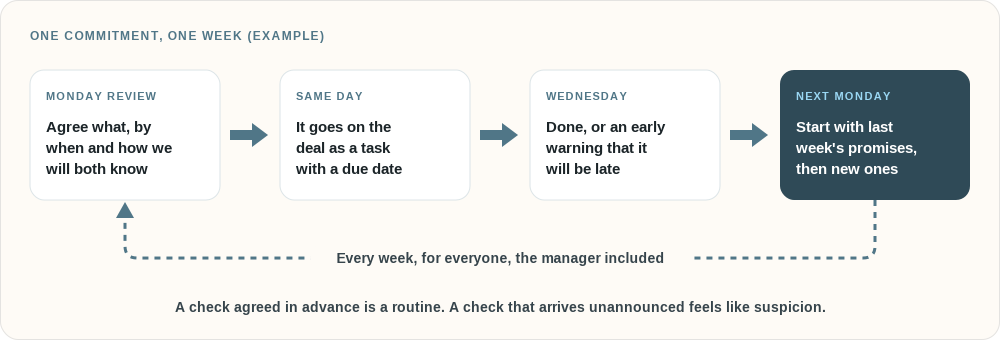
An agreement that is never looked at again teaches the team that agreements are optional. Following up is what makes it real, and it works best as a routine that everybody can predict.
- Open every review with last week's commitments, before any new deal is discussed. Done, not done, or changed. It takes five minutes.
- Agree the check when you agree the commitment. "I will look at the deal on Thursday" is routine. Asking out of nowhere on Thursday feels like suspicion.
- Make early warning the rule. If something will be missed, the person says so before the date, not at the meeting. Bad news early is fine. Bad news late is the problem.
- Do it the same way for everyone, every week, including the weeks when the numbers are good.
When a commitment is missed
Separate "could not" from "did not"
Before you respond, ask one question and listen to the answer: "What got in the way?" There are two very different answers. Could not: the buyer was away, pricing was not approved, or the person has never been shown how to ask a buyer about budget. Did not: they were able, they had the time, and something else won.
Could not is your problem to help solve. Remove the obstacle or teach the skill, then agree again. Remember that ability and willingness go task by task. Someone who is excellent in a closing meeting may be unsure and reluctant on a cold call, and needs more direction there than their overall record suggests. Did not is a conversation about priorities, and it follows the steps below.
- 1
The first time: name it and reset it
Say it plainly and without heat: "We agreed the proposal would go out Thursday, and it has not." Ask what got in the way, agree a new date within days, and move on. Do this at the first miss. Letting it pass is what turns one miss into a habit.
- 2
The second time: name the pattern
Now the subject is not this deal but the fact that it has happened twice. Ask what will be different this time. Agree a smaller step with a sooner check, ask what they need from you, and say clearly what will happen if it is missed again.
- 3
The third time: do what you said
In private, carry out what you described: the deal goes to someone else, or is closed as lost, or the conversation becomes a formal one about performance. Because you said it in advance, it is a decision, not an outburst.
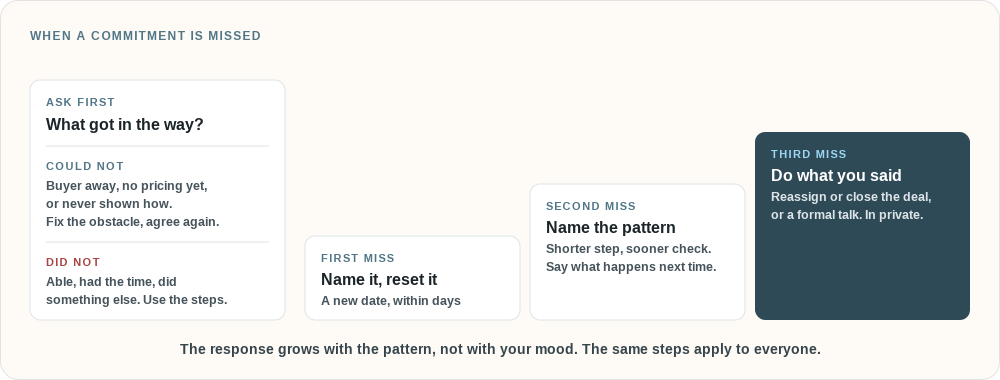
The steps apply to your best seller exactly as they apply to your newest hire. When the top performer's missed commitments are waved through, the rest of the team notices, and the standard stops being a standard.
Your own side of the agreement
- Keep your own commitments. If you promised to approve pricing by Tuesday or to make an introduction, it gets a date and gets reviewed like everyone else's. A manager who is late has little standing to ask others to be on time.
- Do not rescue deals. Taking over the call when a deal wobbles feels helpful, but it teaches the salesperson that a missed commitment ends with you doing the work. Coach before the call and let them make it.
- Do not move the date silently. If a commitment needs to change, change it out loud, with a new date.
- Ask how you are doing. Once a quarter, ask the team where you let things slide. Then act on one thing they say, or they will not answer next time.
Make it normal, not personal
Accountability feels like a fight when it happens rarely, to one person, after a bad month. It feels like nothing at all when it happens to everyone, every week, in the same format. Review deals, not people. Use the same three questions for each deal. Put your own commitments on the list. And thank the person who closes a dead deal or flags a miss two days early, because that is the behavior you are trying to make ordinary.
Start this week
- 1At your next pipeline review, do not accept "I'll chase them." For each deal discussed, ask what, by when, and where you will both see it.
- 2Write each commitment down as a task on the deal before the meeting ends, your own included.
- 3Open the following review with last week's commitments before anything new.
- 4Agree the early warning rule with the team: a commitment that will be missed is flagged before its date.
- 5The first time one is missed, name it that day and agree a new date. Do not wait for the second.
None of this needs a raised voice. It needs a clear sentence on Monday and the habit of reading it again the Monday after.
More on this from The Center for Leadership Studies: The leadership blind spot: why leaders overestimate their ability to hold people accountable
Also from The Center for Leadership Studies: How to hold people accountable at work