
Nearly every forecast is wrong. The useful question is not whether yours is wrong, but whether it is wrong in a way you can see and shrink. Most misses have ordinary causes: deals nobody closed, dates nobody believed, and chances nobody checked against what the buyer is actually doing.
The good news is that none of this needs a statistician or an expensive tool. It needs a pipeline people are willing to be honest in, and a habit of checking it.
A forecast is only as honest as the pipeline under it
A forecast is arithmetic on your open deals: amounts, close dates and a chance of winning. If those three inputs are wrong, no formula will rescue the output. That is why the fix is almost never a smarter model. It is cleaner inputs and an honest conversation about them.
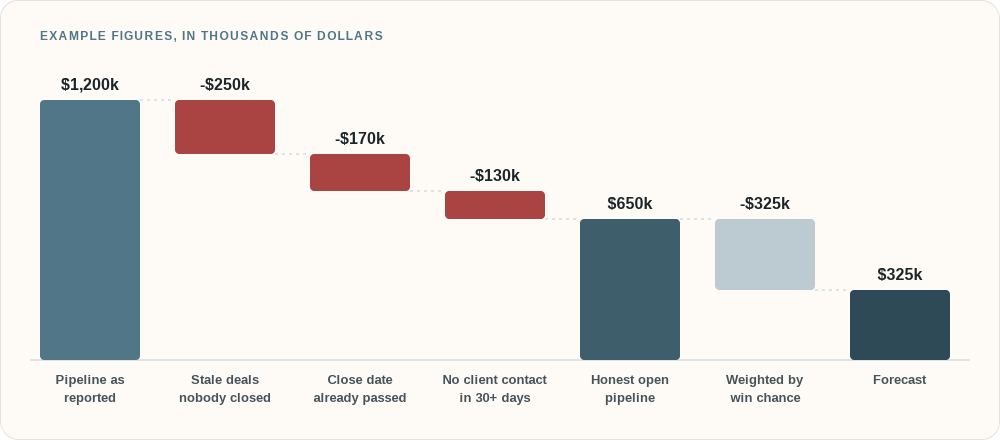
Five ways a forecast goes wrong
- 1
Dead deals that stay open
Closing a deal as lost feels like admitting defeat, and it can touch a commission or a number someone reports upward. So the deal sits there, the pipeline looks healthy, and the forecast counts money that is not coming. When the deal is finally closed, the loss lands in one lump and the history you forecast from is distorted.
- 2
Deals that live somewhere else
A spreadsheet, a notebook, an inbox. It was going to be entered later, and later did not happen. The forecast is missing deals nobody else can see, and the person who can see them is carrying the number in their head.
- 3
Dates and amounts that are hopes
A close date set to the end of the quarter because the field is required. An amount rounded up because the proposal is not written yet. Each is small. Added together, they are the miss.
- 4
One chance for every deal in a stage
Two deals in the same stage are not equal if one buyer replied this morning and the other has been silent for six weeks. A forecast that scores them the same is averaging over the evidence.
- 5
One contact holding the whole deal
If the only person you have spoken to changes jobs, goes on leave or loses the argument internally, the deal stops with no warning. Deals with a single contact are riskier than they look.
Six fixes, in the order they pay back
- 1
Let the person closest to the deal make the call
A forecast built from the bottom up beats one handed down from the top, because the person working the deal knows things no dashboard does. Ask each person to commit to dates and amounts, and review them in conversation instead of overwriting them. Reward accuracy, not optimism: someone who closes a dead deal early should be thanked for it.
- 2
Write one definition for every stage
Say in a sentence what the buyer must have done for a deal to be in each stage, and use the same sentence for everyone. If large and small sales really work differently, give each its own pipeline instead of stretching one. The funnel guide shows how to define stages by what the buyer did.
- 3
Weight each deal by the evidence
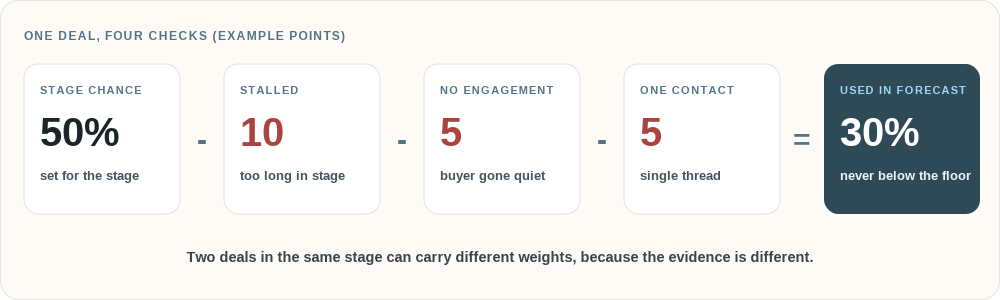
Start with a chance for each stage, then take points off when the evidence is weak: the deal is stalled, the buyer has gone quiet, or you only know one person there. Two deals in the same stage then carry different weights, which is what you want.
- 4
Work backwards from the target
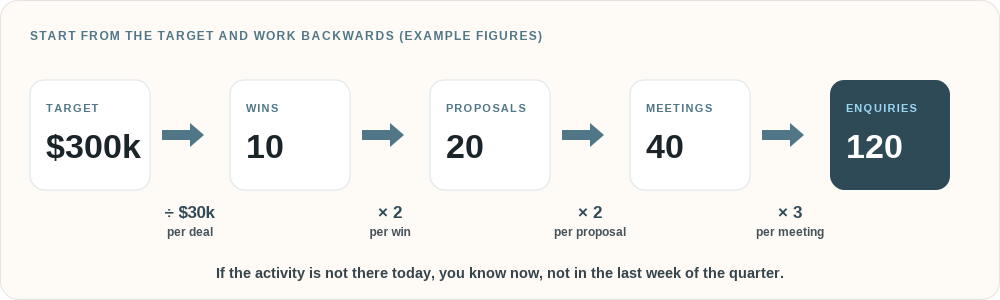
Instead of asking whether the quarter will land, ask what has to happen for it to land. Divide the target by your average deal, then step back through your own conversion rates to the number of proposals, meetings and enquiries you need. If the activity is not there, you know now, not in the last week.
- 5
Look for patterns by person, not for blame
Deals that sit in one stage for months, deals that appear only days before they close, and dates that keep moving all point to a habit worth talking about. The aim is to find the deals that need help and the habits that need changing.
- 6
Check the forecast against what happened
Write down the forecast on the first day of the month and compare it with the result at the end. Note the gap and the cause. After a few months you will know whether you run optimistic and by how much, and you can correct for it.
A weighting you can explain in one breath
The weighting does not need to be clever. It needs to be consistent and easy to explain to the person whose deal it is. Start from the stage, take off a few points for each warning sign, and never let the result fall below a floor you chose in advance.
The five-minute weekly review
A forecast stays honest when someone looks at the deals every week. Go down your open deals, or just the largest ten, and ask these five questions of each.
| Check | Ask | Warning sign |
|---|---|---|
| Close date | Is it still believable? | It has passed, or has moved more than once |
| Next step | What is booked, with whom, and by when? | Nothing is booked |
| Engagement | When did the buyer last respond? | Weeks of silence |
| People | Who else is involved on their side? | One contact only |
| Amount | Does it come from a proposal or a guess? | A round number and no proposal |
Keep the method boring
Start this week
- 1Close every deal you know is dead. Do it before the next forecast, and say a word of thanks to anyone who does it first.
- 2Move any deal that lives in a spreadsheet or an inbox into the pipeline.
- 3Fix every close date that has already passed: a real new date, or closed as lost.
- 4Take points off for deals that are stalled, quiet or single-threaded, and agree the floor.
- 5Write down this month's forecast today, and check it against the result on the last day.
A forecast people believe is built the same way as a good pipeline: from facts that someone was willing to write down.