
A buyer can now learn most of what they need without speaking to anyone. They can read reviews, compare prices and watch a demonstration on their own. So when they do agree to talk to a salesperson, they expect something they could not get from a web page. A person who writes down what they asked for and sends a price is not that.
The usual name for what they do want is a trusted advisor: someone who understands the problem well enough to say what they would do in the buyer's place, including when that is not what the buyer asked for. The opposite is an order taker. Most salespeople believe they are the first. On most calls, most of us behave like the second.
Liked is common. Advising is rare.
Objective Management Group, a firm that assesses salespeople, has published figures that show the size of the gap. Among 9,516 salespeople it evaluated in one year, 56% were strong in relationship building. Yet its research found that only 11% of salespeople are strong in consultative selling, and 37% are weak.
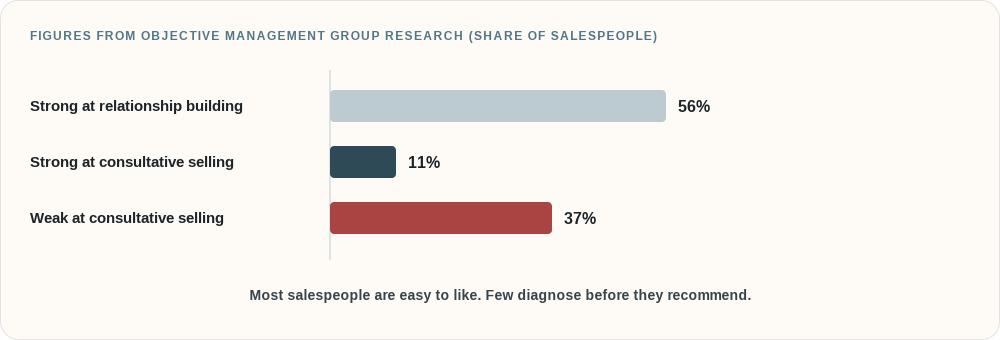
Put plainly: more than half of salespeople are good at being liked, and about one in nine is good at the questioning and diagnosis that advising depends on. The same research points to the cause. It is less a missing technique than what goes on in the seller's head: a need to be approved of, discomfort talking about money, and beliefs about selling that get in the way. The rest of this article is about what to do differently.
The same request, handled two ways
Take a small web agency. A prospect calls and asks for a quote for a new website. Nothing about the request tells you which kind of salesperson picks up. The difference shows in the next sentence.
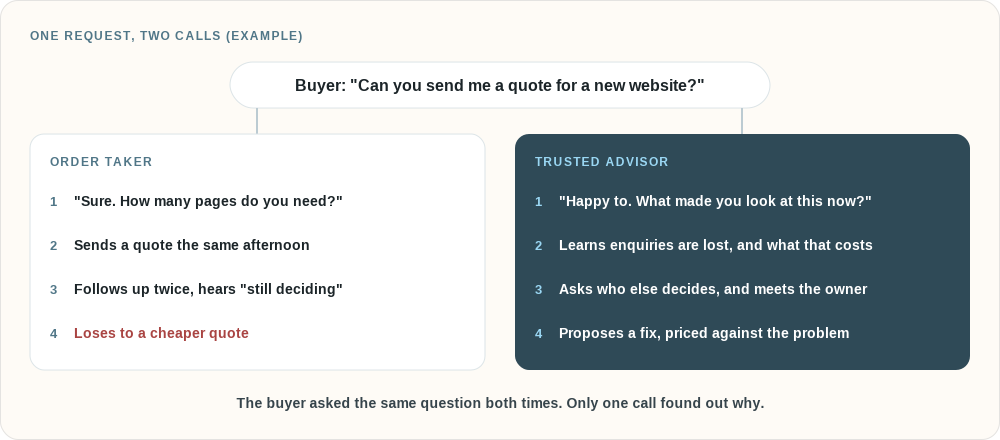
The order taker did nothing wrong by the usual measures. The trouble is that a quote written from the buyer's own description can only be compared with other quotes, and the cheapest one wins. The advisor found out that the real problem was enquiries going unanswered, which a new website alone might not fix.
Five things an advisor does on a call
- 1
Asks why before quoting
A request is the buyer's own answer to a problem you have not heard yet. Before you price it, find out what happened that made them ask, what they have already tried, and what they expect to be different afterwards. Often the request is right. Sometimes it treats a symptom, and you are the only person in the conversation who has seen that before.
- 2
Puts a number on the problem
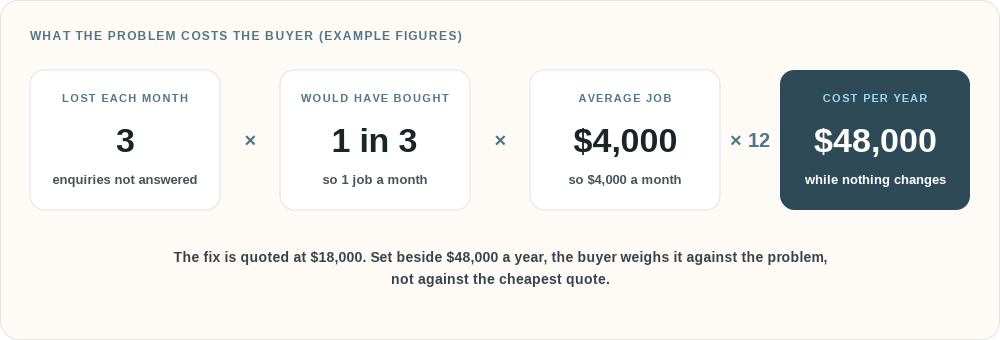
Ask what the problem costs: in lost work, wasted hours, late payments or clients who leave. Let the buyer do the arithmetic and say the figure themselves. Until there is a number, your price has nothing to be measured against except a competitor's price.
- 3
Disagrees when the buyer is wrong
If you think the plan will not work, say so, and say why. Do it once, plainly and without heat, then let the buyer decide. A person who agrees with everything is pleasant company and no use as a guide. Buyers tend to remember the one person who told them something uncomfortable and turned out to be right.
- 4
Says when you are not the right fit
Sometimes the honest advice is a different kind of supplier, a smaller project, or waiting six months. Saying so costs you one deal. It also makes everything else you say believable, and it is a common source of referrals.
- 5
Reaches the person who decides
Advice given to someone who cannot act on it gets passed along as a price and a page count. Ask early how a decision like this gets made and who else has a say, then ask to include them. Offer a reason that helps them: you want to hear the owner's view before you recommend anything.
Questions worth borrowing
None of these is clever. They work because they are asked before the price, and because you then stay quiet and listen to the whole answer.
- What happened that made you look at this now, and not six months ago?
- What have you already tried, and why did it not hold?
- If nothing changes, where does this leave you a year from now?
- Roughly what is it costing you each month? How did you get to that figure?
- When your firm last bought something like this, who was involved and how long did it take?
- I may be wrong, but I do not think that will solve it. Can I say why?
- What would have to be true for you to say this was worth the money?
Why most salespeople do not do this
Very little of the above is hard to understand. It is hard to do, for reasons that have more to do with nerves than with skill.
- Wanting to be liked. A hard question or a disagreement risks a moment of coolness, so it does not get asked. The call stays friendly and nothing is learned.
- Discomfort with money. Asking what a problem costs, or what budget exists, can feel intrusive. So the seller guesses, and the first real talk about money happens when the quote arrives.
- Quoting too early. A quote feels like progress and the buyer asked for one. Sending it quickly is also a way to end a conversation that was about to get difficult.
- Fear of losing the deal. Telling a buyer they may not need you feels reckless when the month is short. The result is a pipeline full of deals that were never a good fit.
- Knowing the product better than the buyer's business. It is easier to talk about what you sell than to ask about a trade you only half understand.
A short self-check after each call
Skills like these improve with review, not with good intentions. Straight after a first call, answer five questions with yes or no. Count the yeses. Do not aim for five every time. Aim for the weekly average to go up.
| Question | A yes looks like |
|---|---|
| Do I know why they are looking now? | I can name the event that started it |
| Did the buyer put a number on the problem? | They said the figure, I did not supply it |
| Did I say anything they did not want to hear? | I disagreed or raised a risk at least once |
| Do I know who decides, and have I asked to meet them? | A name, a role and a next meeting |
| Did the buyer talk more than I did? | I asked, then waited for the full answer |
Practice the uncomfortable parts out loud with a colleague before you need them: the disagreement, the money question, the request to bring in the owner. Said once in a rehearsal, a sentence is much easier to say to a buyer.
Start this week
- 1Pick the next request for a quote and ask two why questions before you price anything.
- 2On one call, ask what the problem costs, and write down the figure the buyer gives.
- 3Find one open deal where you have never spoken to the person who decides, and ask for that meeting.
- 4Run the five-question self-check after every first call for a week and compare notes with a colleague.
- 5Tell one prospect, honestly, that you are not the best fit, and note what happens next.
None of this needs a new method or a script. It needs a willingness to be slightly less comfortable for ten minutes on each call. Buyers can tell the difference between someone who wants the order and someone who wants them to make a good decision, and they tend to buy from the second.
This article draws on research by Objective Management Group. Read more in their research