
In a small firm, the people who sell are often people who never set out to: a partner, a consultant, a founder. For them a no can sting more than it does for a career salesperson, because it feels like a verdict on the work itself.
It almost never is. A no is the most common answer in selling, it comes in several kinds, and each kind calls for a different response.
No is the normal result
Start with the arithmetic, using invented figures. You contact 100 people who look like a fit. 60 never reply. 25 reply to say no. 15 agree to talk. Of those 15 conversations, 9 go no further and 6 lead to a proposal. Of the 6 proposals, 2 become clients.
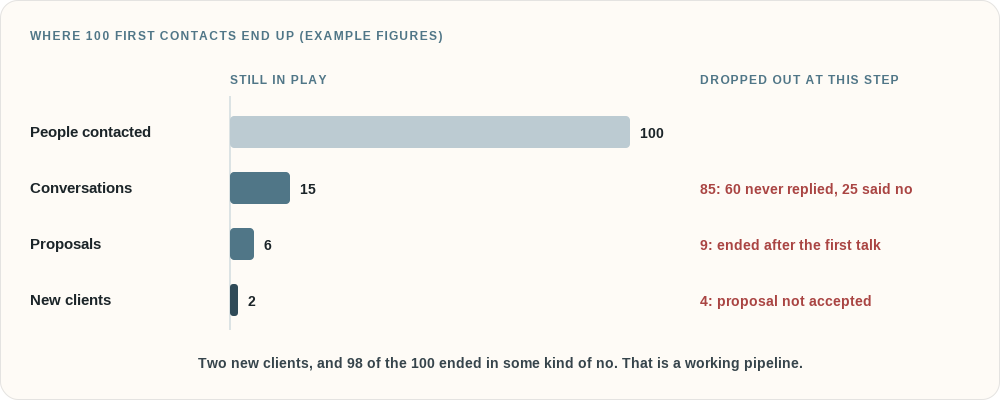
Two new clients, and 98 outcomes that were some kind of no. If two clients is what you needed, that was a good month. The other 98 are what two clients cost.
Know this before you pick up the phone. If you expect most calls to end in yes, every no is a small failure. If you know your own ratios, a no is one of the 98 you were always going to hear, and the only question is what kind it was.
Five kinds of no
People rarely say exactly what they mean when they turn you down. "Not right now" is the polite form of several different answers, and the right next step is different for each.
| Kind of no | What it usually means | What to do |
|---|---|---|
| Not now | The need is real but something else comes first: budget, a busy season, a change of staff. | Ask when it would make sense to talk again, agree a month, and keep the appointment. |
| Not this | They have the problem, but what you offered is the wrong size, scope or price for them. | Ask what would have fitted. Offer something smaller only if you would be glad to do it. |
| Not you | They are buying, from someone else. An existing supplier, a cheaper firm, a friend. | Ask what decided it, wish them well, and check in once after the first few months. |
| Not me | You reached the wrong person. They do not own the problem or the decision. | Ask who does and whether you may use their name. This is a redirect, not a rejection. |
| No reply | Usually nothing at all. Your message was one of many that day. | Follow up a set number of times, then send a closing note and stop. |
One more answer needs no interpreting: "please do not contact me again." Record it and never write again.
What to say in the moment
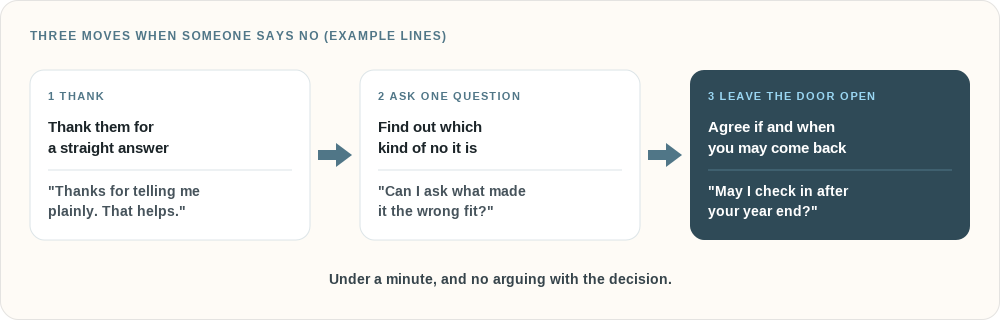
The instinct when someone says no is to argue, or to get off the call as fast as possible. Both waste the moment. For the next minute, someone who has just made a decision will usually tell you why. Three moves are enough.
- 1
Thank them
A clear no is a favor. It saves you weeks of chasing. Say so: "Thanks for telling me plainly. That helps." It also lowers their guard, because they were expecting a push.
- 2
Ask one question
One, not five. "Can I ask what made it the wrong fit?" or "Was it the timing, or the offer itself?" Then listen and do not rebut the answer. You are finding out which kind of no this is, not reopening the sale.
- 3
Leave the door open
If the answer points to timing, agree when: "May I check in after your year end?" If not, keep it light: "If that changes, you know where I am." Then do what you said, and only that.
Not taking it personally, in practice
"Do not take it personally" is easy to say and no help on a bad afternoon. It is normal to feel flat after a proposal you cared about is turned down. What helps is a few plain habits that stop one result from spilling into the next piece of work.
- Judge the effort and the result separately. Did I do what I planned, and did it work? A well prepared call to the right person that ended in no was a good call. A lucky yes after no preparation was not.
- Debrief in two minutes, in writing. What kind of no was it? What would I do differently? What happens next? Three short lines on the record, then close it. Writing it down ends the replaying in your head.
- Put a gap between calls. Stand up, get a glass of water, read the next person's details before you dial. The next buyer has no idea how the last call went, unless your voice tells them.
- Plan the day by what you control. Ten calls made is something you can finish. Two meetings booked is not.
- Say it out loud to someone. A colleague who asks "how did it go?" and listens for a minute is worth a lot. Lost deals that are never mentioned feel heavier than they are.
When a no is information
One no tells you about one buyer. Twenty of the same kind tell you about your selling. Once a quarter, sort your lost deals and disqualified leads by reason and look for the one that keeps coming back.
- Mostly "not me": your list is aimed at the wrong role. Find out who owns the problem and start there.
- Mostly "not this": the offer does not match what this kind of client needs. Look at scope, price and packaging.
- Mostly "not you": someone else is winning on something. Ask the next three what decided it.
- Mostly "not now": your timing is off, such as calling accountants in their busy season, or it is a polite cover for another reason.
- Mostly silence: the first message is not earning a reply. Change one thing at a time and compare.
Be careful with small numbers. Five lost deals do not show a pattern. Read the notes behind the count before you change anything.
When to come back, and when to stop
A "not now" with a month attached is a commitment on both sides. When the date comes, open with what they said: "You asked me to come back after your year end." That is a very different call from a cold one.
Come back without being asked only when something has changed: a new person in the role, news about their firm, or something on your side that answers the reason they gave. "Just checking in" is not a reason.
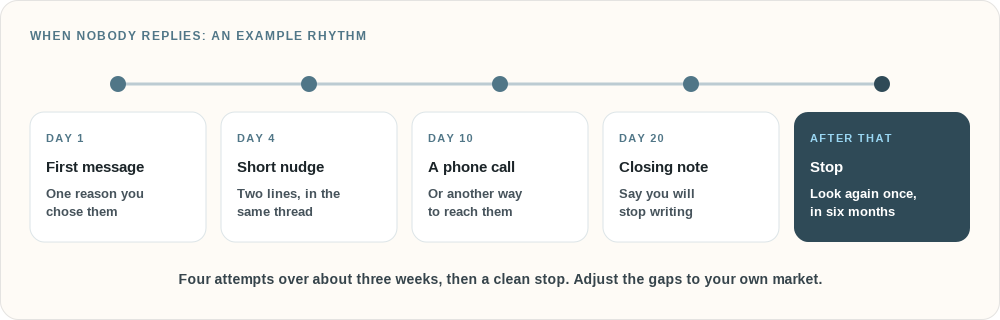
Silence needs a limit you set in advance, so that stopping is a plan and not a defeat. Decide how many attempts you will make and over how long, vary how you reach them, and end with a short note that says you will not write again. That note sometimes gets the reply the others did not.
Stop for good when someone asks you to, when they have clearly said no twice to the same offer, or when they turn out not to be a fit at all. Stopping moves your hours to people who might say yes.
If you manage the team
Lost deals only teach you something if they are recorded honestly. In many firms they are not. A deal is left open for months because marking it lost feels like a confession, and the pipeline fills with deals everyone privately knows are dead.
- Thank people for closing a dead deal. A deal marked lost today is better for the firm than one that inflates the forecast for another quarter.
- Ask "what did we learn?" before "what went wrong?" The first gets a reason. The second gets a defense.
- Talk about your own losses first. If the owner describes a proposal they lost last month, everyone else is free to do the same.
- Review reasons across the team, not by person. The useful question is why the firm loses, not who lost the most.
Start this week
- 1Count your own ratios for the last three months: people contacted, conversations, proposals, clients.
- 2Agree a short list of loss and disqualify reasons based on the five kinds of no, and use it on every deal and lead you close from now on.
- 3Write your own three lines: a thank you, one question, and a way to leave the door open. Keep them in sight during calls.
- 4Close the open deals you already know are lost, with a reason on each.
- 5For every "not now" you can remember, set a dated task to come back.
Rejection does not stop being unpleasant. What changes with practice is how long it lasts and what you get from it. A no you understood and recorded has paid for itself. A no you avoided hearing is still sitting in your pipeline.