
Most large deals that are lost were never as close as they looked. The buyer liked you, the meetings went well, a proposal went out, and then nothing. When you look back, the reason is usually something you did not know: who really decides, what it had to compete with for budget, or whether the problem was painful enough to act on.
MEDDIC is a checklist of six things to know about a deal before you believe in it. It came out of enterprise software sales in the 1990s, where sales ran for months and forecasts kept missing. You do not need to be an enterprise to use it. You need a deal that is big enough, or slow enough, that guessing is expensive.
A checklist for the deal, not a script for the call
This is the point most people get wrong. MEDDIC does not tell you what to say to a buyer or in what order. It is a way to inspect a deal after the conversation: what do we actually know, how do we know it, and what is still a guess? The conversation itself should sound like any good discovery call, with open questions and a lot of listening.
If you know BANT, think of that as the lighter cousin: a quick screen for whether a lead deserves your time. MEDDIC goes further and keeps working for the whole life of the deal.
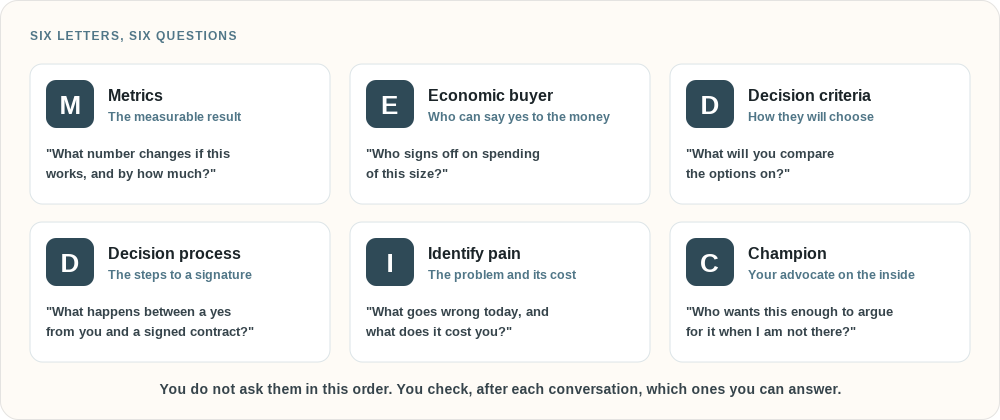
The six letters, one at a time
- 1
Metrics: the result in numbers
What will be measurably different if the buyer goes ahead: hours saved, errors avoided, revenue gained, a deadline met. Ask "How would you know, six months on, that this was worth it?" and "What does that come to in a year?" A weak answer has no number in it: "we want to be more efficient". A buyer who cannot put a figure on the gain will struggle to defend the spend to anyone else.
- 2
Economic buyer: the person who can say yes to the money
Not the person who likes you, and not always the most senior person in the room. It is whoever can approve spending of this size without asking someone else. Ask "Who signs off on something like this?" and "When they last approved a project this size, what did they need to see?" A weak answer is "I make the call, I just need to run it past the partners". That means the partners decide.
- 3
Decision criteria: how they will choose
The things they will compare options on: price, speed, experience in their industry, references, risk. Options include doing it themselves and doing nothing. Ask "What matters most when you compare the options?" and "Which of those would you not give up?" A weak answer is a list where everything is equally important, or criteria you are guessing from the questions they asked.
- 4
Decision process: the steps to a signature
Who has to review it, in what order, by when, and what happens after the yes: a contract review, a purchase order, a board meeting that only happens monthly. Ask "If you decided today that you wanted this, what happens next on your side?" A weak answer is "it should be quick", or a close date that only you have ever said out loud.
- 5
Identify pain: the problem and what it costs
A problem that someone with authority feels and wants gone. Ask "What goes wrong today because of this?" and "What happens if nothing changes this year?" A weak answer is interest without urgency: "we are always looking at ways to improve". If doing nothing costs them nothing, doing nothing will usually win.
- 6
Champion: someone inside who sells for you
Most of the decision is made in rooms you are not in. A champion is a person inside the buyer's firm who wants the outcome, is listened to, and will argue for it. Ask "Who else needs to be convinced, and what will they push back on?" and "What would help you make the case?" A weak answer is warmth without action. Friendly is not the same as willing to spend their own credibility.
When it is worth it, and when it is overkill
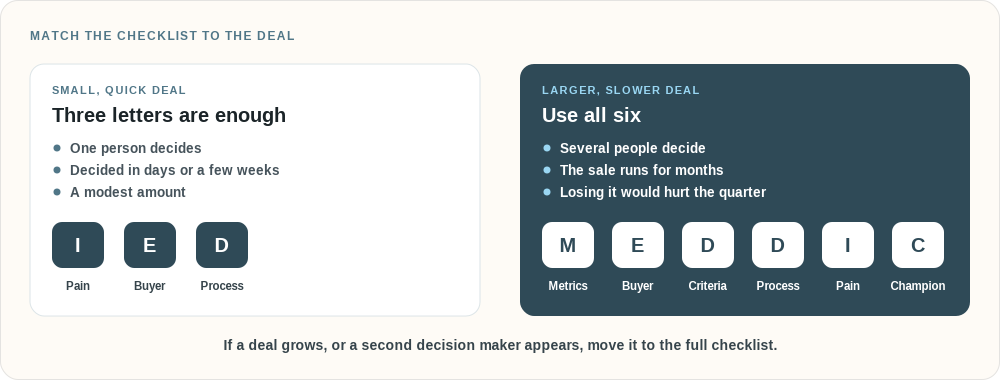
The full checklist earns its place when three things are true: several people have a say, the sale runs for months, and the amount is large enough that losing it would hurt. That describes a retainer, a multi-phase project or a contract that needs a board or a partner group to approve it.
It is overkill for a small, quick sale with one decision maker. Asking an owner who can sign today to walk you through their approval process wastes their time and makes you look like you were not listening. For those deals, keep three letters: is there a real pain, am I talking to the person who decides, and what happens next.
You will also see longer spellings with extra letters, for things such as the paper process (contracts, legal and procurement steps) and the competition. They are the same idea with more boxes. Add a letter only when a deal has been lost to the thing it covers.
Review an open deal: the gaps are the plan
The most useful thing to do with MEDDIC is to take one open deal and go down the six letters, writing what you know and how you know it. Mark each one known, partly known or a gap. Be strict: "known" means the buyer said it, not that you assume it.
Then stop asking "what should I do next on this deal?" The gaps answer that. Each one becomes a next step with a person and a date.
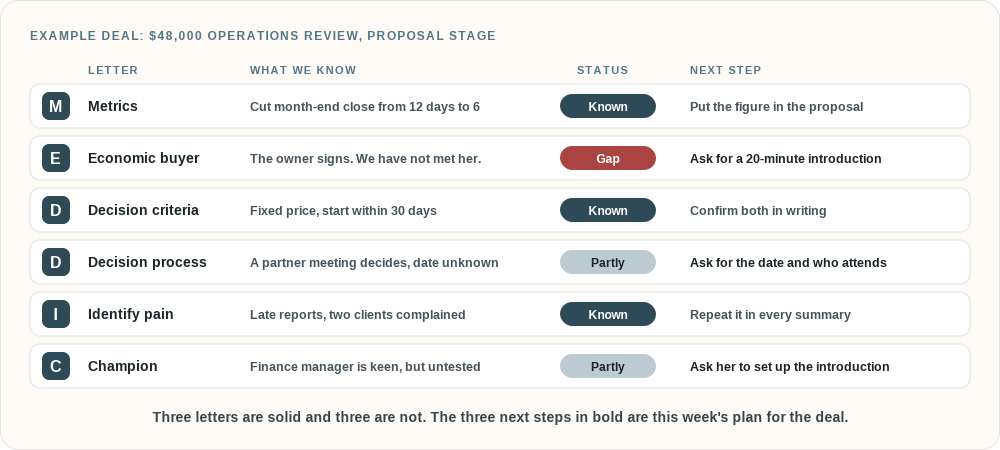
Notice that in the example one request closes two gaps. Asking the finance manager to arrange a short meeting with the owner gets you to the economic buyer, and shows whether she is a champion or only friendly.
How it makes the forecast more honest
A stage tells you how far the selling has gone. It does not tell you how far the buying has gone. Two deals can both sit at proposal, one with the owner's agreement and a date for the partner meeting, the other with a keen contact and nothing else. A forecast that treats them the same is counting hope.
The six letters give you a second reading. A simple rule works well for a small team: no deal goes into the number you commit to for the quarter unless the economic buyer and the decision process are both known. Everything else can stay in the pipeline, at a lower chance, until the gaps close.
Four mistakes to avoid
- Interrogating the buyer. Six letters fired off as six questions feels like an audit. Spread them over several conversations and ask only what you could not work out yourself.
- Calling a friendly contact a champion. Until they have done something for the deal, they are a contact.
- Ticking boxes from hope. "I think the owner is on board" is a gap. Write down who said what, and when.
- Filling it in once. People change jobs, budgets move and a new decision maker appears. Go back over the letters whenever a deal changes stage or goes quiet.
Start this week
- 1Pick your three largest open deals and go down the six letters for each. Mark every one known, partly known or a gap.
- 2For each gap, write one next step with a name and a date, and book the first one today.
- 3Test one champion: ask for an introduction to the person who signs.
- 4Decide which deals get the full six letters and which get three, and write the rule down in one sentence.
- 5Before the next forecast, take out of your committed number any deal where you have not met the economic buyer.
MEDDIC does not win deals. It shows you, early and without flattery, what you still need to find out. The winning is done by going and finding it out.