
Deals are rarely lost in one dramatic moment. They leak. You call at the wrong time, you ask something the buyer already answered last month, you pitch a new service while a support problem is still open, or an objection lands in the final meeting that you could have seen coming.
Almost every one of those mistakes is something someone at your firm already knew. The trouble is not missing information. It is information in the wrong place, or only in one person's head.
Where what you know actually goes
Walk through a typical client relationship and count the places knowledge ends up: what the buyer said on a call sits in the salesperson's memory, the follow-up thread sits in an inbox, the invoice problem sits with whoever does the billing, and the support issue sits in a help tool. Each place is fine on its own. Together they are a buyer you only half know.
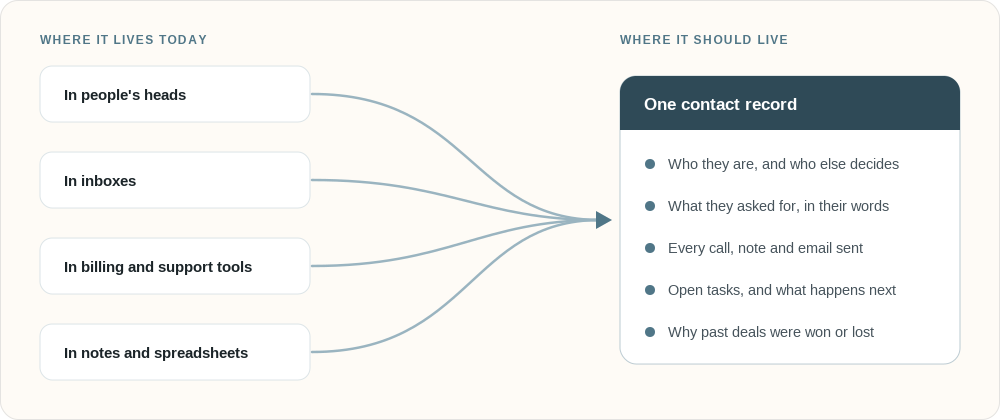
Five gaps, and how to close each one
- 1
You do not know what they have already told you
The buyer explains their goal, their deadline and their worry to one person, then explains it all again to the next. Right after a call, write down what was said as plain facts: the goal, the date that matters, who decides, what worries them. "Good call" helps nobody.
- 2
You do not know who else is in the decision
A deal with one contact is a deal with one point of failure. If that person goes on leave, changes jobs, or simply cannot say yes alone, you are back to the start. Add everyone who influences the decision to the deal, even the ones you have not met.
- 3
You do not know what the rest of your firm has been saying
A colleague sent a proposal last week. Support promised a fix by Friday. An invoice is overdue. None of that is visible to the person about to send a cheerful upsell. Look before you reach out, and hold the sales message when a service problem is still open.
- 4
You do not know why you lost the last one
Without a reason on every closed deal, each loss teaches nothing, and the same objection ambushes you again. Record the objection when it is raised, and the reason when the deal ends, in one consistent list so you can see patterns.
- 5
You do not know what changed since you last looked
A deal that has sat for three weeks is a different deal. A person may have moved on, the close date may have slipped, or a task may have been missed. Before an important call, review what has changed, not just where the deal stands.
Prepare for objections before they arrive
An objection that surfaces in the last meeting is expensive because everything depends on it and there is no time to respond well. The same objections come up again and again, so most of them can be predicted from what you already know about the buyer and from deals like theirs.
| They say | It often means | Have ready |
|---|---|---|
| Your price is higher | The value is not yet concrete to them | A worked example of the result for a similar client |
| We are happy with who we use | Switching feels risky, or like work | A low-risk first step, such as a small pilot |
| I need to run this by someone | The real decision maker has not been engaged | A one-page summary they can forward |
| Now is not the right time | Another priority, or no urgency yet | A question about what would have to change, and a dated follow-up |
| Send me some information | A polite way to end the conversation | A question about which decision it should help them make |
A routine that fits around real calls
None of this needs a long process. It needs a few minutes in the right place: five before the call, a little attention during it, and a short write-up within the hour while it is still fresh.
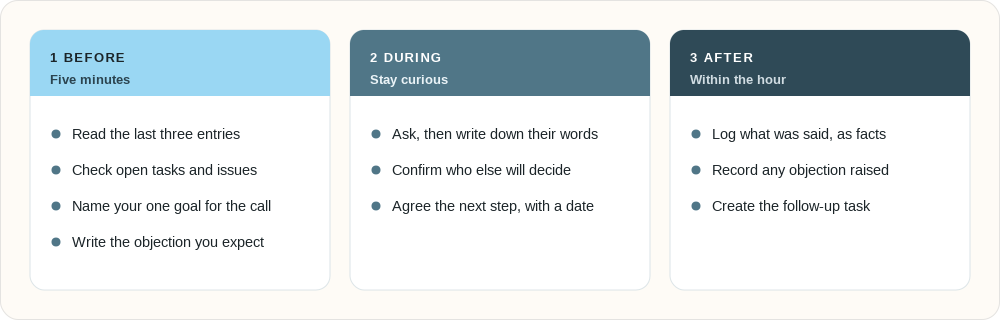
Start with one deal
- 1Pick the one open deal that matters most this month.
- 2Add every person involved, including those you have not met.
- 3Write down, in plain facts, what the buyer has told you so far.
- 4Name the single objection you expect, and what you will say.
- 5Set a dated task for the next step, and log the call within the hour.
A buyer who feels known tends to say yes sooner. They are not impressed by the tool you use. They are relieved that nobody made them repeat themselves.