
Ask a small firm how long it takes to win a client and the usual answer is "it depends" or "a couple of months". Few have counted. That matters, because a deal that takes twice as long ties up twice the follow-up, delays the income, and gives the buyer twice as many chances to get distracted by something else.
This article treats the sales cycle as elapsed time: a number of days you can measure, split up and shorten. It does not go through what the stages should be. The funnel guide covers that. Here the question is simpler: where do the days go?
Decide when the clock starts and stops
Cycle length is the number of days between two events, so you have to pick the events. A workable choice for most firms: the clock starts at the first real conversation about a piece of work, and stops on the day the buyer says yes. Whatever you choose, write it down and use it for every deal. A cycle that starts at the first email for one person and at the proposal for another cannot be compared.
- Count won deals on their own. Lost deals have a length too, and it is worth knowing, but mixing the two hides both.
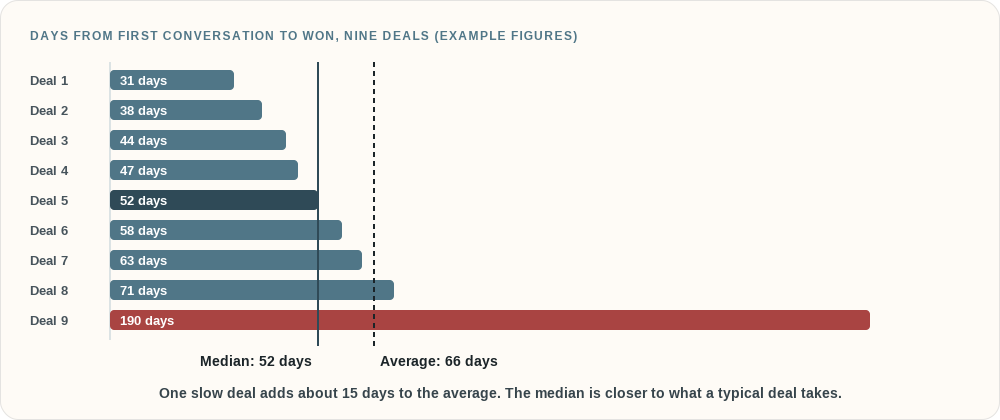
- Look at the median as well as the average. The median is the middle deal when you sort them by length. One deal that dragged on for half a year can move an average a long way.
- Use enough deals. With fewer than ten or so, read the individual deals instead of trusting the number.
Measure it in three passes
- 1
The whole cycle
Take the deals you won in the last two or three quarters and work out the average and the median number of days. This is your baseline. Everything you change later is judged against it.
- 2
Each stage
For the same deals, work out how many days each one spent in each stage. The stage averages add up to the whole cycle, and one of them is nearly always much larger than the rest.
- 3
Each kind of deal
Split the list by something that plausibly changes the pace: deal size, new client or existing client, how the buyer found you. A referral from a happy client and a cold enquiry rarely move at the same speed, and one blended number will mislead you about both.
Find the slow stage
Laid end to end, the stage averages show where a typical deal spends its life. In the example below, proposals take 28 of 66 days. That is where to look first, because a day saved in a long stage is easier to find than a day saved in a short one.
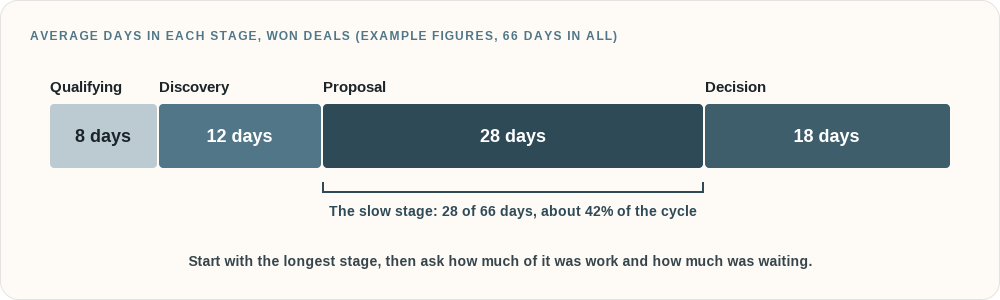
The longest stage is not automatically the broken one. A buyer who has to get three partners to agree needs time, and that is legitimate. So the next question is what the days in that stage were spent on.
| If the days pile up | It often means | Look at first |
|---|---|---|
| Before the first proper meeting | Slow replies, or leads that were never likely to buy | How fast you respond, and who you agree to meet |
| Between discovery and proposal | The proposal is written from scratch each time | A standard base you adapt in an hour |
| After the proposal is sent | Nobody agreed what happens next | A walk-through call booked before you send it |
| At the decision | Someone you never met has to approve it | Who signs, asked in the first two conversations |
Most of a sales cycle is waiting
Take one deal from your slow stage and write out what happened, day by day. The usual finding is that the work took a few hours and the calendar took a month. The time is not lost in the steps. It is lost between them.
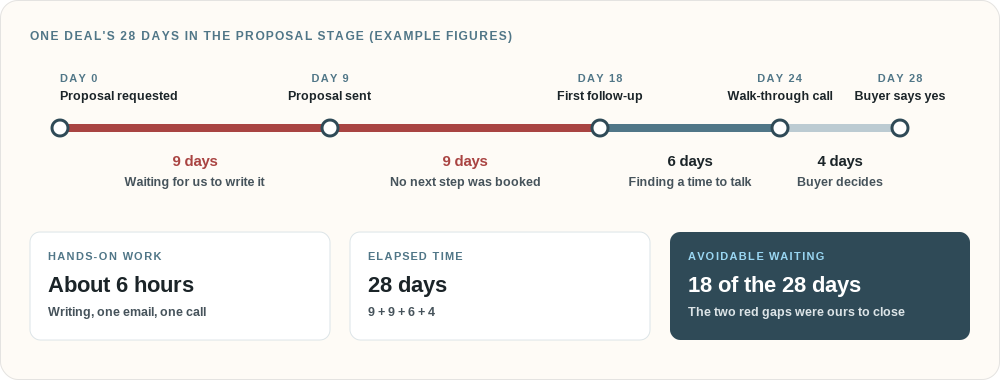
This is good news. You cannot make a buyer think faster, and you should not try. You can remove the days in which nobody was thinking about the deal at all.
Five places the days go
- 1
Gaps between steps
A meeting ends with "I will send something over" and the something goes out the following week. Each gap is small and feels reasonable. Five of them are a month.
- 2
No agreed next step
"Let me know what you think" hands the timetable to the busiest person in the conversation. Without a date both sides have accepted, the deal moves only when someone remembers it.
- 3
The decision maker appears late
You spend six weeks with someone who likes the idea, and then learn that a partner or a finance lead has to approve it and is hearing about it for the first time. Part of the sale starts again.
- 4
Slow proposals
The buyer is most interested on the day they ask for a proposal. Every day it takes to arrive, that interest cools and other priorities move in.
- 5
Objections that surface at the end
Price, timing, a contract term, an incumbent supplier. If the first time these come up is after the proposal, they cost weeks. Raised early, most take one conversation.
Shorten it without pushing the buyer
None of these fixes involve pressure. They take out your own delays and make it easier for the buyer to keep moving at the pace they already wanted.
- 1
Never end a conversation without the next one booked
Agree the date while you are both still talking, and put it in both calendars. This single habit removes more waiting than anything else on the list.
- 2
Set yourself a proposal deadline
Pick a standard, such as two working days, and build what you need to meet it: a base document, standard scope wording, a price list. Tell the buyer the date so they expect it.
- 3
Ask how the decision gets made, early
"Who else will want a say in this, and what will they want to know?" is a normal question in a first or second conversation. Then offer to meet those people, or give your contact something short they can pass on.
- 4
Plan backwards from the buyer's date
Ask when they want the work to start, then lay out together what has to happen before then: proposal, review, sign-off, kickoff. A shared plan built from their date reads as help, not as chasing.
- 5
Bring up the hard parts first
Give a price range before you write the proposal. Ask what would stop this from going ahead. An objection you hear in week two is a conversation. In week eight it is a stalled deal.
- 6
Let weak deals go sooner
A deal that will be lost costs less if it is lost quickly. Qualifying harder at the start shortens the average, and frees time for the deals that are moving.
Check that it worked
Change one thing in the slow stage, then measure the same way again after enough deals have closed to mean something. Watch the win rate alongside the days. If the cycle gets shorter and the win rate holds, you removed waiting. If the win rate drops, you may be rushing buyers or dropping deals that needed more time. And when the slow stage improves, a different stage becomes the longest. That is the next one to look at.
Start this week
- 1Write one sentence that says when your clock starts and when it stops.
- 2Work out the average and the median days to win for your last ten to twenty won deals.
- 3Split those days by stage and name the longest one.
- 4Pick two deals from that stage and write out, day by day, what happened and who was waiting for whom.
- 5Choose the one delay that was yours, fix it, and put a date in the calendar to measure again.
A shorter cycle rarely comes from selling harder. It comes from noticing the days when nothing was happening, and giving the buyer fewer of them.