
A sales funnel is a picture of how a stranger becomes a client, and then a client who sends you someone else. You do not need a marketing department to build one. You need an honest description of how your buyers make up their minds, a pipeline that mirrors it, and a few numbers that tell you where people get stuck.
Funnel and pipeline are two views of one thing
The funnel is the buyer's view: what they are thinking and doing before they talk to you, while they compare options, and after they sign. The pipeline is your view: the stages a deal sits in, so you always know what to do next.
A good setup keeps the two lined up, so that a deal moving to the next pipeline stage means something real happened on the buyer's side, not just that you were busy.
The journey, from the buyer's chair
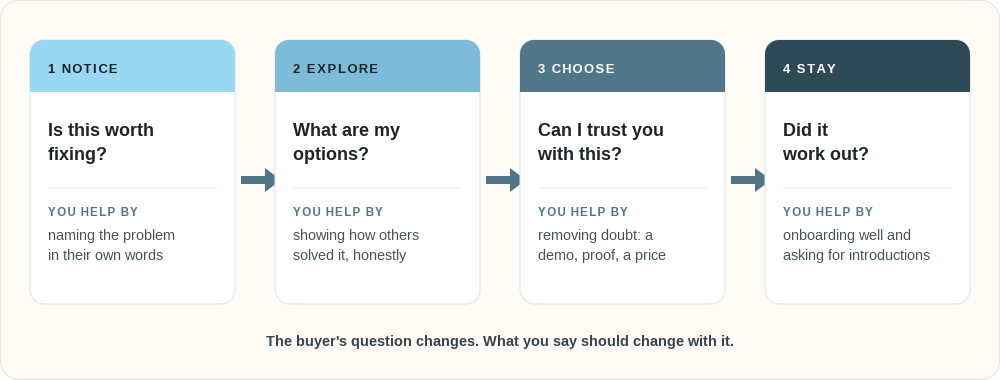
Before you name any stages, listen to the question a buyer is silently asking. It changes as the relationship matures, and what you say should change with it.
- 1
"Is this worth fixing?"
They feel friction, such as slow months, lost hours or a competitor pulling ahead, but they have not named the cause. Help by describing the problem in their own words: a short article, a talk, a useful newsletter.
- 2
"What are my options?"
They know the problem and are looking at ways to solve it, including doing nothing. Help by showing how people like them solved it, comparing the choices honestly, and being clear about who you are for and who you are not.
- 3
"Can I trust you with this?"
You are on a shortlist. Remove doubt with a demo or a trial, a reference they can call, a straight answer on price, and a plan for the thing that worries them most.
- 4
"Did it work out?"
The sale is the start of the relationship, not the end of it. Onboard well, check in on a schedule, and ask for feedback while the good result is fresh.
Seven stages you can run in a pipeline
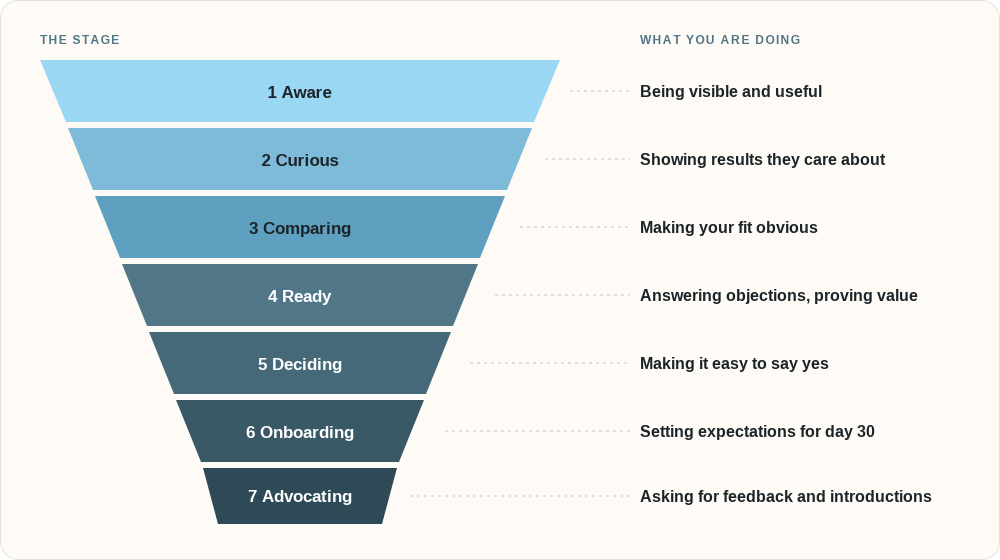
Four phases are enough to think with, but a pipeline needs finer steps so you can see exactly where each deal stands. Seven works for most professional firms. Rename them to match how your own buyers talk.
| Stage | The buyer is | You are | What helps |
|---|---|---|---|
| Aware | Noticing a problem | Being visible and useful | Articles, talks, a newsletter |
| Curious | Reading, subscribing, replying | Showing results they care about | Client stories, a short guide |
| Comparing | Weighing a few providers | Making your fit obvious | A comparison page, references |
| Ready | Asking for a call or demo | Answering objections, proving value | A demo, a worksheet, testimonials |
| Deciding | Checking price, terms and risk | Making it easy to say yes | A clear proposal and scope |
| Onboarding | Signing and getting started | Setting expectations for the first 30 days | A welcome pack, a kickoff call |
| Advocating | Getting value and telling others | Asking for feedback and introductions | Check-ins, a thank-you for referrals |
Five numbers worth watching
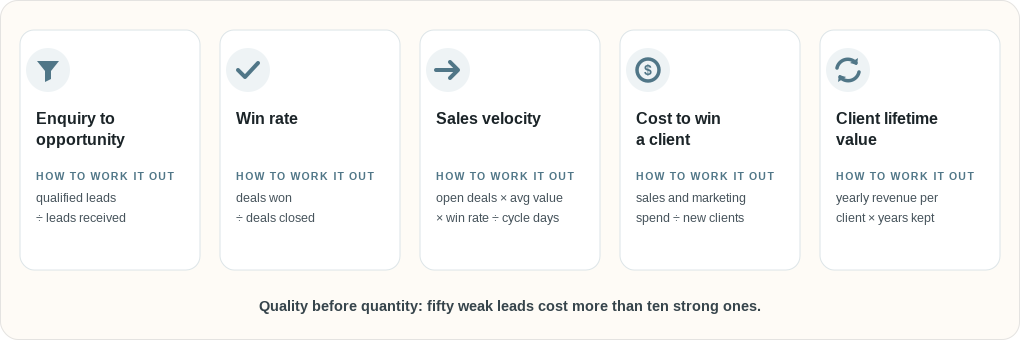
What you measure is what improves, and a handful of numbers beats a wall of charts. These five are enough to tell you where the funnel is healthy and where it is not.
- 1
Enquiry to opportunity rate
Of the people who got in touch, how many turned into a real conversation about a deal. A low rate usually means you are attracting the wrong people, not that you are bad at selling.
- 2
Win rate
Deals won divided by deals closed, won or lost. Track it by pipeline stage of entry and by who sourced the deal, because the average hides a lot.
- 3
Sales velocity
Open deals times average deal value times win rate, divided by the number of days a typical deal takes. It tells you how fast value moves through the pipeline, and which of the four inputs to work on.
- 4
Cost to win a client
Everything you spend on sales and marketing in a period, divided by the new clients you won in it. Include your own time if you can.
- 5
Client lifetime value
The revenue a typical client brings over the whole relationship. If it is much larger than the cost to win a client, you can afford to invest in growth. If it is not, fix that first.
Where funnels leak, and how to patch them
- 1
It is aimed at everyone
Write one paragraph describing your five best clients, then qualify every new lead against it. In DealSight, record those traits as custom fields so you can filter on them later.
- 2
Everything is behind a form
Keep early material free, and ask for details only when the buyer wants something personal, such as a review or a quote.
- 3
The automation reads like automation
Automate the timing and personalize the content. Sequences in DealSight send from your own mailbox, so each message arrives as you.
- 4
Finding leads and closing them are separate worlds
Agree on one definition of a qualified lead and hold one short review a week where both sides look at the same list.
- 5
Clients are forgotten after they sign
Put the 30 and 90 day check-ins on the calendar the day the deal closes. A task with a reminder is enough.
From funnel to flywheel
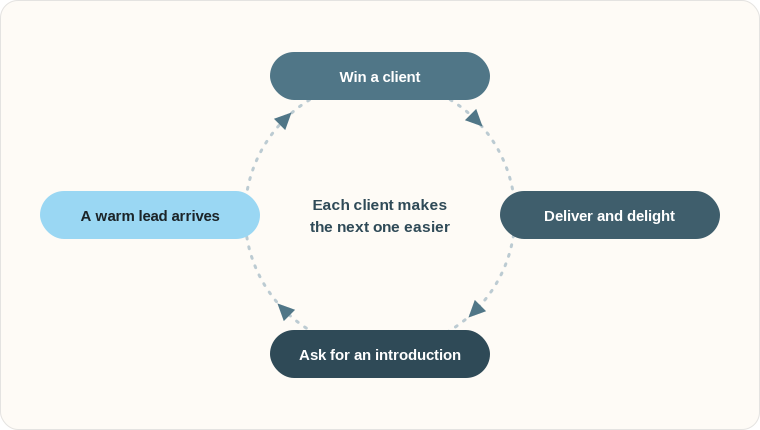
A funnel ends at the signature. A flywheel keeps turning: a good first project earns trust, trust earns a second engagement and an introduction, and the introduction starts someone new near the top of your funnel, already warm.
Treat your funnel as a working draft. Once a month, look at where people stop, fix the single worst leak, and check again next month. Small, steady repairs beat a redesign every time.
Start this week
- 1Write down the four questions above in your buyers' own words, using real conversations.
- 2Rename your pipeline stages so each one is something the buyer did.
- 3Pick the one number from the five that you cannot answer today, and find it.
- 4Choose the leakiest stage and change one thing about it.
- 5Put a check-in on the calendar for every client you signed in the last 90 days.
Build the funnel so that every client you win makes the next one easier to win.