
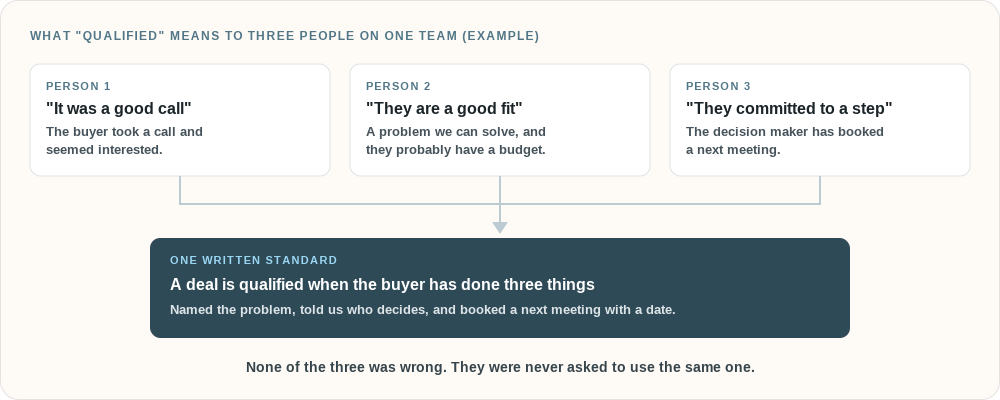
Ask three people on the same sales team what makes a deal qualified, and you will usually get three answers. Each of them is sure the answer is obvious. Each of them has been working to it for months. And the owner, who has a fourth answer, is wondering why the pipeline never quite matches what was said in the meeting.
When a salesperson falls short, the first guess is usually effort or skill. Often it is neither. The person did what they understood the job to be. Nobody had told them, in words they could check their own work against, what good looks like.
The standard nobody wrote down
A small team runs on shared assumptions. The owner sold the first hundred deals personally and knows what a real opportunity feels like. That knowledge was never written down because, for years, there was nobody to write it for. Then the team grew. Each new person filled the gap with the standard from their last job, or with their own common sense.
What unclear expectations cost
- Arguments about the forecast. If one person puts a deal in the proposal stage when they send a price and another waits until the buyer has asked for one, the stage totals mean nothing, and the meeting turns into a debate about whose deals are real.
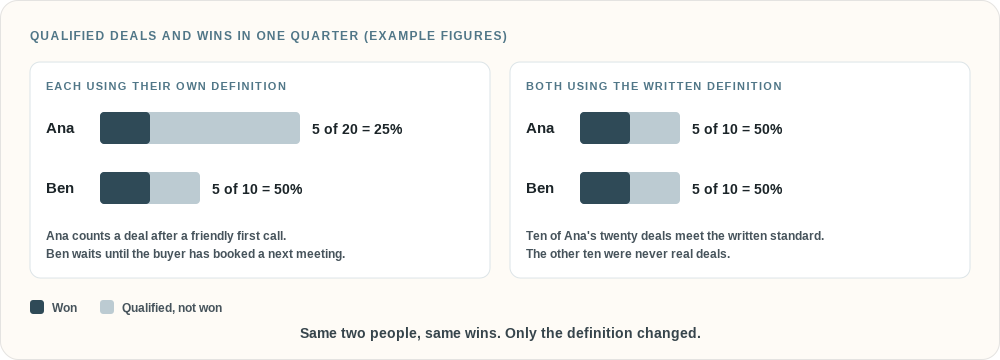
- Unfair comparisons. Win rates, pipeline size and activity counts only compare people who are counting the same thing. Otherwise the careful person looks slow and the generous one looks busy.
- Rework. Proposals written for buyers who were never going to buy, and records someone else has to fix before a report can be trusted.
- Feedback that feels personal. Telling someone they fell short of a standard they never heard feels like an ambush. With a written standard, the same conversation is about the work.
Three places a small sales team needs it in writing
You do not need a handbook. Three short lists cover most of the arguments a small sales team has. The wider document they belong in is covered in the guide to building a sales playbook.
- 1
What must be true for a deal to move forward
For each stage, one or two things the buyer has done before the deal may leave it. The buyer, not the salesperson. "Sent a proposal" is your action and proves nothing. "The buyer asked for a proposal and told us who will sign it" is evidence. The funnel guide explains the stages themselves, so this list only needs the exit test for each one.
- 2
What a normal week contains
The handful of activities that, done every week, keep a pipeline alive: new conversations started, follow-ups made, proposals sent, existing clients contacted. This is the floor for a normal week, not the result each person is asked to deliver. Results belong with targets, which the guide to setting sales targets covers.
- 3
What counts as a qualified deal
The few facts that must be known before something is called a deal and given an amount. Typically: the problem in the buyer's words, who decides, roughly when, and a booked next step. Everything short of that is a lead, however friendly the call was.
| Standard | Example wording | How you would check it |
|---|---|---|
| Leaving the discovery stage | The buyer has described the problem and named who decides | Both are written on the deal |
| Leaving the proposal stage | The buyer has the proposal and a review meeting is booked | The deal has a meeting with a date |
| A normal week | 10 new conversations started and every open deal touched | Count the week's recorded activity |
| A qualified deal | Problem, decision maker, timing and next step are all known | Four yes or no answers |
The wording and the number in the table are examples. Yours will depend on what you sell and how long a sale takes.
Write it so it can be checked
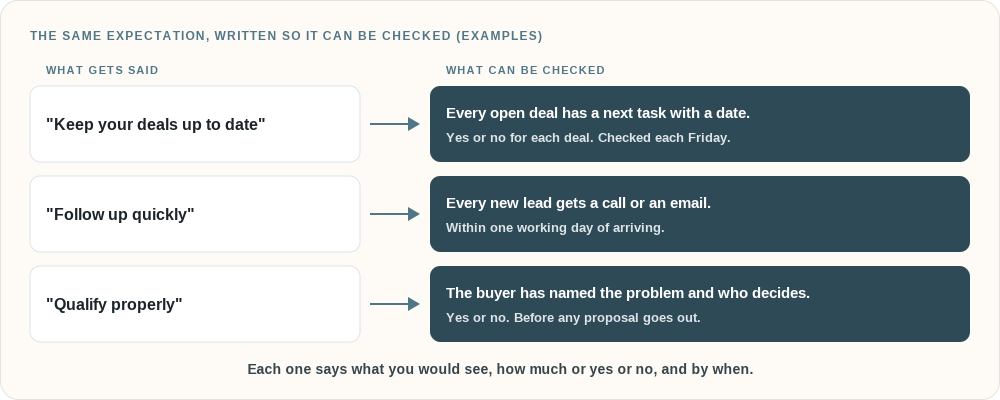
Most expectations fail because they describe an attitude. "Take ownership of your pipeline." "Be responsive." "Qualify harder." Everyone agrees with these, and nobody can tell whether they did them. An expectation is useful when two people looking at the same deal would give the same answer about whether it was met. Three tests get you there.
- It is observable. It describes something a person does or something that exists on a record, not a quality of character.
- It has a number or a yes or no. "Every open deal has a next task" can be answered. "Stay on top of your deals" cannot.
- It has a time. Within one working day, by Friday, before a proposal goes out.
Say why as well. A rule with no reason gets followed when someone is watching. "A next task on every deal, because a deal with nothing booked is the one we lose without noticing" is a rule people keep when they are busy.
The expectations about record keeping
Record keeping is where standards are vaguest and resentment is highest. The manager wants everything written down. The salesperson hears a demand for typing instead of selling. Settle it by naming the few things that must be recorded and when, and letting the rest go.
- A deal exists in the system the same day it becomes qualified, with an amount and a close date that the person would defend.
- Every call and meeting with a buyer is recorded by the end of that day, with one or two lines on what was learned and what was agreed.
- Every open deal has a next task with a date.
- A deal that is dead is closed as lost that week, with the reason.
Agree it, do not announce it
A standard handed down in an email gets compliance at best. Write a first draft yourself, then put it in front of the team and ask where it is wrong. The people doing the selling know things you do not: that the decision maker in your market never joins a first call, or that ten new conversations a week is easy in one territory and impossible in another.
You still decide. But a standard that has survived the team's objections is one they will hold each other to, and it is usually a better standard. Test the draft against ten recent deals, won and lost, before you settle it. If the best deals of last quarter would have failed your exit test, the test is wrong.
Ask them to say it back
"Does that make sense?" always gets a yes. It tells you the person wants the conversation to end. Ask a question that can only be answered by someone who understood: "Take the Harlow deal. Is it qualified under this, and what would you need to find out to make it so?" The gaps show up in the answer, and they are nobody's fault at that point. This matters most with a new hire, who will not admit confusion in the first month.
See whether the standard is being met
A standard nobody looks at fades within a quarter. Pick a regular moment, the weekly meeting or each one-on-one, and check a few deals against it. Look for the pattern, not the culprit. If one person misses a standard, that is a conversation. If everyone misses it, the standard is unclear or unrealistic, and that is yours to fix.
Revisit when the market or the role changes
Expectations go stale quietly. You add a new service with a longer sale, and the activity standard built for the old one no longer fits. Buyers start involving a finance person, and your definition of qualified misses them. Someone moves from finding new clients to managing existing ones, and is still being measured on new conversations.
Put a review in the calendar twice a year, and reopen the list whenever what you sell, who you sell to or someone's role changes. Say out loud when a standard has changed. People keep working to the last version they heard.
Start this week
- 1Ask each person, separately, to write one sentence on what makes a deal qualified. Compare the answers in the next team meeting.
- 2Draft the exit test for each stage as something the buyer has done, and check the draft against ten recent deals.
- 3Rewrite your three vaguest expectations so each is observable, has a number or a yes or no, and has a time.
- 4Agree four or five record keeping rules with the team, and the reason for each.
- 5Pick three open deals in your next one-on-one and ask the person to walk them through the standard.
Clear expectations are not about control. They are what lets a salesperson know, without asking, that they have done a good job, and what lets you say so and mean the same thing.
More on this from The Center for Leadership Studies: What "good" looks like: how to set clear expectations for your team