
In most small firms, the way the firm sells lives in one head. Usually the owner's. It works well until a second person starts selling. Then the new person guesses, the owner corrects, and the same ten questions get answered again for the third hire.
A sales playbook is the fix. It is a short written document that says how your firm sells: who to, in what steps, with which words, and under which rules. It is not a training manual and it is not a binder. For a firm of five or ten people it should be a few pages that someone can read in one sitting and find an answer in within a minute.
What belongs in it, and what does not
The test for every line is simple. Would a new salesperson need this in the middle of a working day? If yes, it goes in. If it is background, it goes somewhere else.
- 1
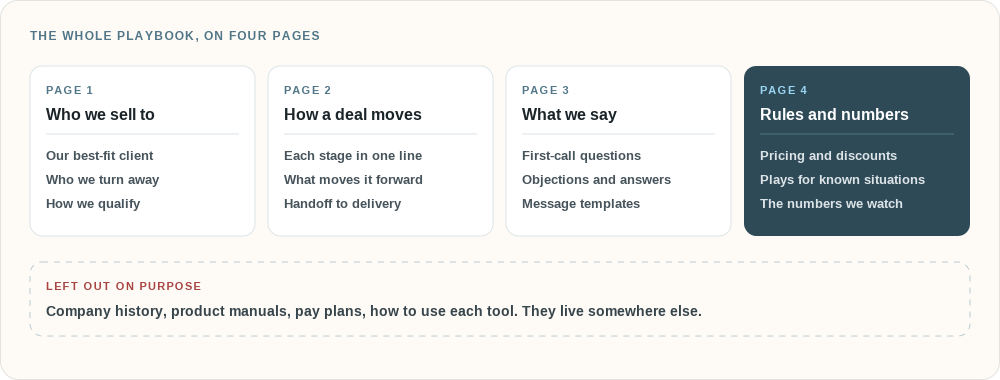
Who you sell to, and who you turn away
Describe your best-fit client in three or four plain facts: the kind of firm, its size, the problem it has, and who there decides. Then write the harder half: the clients you say no to, and why. A new person will chase anyone who replies unless the page tells them not to.
- 2
The stages, and what moves a deal forward
One sentence per stage, written as something the buyer has done, not something you have done. "Proposal sent" is your action. "Buyer has agreed the scope and asked for a price" is theirs. If you have already worked through your funnel stages or chosen a sales method, this page is where that thinking gets written down in your own words.
- 3
The first conversation and how you qualify
List the six to ten questions your best person always asks in a first call, in the order they ask them. Then list the three or four answers that make a deal worth pursuing, and the one or two that end it politely.
- 4
Objections, with your answers
You hear the same five objections over and over. Write each one down with the answer that has actually worked, in the words you would say out loud. Include the honest cases where the right answer is "then we are not the right firm for you."
- 5
Pricing rules, and who can discount
How a price is built, what is never given away, and how far a salesperson can go alone. For example: up to 10 percent off without asking, anything more goes to the owner. A clear limit saves a call and protects your margin.
- 6
Templates, handoff and numbers
The handful of messages you send again and again, your proposal outline, what delivery needs to know on the day a deal is won, and the three or four numbers you look at each week.
What stays out: the history of the firm, full service descriptions, pay and commission plans, and step-by-step instructions for your software. They matter, but they change on a different schedule and nobody looks them up during a call. Link to them in one line.
Write the first version in an afternoon
Do not start from a blank page and do not start from a template full of headings you will never fill. Start from what your best seller already does. In a small firm that is often the owner. The first version is a description, not a design.
- 1Pick three deals you won recently and one you lost. Open the emails, notes and proposals for each.
- 2Have someone interview the best seller for an hour and take notes. How did each deal start? What did you ask first? When did you know it was real? What nearly stopped it? What did you say?
- 3Sort the notes under the headings above. Use the seller's own words. If they say "I always ask who else has to sign this off," that sentence goes in as written.
- 4Copy the real emails and the real proposal into the templates section, with the client's details taken out.
- 5Cut it to a few pages. If a section runs past half a page, it has turned into training material. Move the extra out.
- 6Give it to the newest person on the team and ask what is unclear. Fix those parts first.
Add plays for the situations that repeat
A play is a short instruction for one specific situation. It names the moment, the move, and the point where you stop. Most of selling is judgment, and a play does not replace that. It covers the handful of moments where your firm already knows what works and a new person would otherwise have to find out the slow way.
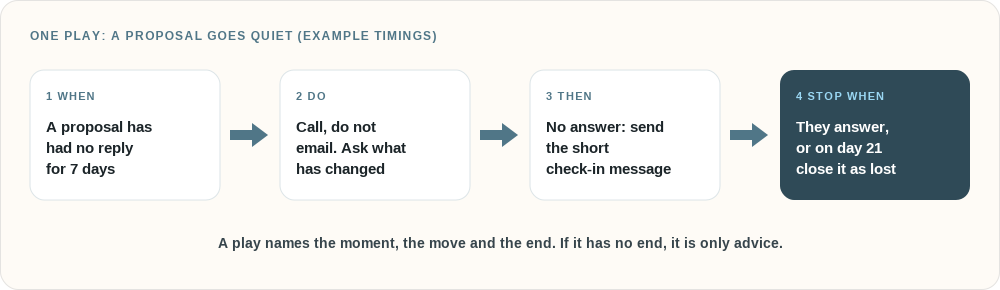
Three plays cover a lot of ground for a small firm. The timings below are examples.
| Situation | First move | What a new person gets wrong |
|---|---|---|
| A referral arrives | Reply the same day and name the person who referred them. Thank the referrer, and tell them later how it turned out. | Treating it like any other lead and waiting three days. |
| A proposal goes quiet | Call after 7 days and ask what has changed on their side. Set a date after which the deal is closed as lost. | Sending "just checking in" every week for three months. |
| A competitor is named | Ask what they like about the other firm. Then name the one or two things you do differently, and for whom that matters. | Running the competitor down, or cutting the price at once. |
Write a new play only when the same situation has come up three times. Ten plays that people remember are worth more than forty they have to search.
Keep it alive
A playbook written once and never changed becomes wrong slowly, and then people stop trusting it. Two habits keep it current, and neither takes long.
- Change it when you learn something. When a deal closes, won or lost, ask why in one sentence. If the reason is new, it belongs in the playbook: a new objection and its answer, a new kind of client to turn away, a question you should have asked in the first call.
- Review it each quarter. One hour, the whole team, the document on the screen. Read the reasons for the quarter's wins and losses. Then ask three questions. What in here did we not do? What did we do that is not in here? What is out of date?
- Give it one owner. Everyone can suggest a change, one person makes it. Without an owner the document splits into three versions.
- Delete as well as add. Every review should remove something. A play nobody has used in two quarters goes.
Use it when someone new starts
The playbook pays for itself in a new person's first month. It does not replace sitting beside someone good. It gives the two of them something to point at, so the new person hears "this is the question on page three" and not a different version from each colleague.
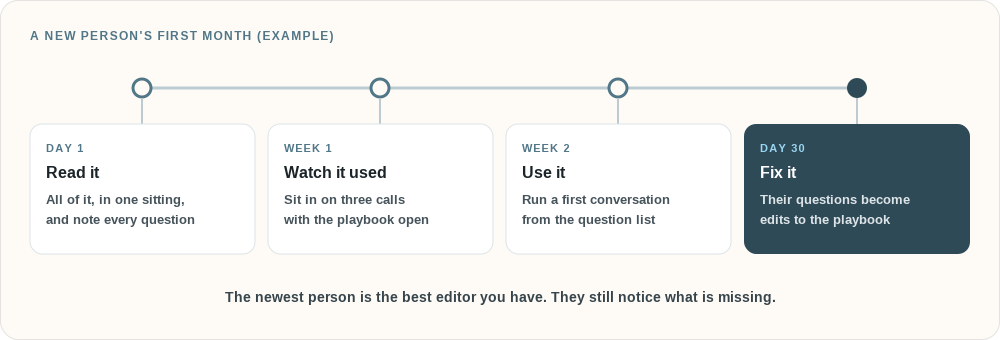
The last step matters most. A new person notices every gap, because they do not yet know the unwritten answer. After a year they will have stopped seeing the gaps. Ask for their list at the end of the first month and make the edits that week.
Start this week
- 1Block one hour with your best seller and three recent deals. Take notes on what they asked, said and sent.
- 2Write page one: who you sell to, who you turn away, and the three or four answers that qualify a deal.
- 3Write one play for the situation that came up most often last month.
- 4Give both pages to the newest person on the team and ask what is unclear.
- 5Put a one-hour review in the calendar for the end of the quarter.
A playbook does not need to be complete to be useful. Two honest pages that match how your best deals were won will do more for the next hire than a long document nobody finished writing.