
Two beliefs keep a lot of small firms from getting better at selling. The first is that good salespeople are born that way, so the only lever is hiring. The second is that selling in your field is unlike selling anywhere else, so what works for others does not apply. Both are comfortable, because both mean there is nothing for the owner to do on Monday morning.
A piece of research from a sales assessment firm gives a reason to doubt both. It does not settle the argument, and this article says where its limits are. But it points in a useful direction: toward what a firm does with its people, and away from who they happened to be when they arrived.
What the research found
Objective Management Group assesses salespeople and publishes findings from its own results. One of the things it scores is what it calls Sales DNA. That is the firm's own term. In plain words it covers the beliefs and emotional habits that help or get in the way when someone sells, as distinct from the techniques they have been taught.
Objective Management Group's research compared six industries, among them professional services, manufacturing, and finance and insurance. The average Sales DNA score barely moved from one industry to the next: 65% in the lowest and 68% in the highest. The share of salespeople rated proficient was a different story. It ran from 23% in the lowest industry to 39% in the highest.
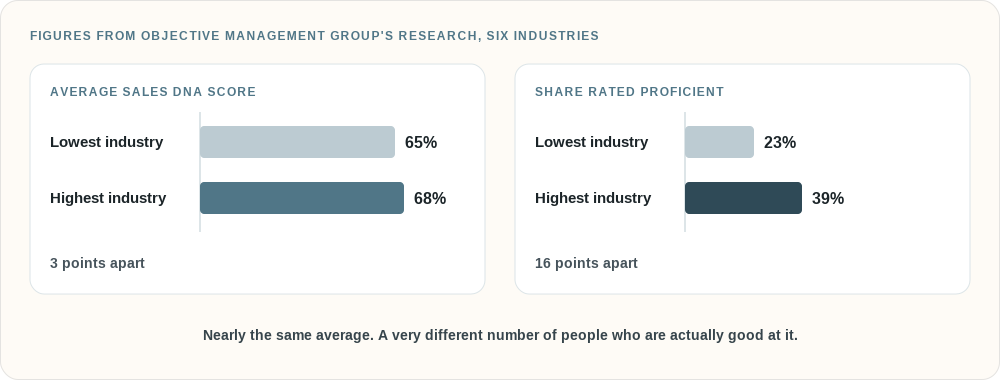
The firm's own reading is that this is not about who gets hired. In its view, what separates the stronger industries is which abilities get named, coached and reinforced, and how specifically. It also makes a point any manager can use: an average hides the thing you care about. Two teams can share an average while one has several people who are really good and the other has none.
What this suggests for a small firm
If the typical salesperson looks much the same in every industry, the raw material is not what sets one firm apart from another. The difference is made later, by what the firm expects, shows, practices and corrects. That is good news for a firm with three people selling and no budget to hire a star.
- "Salespeople are born." Some people do start with an advantage. But if selling were mostly a matter of who you are, the share of strong performers should be about level wherever the people are about level. In this data it is not.
- "Our industry is different." Your buyers, prices and sales cycle are your own. The people doing the selling, on this evidence, are not unusual. An industry where few are proficient is more likely one where few firms coach than one where selling is impossible.
- "We will fix it with the next hire." A new person joins the same habits, the same lack of practice and the same manager. Without a way to build skill, the next hire drifts to the level of the room.
Name the few skills that decide your sale
"Get better at selling" cannot be practiced. A named skill can. Look at how your deals are actually won and lost, and pick the three or four moments that decide the outcome. For most small firms they come from a short list: getting a first conversation, finding the real problem and what it costs, reaching the person who decides, talking about price without flinching, and agreeing a next step before the call ends.
For each one, write a sentence on what good looks like and choose something you can count. The count is what lets you see practice working before the revenue shows it.
| Skill | What good looks like | A behavior you can count |
|---|---|---|
| Finding the real problem | The buyer says, in their own words, what the problem costs them | First calls where a cost or consequence was written in the notes |
| Reaching the decision maker | The person who signs has been in a conversation before the proposal goes out | Proposals sent with a decision maker named on the deal |
| Talking about price | A price range is raised early and the buyer reacts to it | Deals where budget was discussed before the proposal |
| Agreeing the next step | Every call ends with a date in both calendars | Calls that ended with a booked next step |
Coach one skill at a time, every week
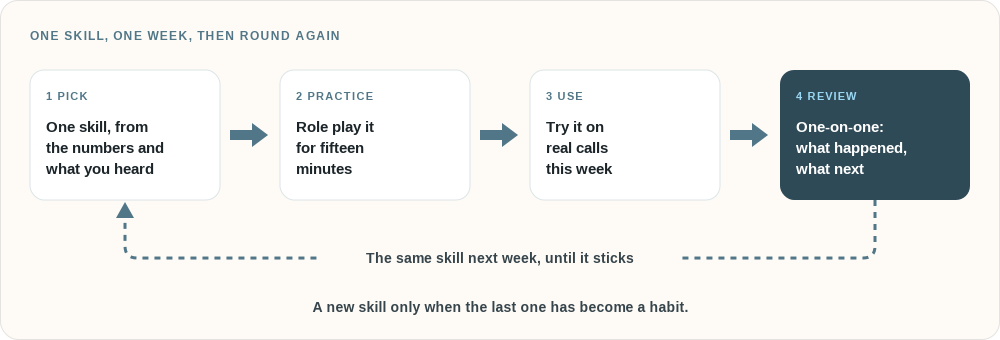
Skill is built the way it is in any craft: a small piece, repeated, with someone watching who says what to change. The routine below takes about half an hour a week per person. What makes it work is that it is narrow and that it happens every week, including the busy ones.
- 1
Pick one skill for this person
Not the team's weakness, this person's. Use two sources: where their deals stall or die, and what you hear when you sit in on a call. Agree the choice with them. People practice what they chose far harder than what they were assigned.
- 2
Practice it away from the buyer
Role play feels awkward and works anyway. Play the buyer yourself, use a real deal, and run the same two minutes three times, changing one thing each time. Fifteen minutes is enough. The point is to say the hard sentence out loud before it has to be said to a client.
- 3
Use it on real calls, then review one
Agree how many times they will try it this week. Then review one real conversation together. Join the call and stay quiet, or ask them to talk you through their notes straight afterward. Ask what they would do again and what they would change before you offer your own view.
- 4
Stay on it until it is a habit
The temptation is to move on after one good week. Stay with the same skill until they do it without thinking, which usually takes several weeks. Then pick the next one.
Measure the behavior, and give it months
Results arrive late. A deal won this month was shaped by conversations held weeks or months ago, so a better habit started today will not show in won revenue for a while. If you judge practice only by results, you will give up just before it pays. Count the behavior every week and read the results every quarter.
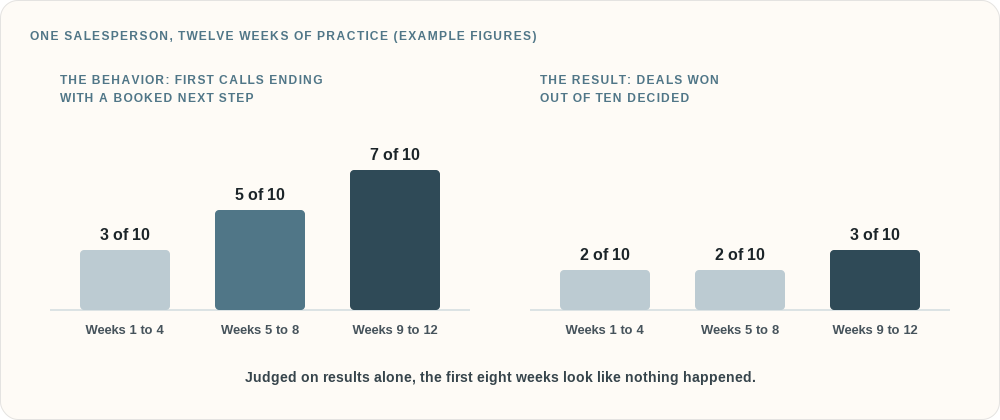
With numbers this small, one deal either way changes the picture, so treat a single quarter as a hint. What you are looking for over two or three quarters is a behavior that rose and stayed up, followed by a win rate or a sales cycle that moved the right way for the same person.
Where this stops being true
Three cautions. First, this is one firm's data from its own assessments, and that firm sells assessments and training. The page we read does not say how many salespeople are behind the figures or where the bar for proficient sits. Second, a small difference in an average can produce a larger difference in the share above a cutoff, so part of the gap may be arithmetic and not coaching. The research shows a pattern. It does not prove the cause.
Third, not everything can be coached at the same speed. A technique such as asking a better question can change in weeks. Deeper habits, such as how much someone needs to be liked or how they handle being told no, move slowly and sometimes not much. Hiring still matters for those. Built, not born, is the better working assumption for most of the job. It is not a promise that anyone can become anything.
Start this week
- 1Write down the three or four skills that decide your sale, with one sentence each on what good looks like.
- 2For each person who sells, pick one of those skills with them, and choose one behavior you will both count.
- 3Put a thirty minute one-on-one in the calendar every week: fifteen minutes of role play on that skill, fifteen on one real conversation.
- 4Count the behavior weekly, and set a date three months out to read win rate and sales cycle for that person.
- 5Hold your own verdict until that date.
A small firm cannot outspend a large one on hiring. It can out-practice one. Half an hour a week on one named skill, kept up for a few months, is within reach of any owner, and on this evidence it is more likely to raise the level of your selling than waiting for the right person to walk in.
This article draws on research by Objective Management Group. Read more in their research