
Most of what decides a sale happens in conversation, and almost none of it is written down. The salesperson comes off the call and reports that it went well. The notes say "good chat, sending proposal". Nobody else heard what the buyer asked, what worried them, or which other firm they mentioned.
Recording a few calls changes that. A whole category of software has grown up around the idea, usually sold under the name conversation intelligence. This article explains what those tools do, what a small team can learn from its own calls, how to get most of the benefit without buying anything, and how to decide whether a dedicated tool is worth the money.
What these tools do, in plain words
They do four things, one after the other.
- Record. The tool joins your video meetings or listens to your phone line and keeps the recording.
- Transcribe. It turns the recording into text, marked with who spoke and when.
- Analyze. It counts things, such as how much each person talked and how many questions were asked, and it flags moments where a topic came up: price, a competitor, a concern.
- Summarize and file. It writes a short summary with the agreed actions, and can copy it into your client records.
The counting and the summaries save time. They do not coach anyone. A person still has to listen, form a view and have the conversation with the salesperson. That part is where the value is, and it is the same with or without software.
Five things your own calls can teach you
- 1
Who did the talking
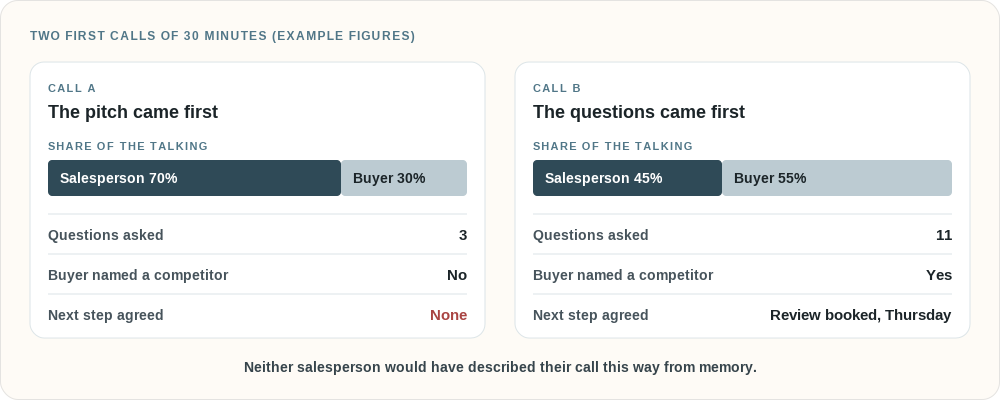
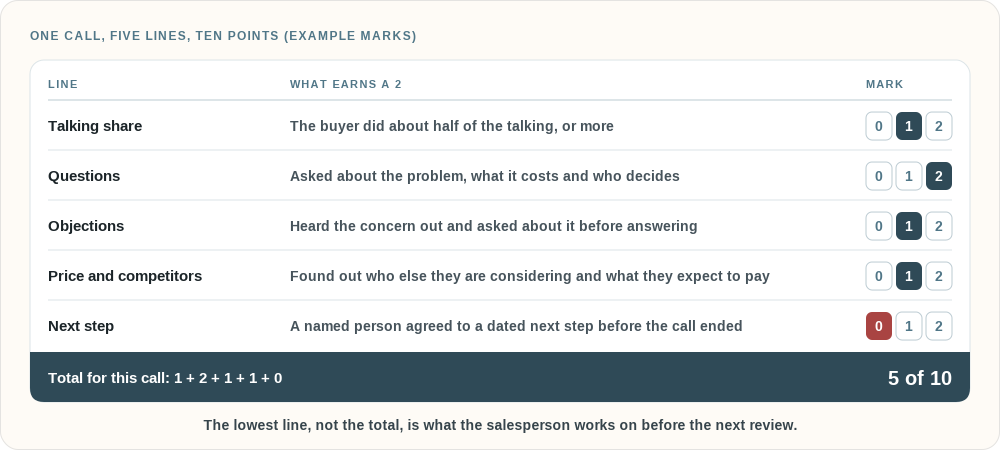
Most people believe they listen more than they do. On a first call, a salesperson who talks for most of the time has usually been presenting, not finding out. There is no perfect ratio, and a demonstration will always lean toward the seller. But a first conversation where the buyer hardly speaks is worth a second look.
- 2
Which questions were asked
Listen for the questions that move a sale: what the problem is, what it costs the buyer to leave it alone, who else has a say, and what happens if they do nothing. Also notice the questions that were never asked. Those are easy to miss from memory and obvious on a recording.
- 3
How a concern was handled
When the buyer says it is expensive, or that the timing is wrong, what happens next? A quick defense, a discount offered too early, or a question that finds out what is behind the concern. The same two or three objections come up again and again, so one good answer is worth sharing with everyone.
- 4
Whether a next step was agreed
The last two minutes of the call tell you a lot. "I will send something over" is not a next step. A date, a named person and a reason to talk again is. Deals that end a call without one tend to drift.
- 5
What the buyer said about price and competitors
Buyers say things on calls that never reach the notes: who else they are speaking to, what they paid last time, which words they use for their own problem. Those words belong in your proposals and on your website, and the owner of the firm rarely gets to hear them first hand.
Get most of the benefit without buying anything
A team of three or four people does not hold enough calls for clever analysis to matter. What matters is that someone listens. You can start with what you have.
- 1
Ask, then record with the meeting tool you already use
Most video meeting tools can record, and many now produce a transcript too. Ask at the start of the call, say why, and accept a no without fuss. Something like: "Do you mind if I record this? It saves me taking notes and we use it for training."
- 2
Pick one call a week
One is enough. Let the salesperson choose it, and rotate so that everyone has a turn, including the owner. Ordinary calls teach more than the best or the worst one.
- 3
Listen together with a scorecard
Thirty minutes, the salesperson and one other person. Each marks the same five lines separately, then they compare. Where the marks differ is where the useful conversation is.
- 4
Agree one thing to try
One, not five. Write it down, and start the next review by asking how it went.
When a dedicated tool is worth it
A tool earns its place when the volume of calls is more than anyone can listen to, when the team is spread out, when new people need to hear many good calls quickly, or when typing up notes after every call is eating real selling time. If none of those is true yet, the free routine above will tell you more than a subscription would.
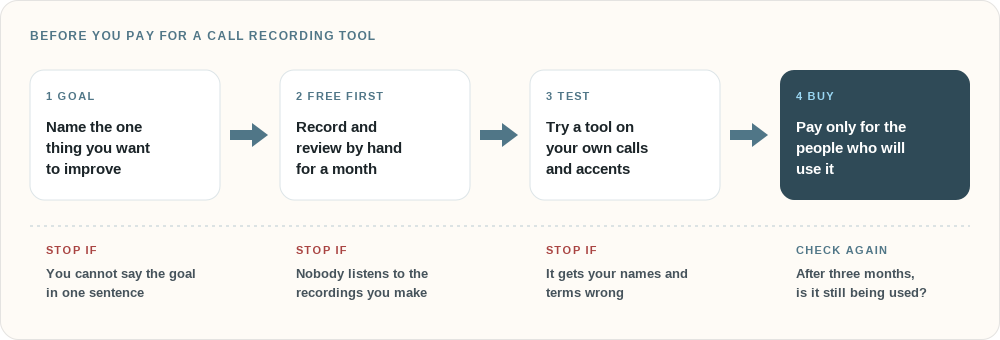
If you do go looking, take these questions to every trial.
| Check | Ask | Warning sign |
|---|---|---|
| Goal | What one thing should be better in three months? | The answer is a list of features |
| Fit | Does it work with the meeting tool, phone and client records we already use? | You would have to change how you hold calls |
| Accuracy | How does the transcript read on our own calls, with our accents, names and terms? | You only saw the seller's sample call |
| Records | How does a summary reach the client record, and who checks it first? | Copy and paste, or summaries filed unread |
| Use | Will the team open it every week without being chased? | Only the manager logged in during the trial |
| Cost | What is the price per person per month, for how long, and who really needs a seat? | A long contract before you have tried it |
| Security | Where are recordings stored, who can hear them, and how long are they kept? | No clear answer, or no way to delete a call |
Consent and privacy come first
A recording of a client talking about their business is sensitive, and the rules about making one are not the same everywhere. In some places one person on the call may record it. In others everyone on the call has to agree. Calls that cross a state or national border can fall under more than one set of rules, and some industries add their own. This is not legal advice. Check the rules that apply where you and your buyers are, and ask a lawyer if you are unsure.
- Tell everyone on the call that it is being recorded, every time, before you start. A notice on the screen is not a substitute for saying it.
- If anyone says no, do not record. Take notes instead.
- Tell your own team as well. They are being recorded too.
- Decide who may listen, where recordings are kept and when they are deleted, and write it down.
- Stop the recording when the conversation turns to something the buyer would not want kept.
Keep it coaching, not surveillance
The same recording can help someone improve or make them feel watched. Which one it is depends on how you use it. People who feel watched start performing for the recording, or find reasons not to record at all.
- Say what the reviews are for before the first one, and what they will never be used for.
- Let the salesperson choose the call and speak first. Most people are harder on themselves than you would be.
- Go first yourself. If the owner sells, the owner's call is reviewed too.
- Start with what worked, and be specific about it.
- Share good moments with the whole team. Keep the critique between the two of you.
- Never play a call to embarrass someone, and never use a single call to decide pay.
Start this week
- 1Check the recording rules where you and your buyers are, and agree the sentence everyone will use to ask permission.
- 2Tell the team why you are doing this, and that your own call will be the first one reviewed.
- 3Record two or three video calls with the meeting tool you already have.
- 4Book thirty minutes, listen to one call with the five-line scorecard, and agree one thing to try.
- 5Write what the buyer said about price and competitors on their record, and put the next review in the calendar.
After a month of this you will know two things: what your team actually says to buyers, and whether you have a habit worth paying a tool to speed up.