
Most owners hire a salesperson the way they hire anyone else: read the resumes, interview the best three, pick the one who impressed most. For a bookkeeper or a project manager that works reasonably well. For a salesperson it often produces someone who interviewed brilliantly and then spent six months not booking meetings.
In a firm with one or two salespeople, that mistake is expensive. You lose the salary, the leads they worked badly and half a year of growth. This article explains why sales is a special case and gives you a process you can run without a human resources department.
Why sales is harder to hire for
- 1
The interview is the candidate's home ground
A salesperson's job is to build rapport quickly, read the person across the table and present a confident case. An interview tests exactly that, so even a weak salesperson can do it well for an hour. You end up measuring how they sell themselves, which is not the same as how they will sell your service to a stranger who did not ask to be called.
- 2
Past results belong partly to the old employer
A strong number on a resume came from a person plus a brand, a marketing budget, a flow of leads, a territory and a price list. You are hiring only the person. Someone who closed well when leads arrived warm may never have had to find a deal from nothing.
- 3
The things that matter most do not show on paper
A resume cannot tell you whether someone will pick up the phone on a slow Tuesday, or how they react to hearing no five times in a row. Willingness to prospect and the ability to take rejection without slowing down decide most sales careers, and neither has a line on a resume.
What the research says an interview misses
Objective Management Group, a firm that assesses salespeople and sales candidates, says that across more than 35 years of evaluations its research has consistently pointed to four characteristics behind sales success: the will to sell, what it calls Sales DNA (the beliefs and mindset that support or undermine selling), tactical sales skills, and fit with the specific role. It reports that when one of the four is missing the others rarely make up for it, and that most hiring processes examine only one or two of them, usually skills and role fit.
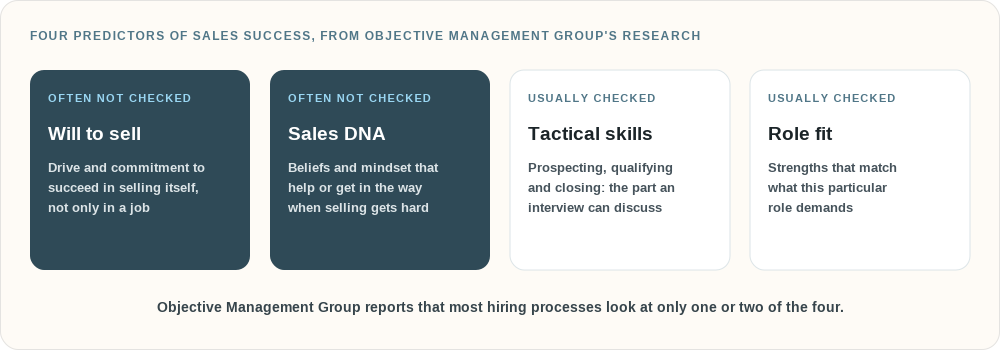
That matches what owners see. The two that go unexamined are the two an interview is worst at showing. A candidate can describe a qualifying method perfectly and still avoid the awkward money conversation when it is real. So the process has to find other ways to look.
A hiring process built for sales
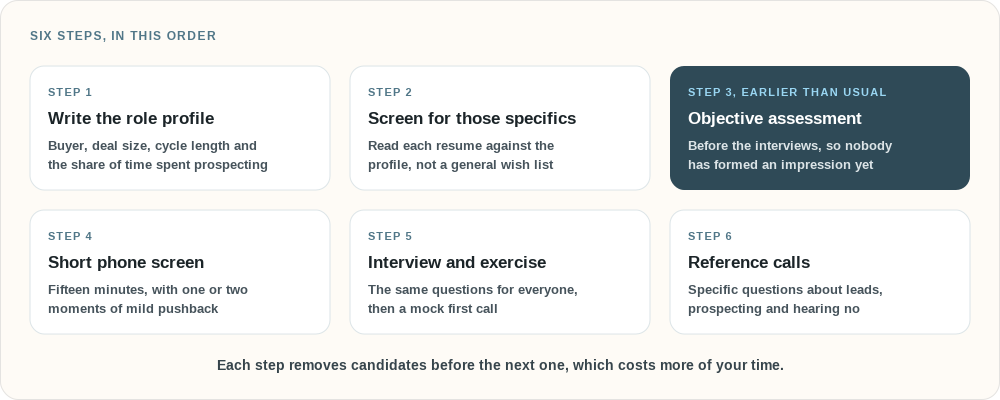
None of these steps is complicated. What matters is the order, and doing every one of them for every candidate.
- 1
Write down what this role must do
Before the advert, answer four questions on one page. Who will this person sell to: owners, finance heads, technical buyers? What is a typical deal worth? How long does a deal take from first conversation to signature? How much of the week is prospecting, and how much is working leads you hand over? A person who thrived on quick small sales to warm leads is a different hire from one who can open cold doors and carry a four-month deal.
- 2
Screen for those specifics
Put the specifics in the advert, plainly, including the prospecting share. Some people will not apply, which is the point. Then read each resume against the page you wrote, not against a general idea of a good salesperson.
- 3
Use an objective assessment early
If you use a sales assessment, use it before the interviews. Used at the end, it arrives after you already like someone, and you will explain away whatever it says. Used early, it tells you who to spend time on and what to probe. Choose one built for sales roles, not a general personality test.
- 4
Run a short phone screen with a little pressure
Fifteen minutes is enough. Be polite but not warm, and push back once or twice: "I am not sure your background fits. Why should we keep talking?" You are not being unkind. You are watching what a prospect would see: do they ask a question, hold their ground, or fold?
- 5
Interview with the same questions for everyone
Write eight to ten questions from the role page and ask all of them of every candidate, scoring each answer on the day. Ask for specifics: where a recent deal came from, what they did when it stalled, how many first conversations they started in a normal week. Then add a practical exercise, such as a ten-minute mock first call with you as the buyer, or a written outreach message to a company you name.
- 6
Make reference calls with specific questions
"Was she good?" gets you a polite yes. Ask instead: where did her leads come from, how much did she find herself, how did she handle a bad quarter, would you hire her again for a role that is mostly prospecting? Listen for hesitation as much as for words.
Four mistakes that small firms make
| Mistake | Why it is tempting | What to do instead |
|---|---|---|
| Hiring for industry experience alone | They already know the vocabulary and some of the buyers | Treat it as a bonus. Your industry can be taught in weeks. Willingness to prospect cannot. |
| Hiring the most likable candidate | You enjoyed the conversation and can picture working together | Score every answer against the same questions, and let the exercise count as much as the chat |
| Trusting a big-company track record | The numbers are large and the employer is well known | Ask how much of it came from leads, brand and territory, and what they built from nothing |
| Skipping the first 90 day plan | The hire is experienced and should know what to do | Write the plan before the offer, and share it with the candidate |
There is one more reason to take care in a small team. Objective Management Group reports that in 30% of sales teams, a single seller accounts for 50% or more of total team revenue. In a small firm that single seller is often the owner. A second salesperson is meant to reduce that dependence, and a poor hire leaves it exactly where it was.
What the first 90 days should contain
A good hire with no plan can still fail. Most new salespeople cannot close much in their first three months, especially when your deals take a while, so judging them on revenue tells you nothing until it is too late. Judge them on what they can control: learning, conversations started and deals added to the pipeline.
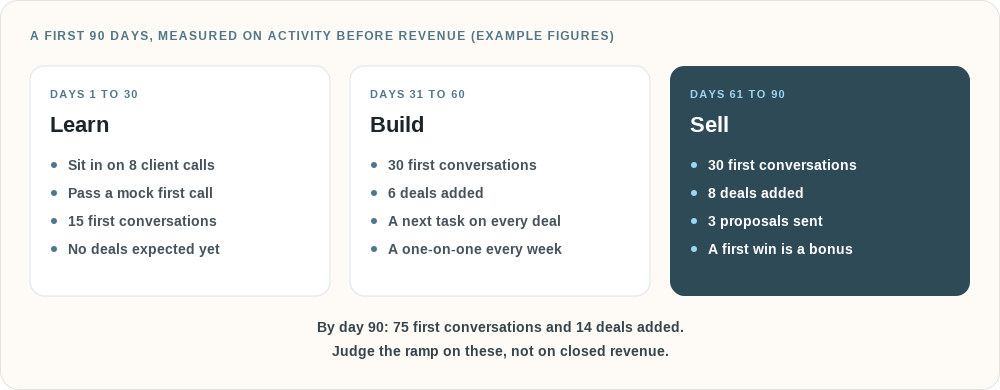
- Days 1 to 30, learn. They sit in on your client calls, learn who you sell to and why clients buy, and practice a first call with you until it is good enough to use. They start a modest number of real conversations so the habit forms in the first weeks.
- Days 31 to 60, build. The conversation count rises to its full weekly level and deals start to appear in the pipeline. Every deal has a next task with a date.
- Days 61 to 90, sell. Activity holds steady, more deals are added and the first proposals go out. A first win is welcome, but it is not the test unless your sales cycle is short.
Meet for a one-on-one every week through all three periods. Look at the numbers together, then listen to how a real conversation went. If activity is at plan and the pipeline is still empty by day 60, the problem is in the conversations, and you have time to coach it. If activity is far below plan, you have learned something different, and you have learned it early.
Start this week
- 1Write the one-page role profile: who they sell to, typical deal size, cycle length and the share of the week spent prospecting.
- 2Rewrite the advert from that page, and state the prospecting share in plain words.
- 3Write eight to ten interview questions and one practical exercise, and commit to using the same set for every candidate.
- 4Decide which assessment you will use, if any, and place it before the interviews.
- 5Draft the first 90 day plan now, with activity and pipeline numbers for each 30 days, so you can show it to the person you choose.
You will never remove the risk from a sales hire. What a process does is move your judgment from how the candidate made you feel to what they showed you they can do, and give the person you choose a fair, measured start.
This article draws on research by Objective Management Group. Read more in their research