
In a small team, everyone knows who brought in the most revenue last quarter. It is the easiest number to find and the one people remember. It is also a weak way to judge a person, because a large part of it was decided by things the person did not control.
Judging someone fairly does not take a scoring system. It takes one page with a few numbers in three layers, the right things to compare them with, and some evidence that is not a number at all.
Why revenue alone misjudges people
Revenue won is the result the firm is paid for, so it belongs on the page. The trouble starts when it is the only thing on the page. Five things bend it that have nothing to do with skill or effort.
- The patch. One person covers the city where you are well known, another a region where nobody has heard of you.
- Inherited accounts. A renewal from a client someone else won years ago counts the same as a new client won from a cold start.
- Deal size. One large deal can outweigh a quarter of steady smaller wins, and large deals are rarely handed out evenly.
- Timing. A deal signed on the first day of the next quarter was worked in this one.
- Luck. A buyer whose budget was frozen, or a competitor who stumbled, moves the number in either direction.
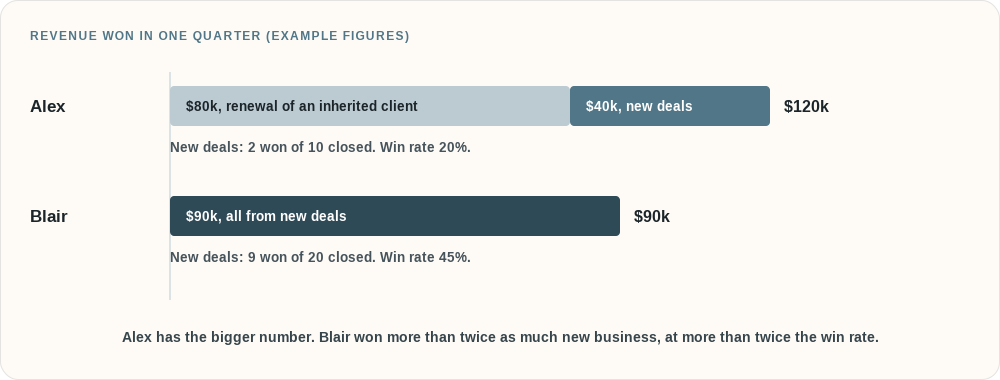
None of this means the person with the bigger number did badly. It means the number alone cannot tell you, and a reward or a hard conversation based on it may land on the wrong person.
Three layers on one page
A fair view has three layers. Results say what happened. Conversion and quality say how well the person turns chances into results. Effort and habits say what the person does every week, which is the layer they control most directly.
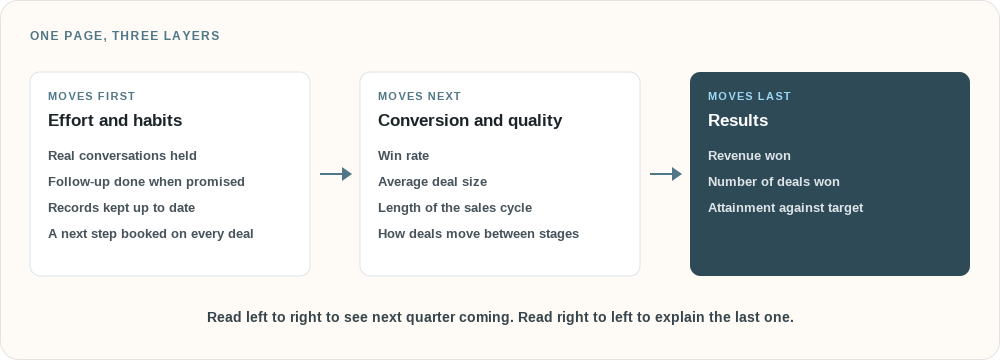
| Layer | What to look at | What it tells you |
|---|---|---|
| Results | Revenue won, number of deals won, attainment against the person's target | What the firm received. Honest, but late and partly outside the person's control |
| Conversion and quality | Win rate, average deal, cycle length, the share of deals that move from each stage to the next | How good the selling is, whatever the size of the patch |
| Effort and habits | Real conversations and meetings, follow-up done on time, records kept, a next step booked on every open deal | Whether the work that produces next quarter is being done now |
Keep it to two or three numbers per layer. A page with twenty measures lets everyone find one they look good on. Count only activity that means something: a conversation with a buyer, a meeting held, a proposal sent. Dials and emails sent measure how busy someone was.
Compare with the right things
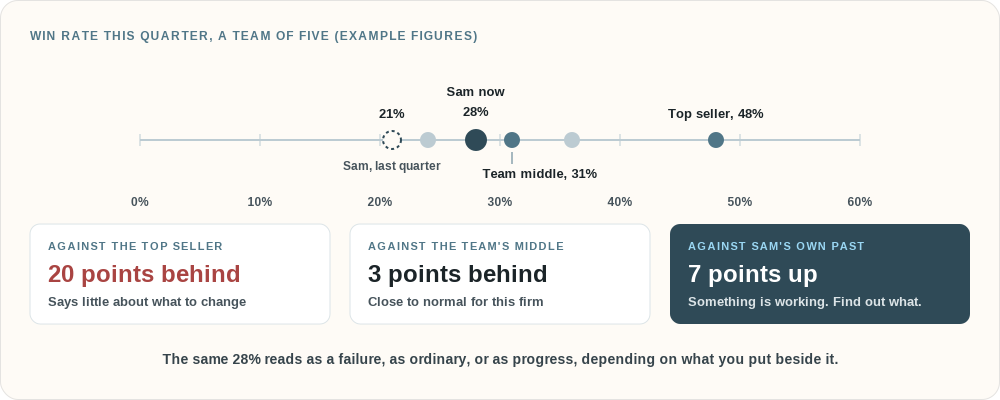
A number means little until you put something beside it. Most teams reach for the top seller, which is the least useful choice. The top seller often has the best accounts and the longest history, and being told you are not them teaches nobody anything.
- The person's own past. Same person, same patch, same accounts. If win rate or cycle length is moving, something they do has changed. This is the fairest comparison you have.
- The middle of the team. Line the team up on one measure and take the person in the middle. That is what normal looks like in your firm, with your prices and your buyers.
- The top seller, last and lightly. Useful for one question only: what do they do differently that others could copy?
What the numbers cannot show
Numbers tell you where to look. They do not tell you what is happening in the conversation. Before you draw a conclusion about a person, collect a little evidence you can see and hear.
- Sit in on two or three calls or meetings, and stay quiet. Notice who does most of the talking, what questions get asked, and whether a next step is agreed before the end.
- Read two recent proposals. Is the buyer's problem stated in the buyer's words, or is it the standard document with a new name on it?
- Ask buyers. A short call to a client who signed, and to one who did not, will tell you things the person selling cannot see.
Reading the common patterns
Read across the three layers and a few shapes come up again and again. Each one suggests where coaching will pay. Treat the middle column as a first guess to test in conversation, not as a diagnosis.
| What you see | What it often means | Coach on |
|---|---|---|
| High activity, few wins | Effort is going to the wrong buyers, or conversations are not uncovering a real need | Who to pursue, and the questions asked in the first meeting |
| Few deals, high win rate | Good selling, but only the safest opportunities are being worked | Finding new business, and taking on deals that are less certain |
| Large pipeline that never closes | Deals are kept open on hope, or stall at the same stage each time | Closing dead deals as lost, and the step where they stall |
| Long cycles, close dates that keep moving | Meetings end without a commitment from the buyer | Booking the next step before the conversation ends |
| Good results, thin records | The person carries their deals in their head | Why records matter to the rest of the firm, and one small weekly habit |
A new person needs a different page
Someone who started two months ago cannot have closed deals from a sales cycle that takes three. Judge a new person by the layers in the order they move. In the first weeks, look only at habits: are they holding conversations, following up and keeping records? After that, look at whether their deals are moving through the early stages at a normal rate. Hold results against them only after they have been in the role for at least one full sales cycle. Write these expectations down on the first day, so that the first review holds no surprises.
Talking about the numbers
The same page can feel like help or like a trial. The difference is in how the conversation is run.
- 1
Share the page beforehand
Nobody should see their numbers for the first time while you watch. Send the page a day ahead, or better, let the person bring it.
- 2
Ask before you tell
Open with "What do you make of this?" People usually spot their own weak point, and they will work harder on a problem they named themselves.
- 3
Go from the number to a deal
A low win rate is abstract. The three deals lost at the proposal stage are concrete. Pick one and walk through what happened.
- 4
Agree one change
One habit, one measure that should move because of it, and a date to look again. A list of five improvements will produce none.
- 5
Keep pay and coaching apart
If every review ends in a judgment about money, people will defend their numbers instead of examining them. Hold the coaching conversation often, and the formal one rarely.
Start this week
- 1Choose two measures for each of the three layers and put them on one page per person.
- 2Next to each measure, write the person's own figure for the previous period and the figure for the middle of the team.
- 3Note how many deals sit behind each percentage, and mark any rate built on fewer than about ten.
- 4Sit in on one call or meeting for each person before you discuss the page.
- 5Hold one conversation per person that ends with a single agreed change and a date to look again.
A fair measure does not make everyone look the same. It makes sure that what you praise, and what you ask someone to change, is something they actually did.