
A sales method is not a script. It is a set of habits for conversations: what to ask, what to listen for, and when to say something they did not expect. Used well, it keeps you from talking too much, qualifying too late, or letting a good prospect drift.
There is no single best method. The strongest sellers in professional firms borrow from several and pick the one that suits the person across the table. This guide helps you do the same.
Start with the kind of sale you actually make
Before choosing a framework, decide where your sales sit between two ends. Most of what firms sell lives much closer to the right-hand column.
| Transactional | Consultative | |
|---|---|---|
| Typical deal | Small, repeatable, priced from a list | Larger, shaped to the client, often a retainer or project |
| Who decides | One person, quickly | One or several people, over weeks or months |
| What wins it | Speed, price and convenience | Trust, a clear diagnosis and a credible plan |
| Your main job | Make buying easy | Understand the problem better than the buyer first did |
| A good first call | Short and to the point | Mostly questions, very little pitching |
If your sale is transactional, you need a clear offer, a fast follow-up and little else. If it is consultative, the frameworks below are worth your time.
Three frameworks for the conversation itself
Consultative selling is the stance. SPIN, BANT and Challenger are tools you use inside it, and each answers a different question.
- 1
SPIN answers: what is really going on?
It comes from research by Neil Rackham into how successful sellers handle large, complex deals. You move through four kinds of question and let the buyer reach the conclusion.
- 2
BANT answers: is this worth my time?
It began at IBM as a quick screen. Four short checks tell you whether to invest in a lead or let it go politely.
- 3
Challenger answers: how do I change their mind?
It comes from research published as The Challenger Sale. You bring an idea the buyer has not considered and guide the decision with confidence.
SPIN: ask before you tell
SPIN stands for Situation, Problem, Implication and Need-payoff. The order matters, because each question builds the weight of the next.
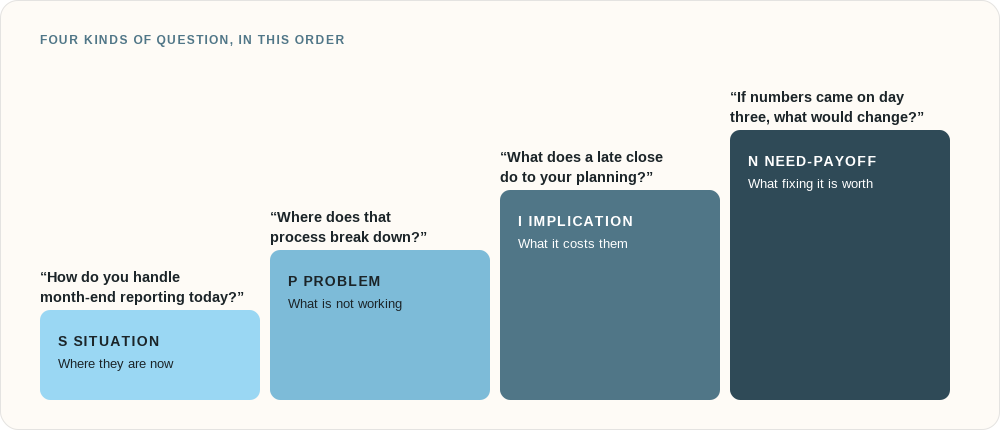
- Situation questions establish the facts. Research first, so you ask only what you could not find out yourself.
- Problem questions find where the current way of working strains or fails.
- Implication questions ask what that problem costs in time, money, risk or reputation. This is the step most people skip, and the one that creates urgency.
- Need-payoff questions ask the buyer to describe the value of fixing it, in their own words.
BANT: decide quickly whether to keep going
BANT is a screen, not a conversation. Use it to decide where your limited time goes, and keep the answers somewhere the whole firm can see them.
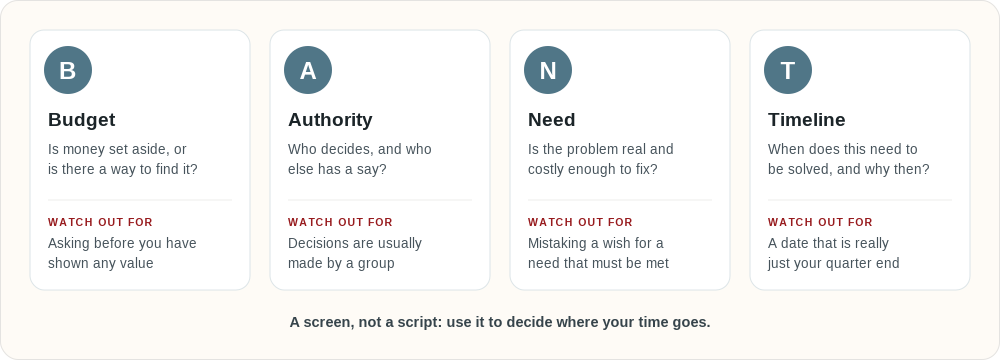
Two cautions apply. Asking about budget before you have shown any value feels like an interrogation, so let it come after a good conversation about the problem. And authority is rarely one person: in most firms a recommendation passes through several people, so map all of them, not just the one who signs.
Challenger: teach something they did not know
Challenger selling suits the moments when the buyer does not yet see the problem, or sees only the price. It rests on three moves.
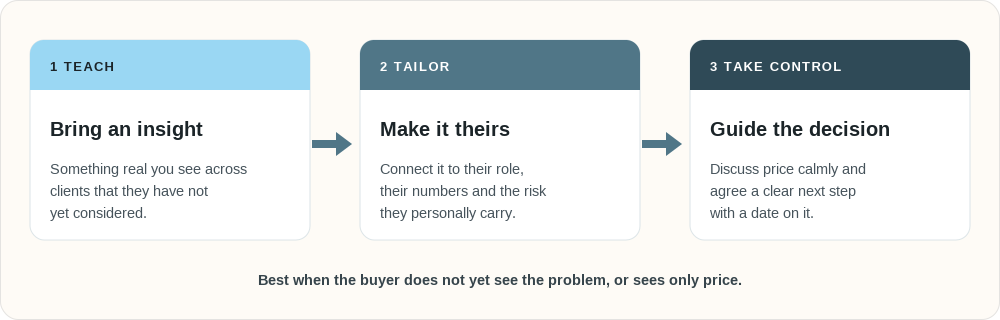
- Teach: bring a real insight, such as a pattern you see across clients, that reframes how they think about the problem.
- Tailor: connect that insight to this person's role, numbers and worries, so it is not a generic lecture.
- Take control: guide the decision, discuss price without flinching, and name the next step.
Blend them in a single conversation
The methods do not compete. They work best in sequence, with a different one carrying each part of a call.
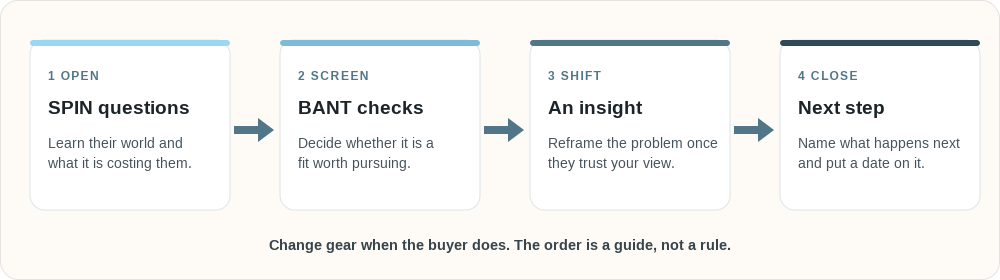
Notice that you can change gear mid-call. If a buyer is vague about their problem, stay with SPIN. If they are clear and in a hurry, qualify faster. If they only want to compare prices, offer an insight that makes the comparison harder.
Find your own style
A method you are comfortable with beats a better one you perform badly. Ask yourself:
- Do I prefer long, exploratory conversations or short, focused ones?
- Am I more natural asking questions or explaining what I see?
- What do the buyers in my pipeline usually need: a diagnosis, a push, or a reason to trust me?
- Which of my best wins started in a way I could repeat?
Try it on your next three calls
- 1Before each call, write the one Implication question you most want to ask.
- 2During the call, note the answers to Budget, Authority, Need and Timeline as they come up naturally, not as a checklist.
- 3End with one insight you could only share because of your experience, and one clear next step with a date.
- 4Afterwards, log what you learned as a note on the deal, so the next conversation begins where this one stopped.
The aim is not to master a method. It is to leave every conversation knowing more about the buyer, and with them knowing more about you.