
A sales target only works if the person carrying it thinks it can be reached. A number people do not believe changes nothing about how they spend Monday morning.
A target, a forecast and a wish
These three get mixed up.
| What it is | Where it comes from | |
|---|---|---|
| Forecast | What you expect to happen if nothing changes | Open deals, their close dates and your past win rates |
| Target | What you have agreed to make happen | The firm's needs, checked against what the team can produce |
| Wish | What would be nice | A round number, or last period with something added |
A target sits above the forecast, because its job is to change behavior. The two have to be connected by a list of things people will do differently. Without that list, a target is a wish with a deadline.
Build the number from both directions
Work the number out twice. First from the top: what does the firm need to sell in the period to cover its costs and fund what it has planned? That tells you what you need, not what is possible.
Then from the bottom, using only your own records:
- Open deals due to close in the period, each weighted by its chance of winning.
- New deals the team can still open and close inside the period, judged from past periods and from how long a sale usually takes.
- Capacity: how many selling weeks each person really has once leave, client work and onboarding are taken out.
- Past conversion: how many first meetings become proposals, and how many proposals become wins.
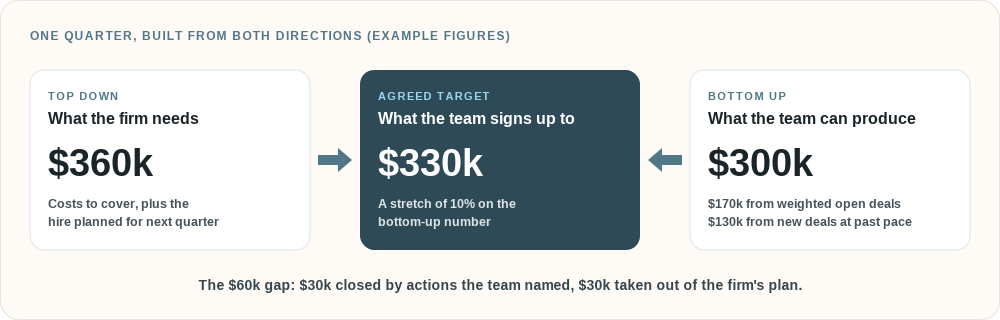
Do not close the gap by declaring the higher number the target. Close it in two parts. Ask the team what they could do differently and what that is worth: going back to past clients, raising a price, sending proposals faster. Whatever is left comes out of the firm's plan: a hire moves back or a cost is trimmed. In the example, the team found $30k and the plan gave up $30k.
Split the team number fairly
Fair does not mean equal. Dividing the team number by the head count gives the same target to the person with fifteen loyal clients and the person who started last month. One will coast and the other will give up. Split by situation instead:
- Experience. What has this person actually sold in recent periods? Start there, not from what you hope.
- Accounts. Someone who holds most of the existing clients begins every period with repeat business in hand. Someone building from nothing does not.
- Ramp. Give a new person a reduced target that steps up over their first few periods, and say in advance when it reaches the full amount.
- Time. A person who also delivers client work, or manages others, has fewer selling hours. Count them honestly.
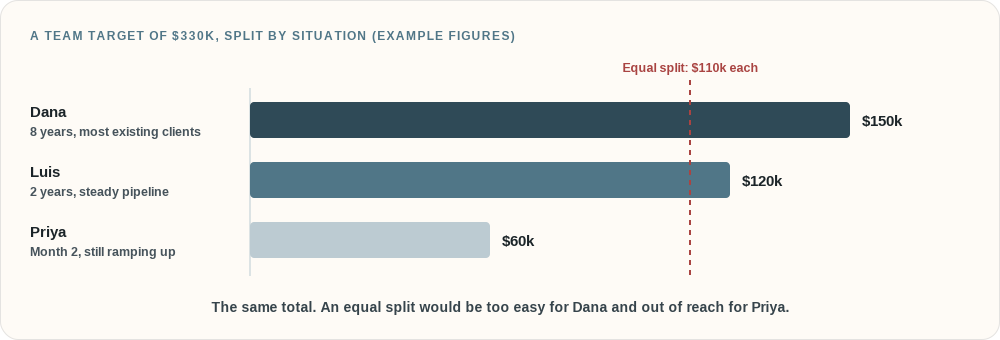
Show the whole split to everyone, with the reasons. People accept a higher number than a colleague's when they can see why.
Turn the revenue number into a week of work
A quarterly revenue figure is too far away to steer by. Translate each person's target into the activity that produces it, using their own conversion rates. The forecasting article explains working backwards from a target, so one small example will do here. Luis has a $120k target for a quarter with 12 selling weeks.
| Step | His own rate (example) | Needed in the quarter | Per week |
|---|---|---|---|
| Wins | Average deal of $20k | 6 | One every 2 weeks |
| Proposals | 1 in 3 is won | 18 | 1.5 |
| First meetings | 1 in 2 leads to a proposal | 36 | 3 |
Three first meetings a week is something Luis can plan and count. It is also a test of the target: had the sum come out at nine meetings a week, the target would be a wish. One caution about timing. If a sale takes six weeks, meetings held in the second half of the quarter feed the next quarter.
Result targets and activity targets: you need both
A result target says what must be won. An activity target says what must be done. Each fails alone. Results arrive late and in lumps, so a result target on its own gives no warning until it is too late to act. Activity is visible every week, but an activity target on its own rewards being busy: forty calls to the wrong people still count as forty calls.
So pair them: one result number, such as revenue won, and one or two activity numbers. Pick activities that move a deal, like first meetings held or proposals sent, over ones that are merely easy to count.
Choose a period that fits your sales cycle
If most deals close within a few weeks, a monthly result target works. If a sale takes two or three months, a monthly target mostly measures which deals happened to land before the last day. Use a quarter, and keep the activity targets weekly so there is still something to look at every Monday.
Stretch without fantasy
A target a little above the bottom-up number is healthy: it asks for a change the person can name. A target far above it asks for a miracle, and people respond by quietly setting their own, lower one. A fair test: a capable person working well should reach the target in most periods, not in all of them. If everyone hits every period, the targets are too low. If nobody does, they are wishes.
Review against an even pace
The simplest progress check is an even pace: halfway through the period, half the target. Deals land in lumps, so read the result and the activity together. In the example below, Luis is $20k behind at the halfway mark, and the activity number says why: 11 first meetings held against the 18 an even pace would give.
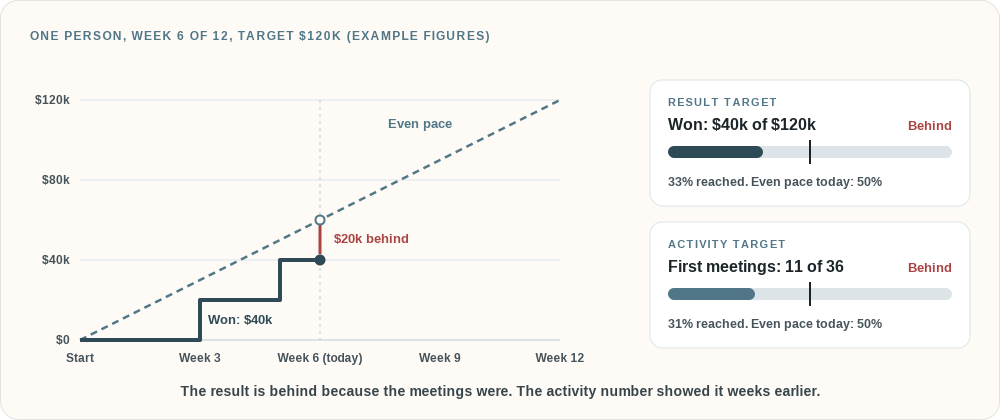
When someone is behind, look for the cause before adding pressure. Work down in this order.
- 1
Is the activity there?
If not, find out what took the time. Client work and a thin list of people to call are different problems.
- 2
Is the activity converting?
If meetings are happening and proposals are not, sit in on two meetings. If proposals go out and nothing comes back, read three of them together.
- 3
Is it only timing?
If the activity and the conversion are fine and one large deal has slipped, check that the new date is real and leave the person alone.
- 4
Agree one change for the next two weeks
One, written down, with a date to look again.
When to change a target mid-period, and when not to
Change a target when the ground under it has moved for reasons outside the person's control: accounts were reassigned, a service was withdrawn or repriced, a colleague left and their work was shared out, or the person was away for a long stretch. Do it once, write down the reason, and apply the same rule to everyone.
Do not change it because someone is behind, because one deal slipped, or because someone reached it early. Lowering a target to spare a hard conversation teaches the team that targets are negotiable. Raising it on a person who got there early teaches them to hold deals back until the next period.
Four common mistakes
- 1
Last period plus ten percent
It looks like a method and is not one. It ignores what is in the pipeline, who is on the team and what the firm needs.
- 2
One number for everyone
Easy to announce, too low for some and out of reach for others.
- 3
Targets nobody was consulted on
A number handed down is the owner's target. A number the person helped build from their own deals and rates is theirs. Consulting does not mean a veto. It means they saw the arithmetic.
- 4
Moving the target as a punishment or a reward
A target is a measuring stick. Once it bends according to how you feel about someone, nobody trusts what it measures.
Start this week
- 1Write down two numbers for the next period: what the firm needs, and what the team's own records say it can produce.
- 2Sit down with the team, show both, and list what would close the gap and what each action is worth.
- 3Split the agreed number by experience, accounts, ramp and selling time, and show everyone the split.
- 4With each person, turn their share into one result target and one or two weekly activity targets, using their own rates.
- 5Put a short weekly review in the calendar, and compare each target with an even pace.
A target people believe is not a softer target. It is one where everyone can see where the number came from and what their week has to look like.