
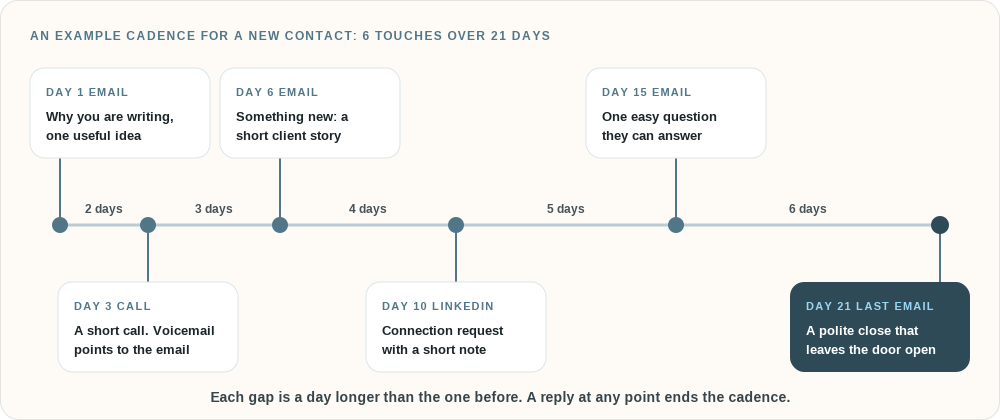
A sales cadence is a short written plan for staying in touch with one person: which touches, in which order, on which days. An email on day 1, a call on day 3, another email on day 6, and so on until they answer or you reach the end. It is decided once, in a calm hour, and then used for everyone in the same situation.
Most small firms follow up from memory instead. That works for the three people you are thinking about this week. It fails for the other thirty, who hear from you once and then never again, or twice in two days because you forgot the first one.
Why a written plan beats memory
- Nobody is dropped. The plan says what happens next, so a busy week delays a touch by a day instead of ending the conversation.
- The decision is already made. You do not have to ask yourself each morning whether it is too soon to write again. You decided that when you were not anxious about the answer.
- Everyone gets the same care. The prospect you like and the one you find hard work both get all the touches, which is often where the surprise wins come from.
- It can be handed over. A new colleague can run your cadence on their first day, and a deal does not go cold because its owner is on leave.
- It can be improved. Follow-up done from memory is different every time, so there is nothing to compare. A cadence is the same each time, so you can count what worked.
How to design one
A cadence has six design choices. None of them needs software to make, only a page and half an hour.
- 1
Decide how many touches
Enough that a busy person has several fair chances to answer, few enough that you would not mind receiving them yourself. For someone who has never heard of you, five to seven is a sensible range. For someone who asked you a question, four or five. For an existing client, three.
- 2
Let the gaps widen
Start close together and spread out. Two days, then three, then four or five. Early touches catch the person while your name is still familiar. Later ones give them room, and show that you are patient and not chasing.
- 3
Mix the channels, in a sensible order
Some people answer email, some pick up the phone, some only notice a LinkedIn message. Two or three channels is plenty. Put the least intrusive one first, and let each later touch point back to the first, so a voicemail says "I sent you a note on Tuesday" and does not start from nothing.
- 4
Give every touch something new
Write down, next to each step, what it adds: a short client story, a question, a checklist, a relevant change in their field. If the only thing a step adds is "just checking in", cut the step. This is the rule that separates a cadence from nagging.
- 5
Write a clear, polite last message
Say plainly that this is your last note for now, assume the timing is wrong and not that they are rude, and leave one easy way back. A last message with no pressure in it often earns more replies than the ones before it, because it is the first that is easy to answer with a single line.
- 6
Decide when it stops
A cadence ends on any reply, yes or no, on a request to stop, and at the last step. After the last step the person goes on a list to revisit in a few months, not back to step 1 next week.
Different situations need different cadences
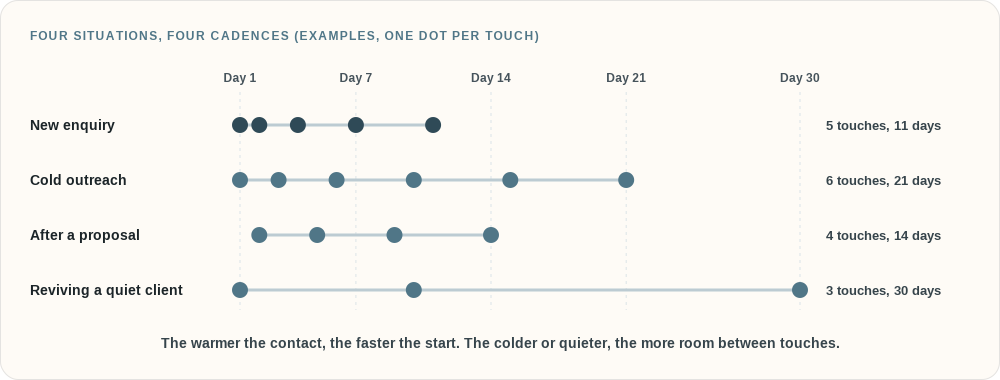
One cadence for everybody is better than none, but the right pace depends on how well the person knows you and who is waiting for whom. Four cover most of what a small firm does.
| Situation | Pace | What the touches carry |
|---|---|---|
| New enquiry | Fast. Answer the same day, try again the next, then ease off | An answer to what they asked, a call, one or two times to talk, a short example of similar work |
| Cold outreach | Slow and patient, with the widest mix of channels | A reason for writing, then a new idea, story or question each time, and a clear last note |
| After a proposal | Short. A few touches over two weeks | A check that it arrived and makes sense, an answer to the likely objection, an offer to walk the decision maker through it, a question about timing |
| Reviving a quiet client | Gentle. Three touches over a month | Something useful with no ask, then a question about what has changed, then an invitation to talk |
The proposal cadence is the one most firms lack, and the one that matters most. A proposal that gets a single "any thoughts?" a fortnight later is a week of work left to chance. Write those four touches before the proposal goes out, while you still remember what the buyer was worried about.
What to keep personal, and what to automate
The timing of a cadence is the same for everyone, so let a tool carry it. The words are not. A useful split:
- Automate the schedule and the reminders. Nobody should have to remember that day 10 is today.
- Automate the skeleton of each message: greeting, the client story, the sign-off.
- Keep the first message personal. The one specific sentence about their firm is what earns the attention the rest depends on.
- Keep calls, and anything sent after a proposal, written or said by a person. By then you know too much about them for a general message to sound right.
- Keep every reply personal. The moment someone answers, the cadence is over and a conversation has started.
A simple check: if a message could be sent to fifty people without changing a word, it may go out automatically, as long as it is still useful to each of them. If it could only have been written to one person, write it yourself.
Measure it, then change one thing
The number that matters is replies, counted per step. An overall reply rate tells you whether the cadence works. The count per step tells you why, and what to change.
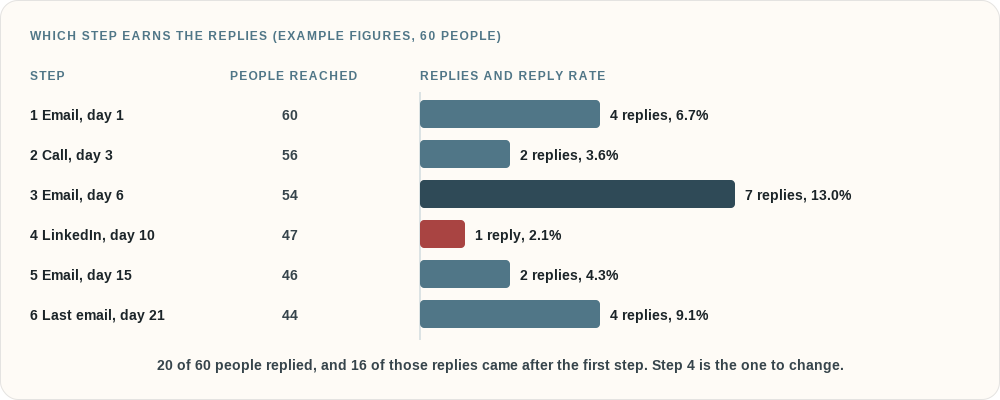
Read a table like this one in three passes.
- Which step earns the most replies? In the example it is the client story on day 6. Ask whether that content should come sooner, or whether it works because of the two touches before it.
- Which step earns almost nothing? Step 4 reached 47 people for one reply. Rewrite it, swap the channel, or remove it and see whether the total drops.
- What do the late steps add? Here the last two steps brought 6 of the 20 replies. Stopping at four touches would have lost nearly a third of them.
Then change one thing: a subject line, the order of two steps, one gap, the last message. Run the new version for the next batch of people and compare. Change two things at once and you will not know which one made the difference. With small numbers, be slow to conclude. One reply more or less out of forty is not a finding. Wait until the gap is too wide to be luck, or until you have seen it in two batches running.
Count the kind of reply as well as the number. A cadence that earns ten "please stop" answers is not beating one that earns four meetings.
Start this week
- 1Pick the one situation where follow-up slips most often. For many firms it is the two weeks after a proposal.
- 2Write the cadence on one page: each touch, its day, its channel, and the one new thing it adds.
- 3Write the last message first. If you cannot write a polite close, the cadence is too long or too pushy.
- 4Run it for the next ten people in that situation without changing it, and mark every reply against the step that earned it.
- 5Count replies per step, change one thing, and run it again.
A cadence is not a way to send more messages. It is a way to decide, once and with a clear head, how much persistence is fair, and then to give every person that much and no more.