
Ask the owner of a small firm how long a new salesperson takes to get up to speed and you will hear a number: three months, six months, a year. Ask what "up to speed" means and the answer gets vague. They will be selling. They will not need me.
That vagueness is the problem. If nobody has said what ramped looks like, nobody can say in week six whether the new person is ahead or behind. You find out in month five, when the revenue is not there, and by then the cheap moment to fix it has gone.
Say what ramped means before the person starts
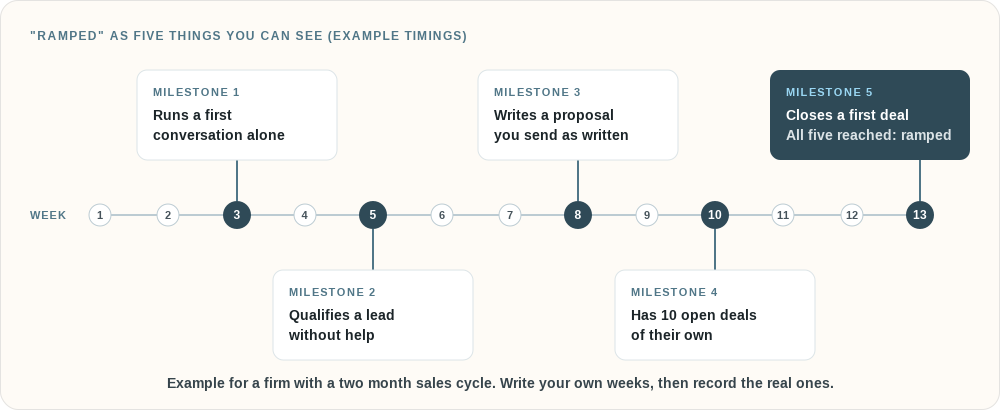
Ramped means the person can do the job without close support from you. That is too broad to measure, so break it into things you can watch happen. For most small firms that sell a service, five milestones cover it.
- 1Runs a first conversation alone. They open, ask the questions that matter and agree a next step, with nobody else from the firm on the call.
- 2Qualifies without help. They can tell a real opportunity from a polite chat, and their reasons match the ones you would give.
- 3Writes a proposal you would send as written. The scope, the price and the wording need no rescue from you.
- 4Holds a pipeline of a set size. Pick a count or value of open deals that an established person normally carries. They found or developed these deals themselves.
- 5Closes a first deal. One they worked from start to signature, not one you handed over at the last step.
Next to each milestone write the week you expect it, then record the week it really happened. The time to each milestone is your ramp, in five parts instead of one. A person who reaches the first three on time and stalls on the fourth has a prospecting problem, and you know it in week ten instead of month six.
Onboarding is your job, not a folder
Many small firms hand a new salesperson a login, a price list and a folder of documents, then go back to their own deals. Documents do not ramp anyone. The person they report to does.
This is hard for a reason. Whoever sells best in the firm, often the owner, has done it for so long that it looks effortless. That judgment took years to build and most of it has never been said out loud. A new hire cannot copy what they cannot see, so your job is to make it visible.
- 1
Be there in week one
Clear your calendar on the first morning. Greet them yourself, walk them through the plan for the week, and name one colleague they can ask the small questions. A new person left alone with a laptop on day one learns that they are on their own.
- 2
Set expectations early
In the first few days, show them the five milestones and the weeks beside them. Tell them what you will look at each week and what you will not judge yet.
- 3
Agree how the two of you will work
Before the first week ends, sit down for half an hour. Ask how they like to get feedback and what a good manager did for them in the past. Fix a weekly one-on-one, and agree that both of you will speak frankly in it.
- 4
Come back to it after a month
Between week four and week six, go over the same ground. Are they getting what you promised? Are you getting what you asked for? Ask what you should do differently as their manager, and act on one thing they say.
Give direction first, then hand over task by task
A new salesperson needs clear direction at the start: this is how we open a call, this is what we ask, this is what a good note looks like. That is not micromanaging. The skill is in letting go at the right speed, and the right speed is different for each task.
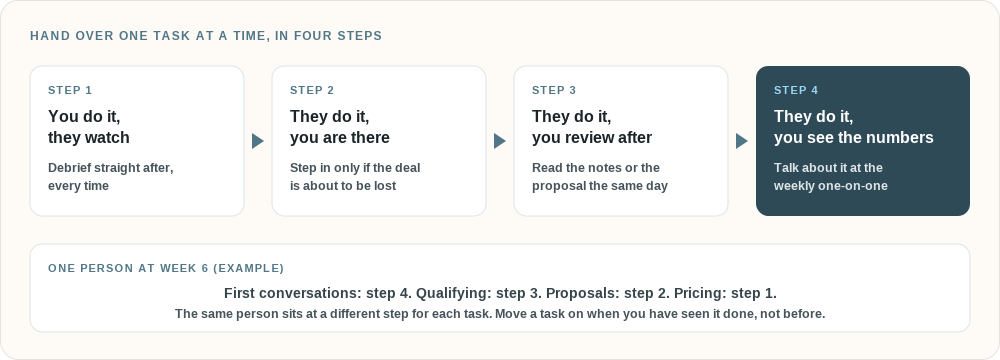
For each task, ask two questions: can they do this one, and are they comfortable doing it? Someone can be fully able on first conversations and still need you beside them when price comes up. Move a task on when you have seen it done well, and move it back without drama if it slips. A person who can do the task but hesitates needs encouragement, not more instructions.
A shape for the first month, and a looser one after
The first month deserves a plan by the week. The one below is an example to adapt.
| Week | What the new person does | What you do |
|---|---|---|
| 1 | Learns who you sell to and why clients buy. Sits in on your calls. | Welcome them in person. Share the milestones. Debrief every call they watched. Check in on Friday. |
| 2 | Practices a first conversation with you until it is usable. Starts outreach to a short list. | Play the buyer. Give two things to keep and one to change after each practice run. |
| 3 | Runs real first conversations with you listening. | Stay quiet on the call. Debrief straight after. Tick milestone 1 when you would change nothing. |
| 4 | Runs first conversations alone. Starts qualifying with you present. | Review their notes the same day. Hold the one month conversation. |
Months two and three need less structure. Month two is about qualifying and building the pipeline: outreach reaches its full weekly level, deals start to appear, and you join the conversations where money or scope is discussed. Month three is about proposals and closing: they write, you review, and you step back from one more task every week or two. Keep the weekly one-on-one all the way through.
What to watch before revenue shows up
Closed revenue is the last number to move. If your deals take two months, a person who starts today cannot show you a result for at least that long. Four other measures move earlier, and they move in order.
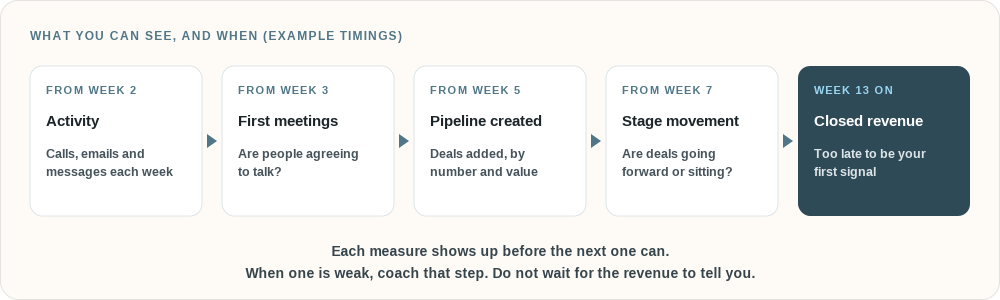
- Activity is steady but few first meetings follow. The message or the list is wrong. Listen to the calls and read the emails.
- First meetings happen but few deals are added. They may be qualifying too hard, too softly, or talking to the wrong people.
- Deals are added but do not move. Look at whether each one has an agreed next step with the buyer.
- Activity itself is low. That is a different conversation, better had in week three than in month four.
Compare the new person with their own previous weeks, not with someone who has sold for you for five years.
Four mistakes that lengthen the ramp
- 1
Throwing leads at them on day one
It feels generous, and it spends your leads on someone who cannot yet run a first conversation. Start with a short list and widen it when milestone 1 is ticked.
- 2
Shadowing with no debrief
Watching you sell teaches little when the reasons stay in your head. After every call, spend five minutes on why: why you asked that, why you did not send a proposal yet.
- 3
Judging on closed revenue too early
Revenue in the first weeks mostly reflects luck and handed-over deals. Use the milestones and the early measures until at least one full sales cycle has passed.
- 4
Leaving them alone because they seem confident
Confidence and ability are different things, and salespeople are good at showing the first. Ask to see the task done before you step back from it.
Make the next ramp shorter
The first time you ramp someone you are guessing at the weeks. The second time you should not be. When the person reaches the last milestone, sit down together for an hour and write down what happened: the real week for each milestone, what helped most, what was missing. Do it soon. In a year they will have forgotten what it was like not to know.
Then fix the plan: real weeks in place of guesses, the missing explanations added, and a list of the tasks a new person kept forgetting. If your best seller ever leaves, this record is also how some of their judgment stays behind.
Start this week
- 1Write your own five milestones, with one sentence each on how you will know it has been reached.
- 2Put an expected week next to each, using your normal sales cycle as the guide for the last two.
- 3Block your calendar for the first morning, and book the weekly one-on-one, the end of week one check-in and the one month conversation before the person starts.
- 4If someone joined recently, mark where they are today on each milestone and at which handover step for each task.
A ramp has to be visible before it can be fast. When both of you can see the next milestone and how far away it is, the new person knows what to work on, you know where to help, and neither of you is waiting for the revenue to deliver the news.
More on this from The Center for Leadership Studies: The time to autonomy
Also from The Center for Leadership Studies: Three ways managers can drive performance through onboarding