
Two people on your team ask you the same thing on the same morning: "The buyer says we are too expensive. What should I do?" One joined three weeks ago. The other has sold for you for eight years. If you answer both in the same way, you will get one of them wrong.
The new person needs you to say what to do next, plainly. The veteran needs someone to think out loud with, and would be mildly insulted by a script. Most friction between a sales manager and a team comes from mixing these up: directing people who wanted to be asked, and asking people who needed to be told.
Judge the task, not the person
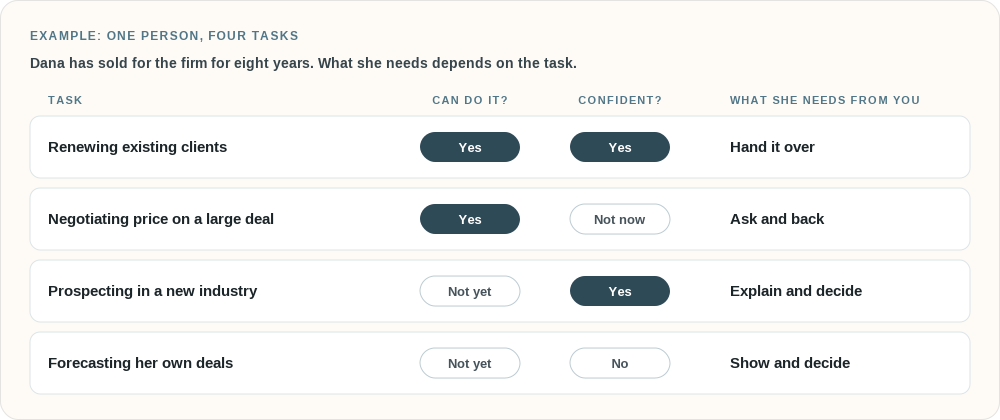
The first mistake is to sort people into "senior" and "junior" and coach the label. Nobody is equally ready for everything. Someone who renews existing clients without a second thought may never have opened a conversation with a stranger in an industry they do not know.
So the question is never "how good is Dana?" It is "how ready is Dana for this particular task?" Break the job into the pieces you actually coach: prospecting, first calls, discovery, proposals, negotiating, renewals, keeping the pipeline honest. Then think about one piece at a time.
Two questions: can they, and will they
For any one task, you are judging two things, and they are separate.
- Can they do it? This is ability: the knowledge, the skill and the track record. The test is whether they have done this task well, more than once, without you. Having sat through the training does not count.
- Will they do it? This is willingness: confidence that they can, and the motivation to try. A person can know exactly how to ask for a referral and still never do it. A person can be eager to run a negotiation and have no idea how.
Keeping the two apart matters because they call for different help. A gap in ability is closed by showing, explaining and practice. A gap in willingness is closed by listening, encouragement and sometimes by finding out what is in the way. Give a pep talk to someone who does not know how, or a training session to someone who has lost their nerve, and nothing changes.
Four situations, and what each needs from you
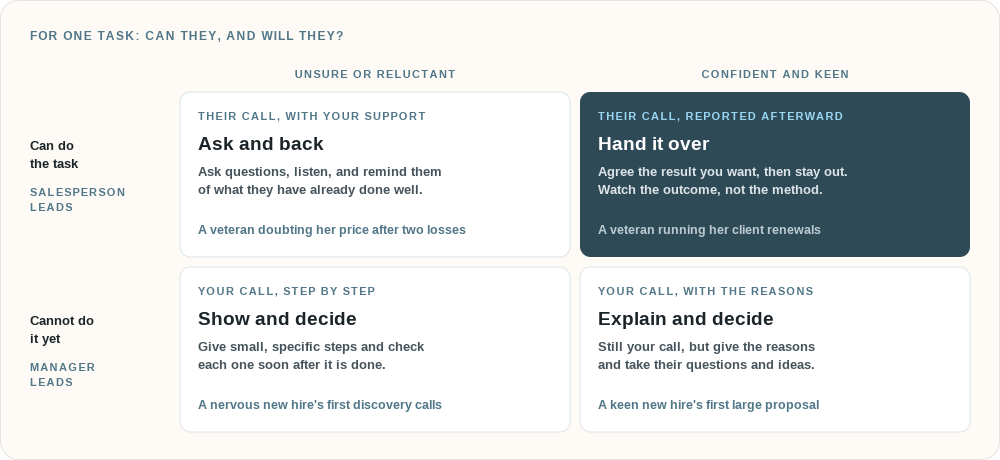
Put the two questions together and you get four broad situations. Real people sit between the boxes, but the boxes are enough to choose a starting point.
- 1
Cannot do it yet, and unsure: show and decide
A new hire is about to make their first discovery calls and is visibly nervous. Do not ask how they would like to approach it. They do not know, and the question adds pressure. Give them five questions to ask, tell them what a good call sounds like, sit in on the first two, and talk straight afterward. Small steps, checked soon.
- 2
Cannot do it yet, but keen: explain and decide
The same hire, a month later, wants to write the proposal for a large deal alone. The energy is worth keeping and the skill is not there yet. You still decide the price and the scope, but you explain why, ask what they would have done, and take their ideas seriously. They draft, you review before it goes out.
- 3
Can do it, but hesitant: ask and back
An experienced salesperson has lost two large deals on price and now wants to discount the third before the buyer has asked. She knows how to negotiate. What has gone is her confidence. Giving her instructions confirms her fear that she cannot be trusted with it. Ask what she sees, what she thinks the buyer values, what she would advise a colleague to do. Remind her of deals she held firm on and won. The decision stays hers.
- 4
Can do it, and confident: hand it over
A veteran runs client renewals and has done so well for years. Agree the result you both want, and step back. She tells you what she decided after she has decided it. Your job is to notice the outcome, remove obstacles when she asks, and say thank you.
Who should lead the conversation
Before a one-on-one or a deal review, decide who should do most of the talking and who should make the call.
When the person cannot yet do the task alone, you lead. You set the agenda, you say what good looks like, and you make the decision. How much you explain and invite questions depends on how keen they are, but the choice is yours, because they do not yet have the experience to make it well.
When the person can do the task, they lead. They bring the deal, they say what they plan to do, and they decide. How much you ask and encourage depends on how confident they are, but you are the sounding board, not the author.
How to tell which situation you are in
Do not guess from job title, years of service or how sure of themselves someone sounds in a meeting. Look for evidence about this task, from three places: the results, what you hear when they do it, and how they talk about it.
| Where to look | Points to able and willing | Points to a gap |
|---|---|---|
| Results on this task | Deals move past this stage at a steady rate, without your help | Deals pile up or die at the same stage, again and again |
| What you hear on calls | They ask the hard question and wait for the answer | They skip the hard question, or talk through the silence |
| How they talk about it | Specific: what they tried, what they will try next | Vague, or a string of reasons why it was not the right week |
| What they do unprompted | They start the task without being reminded | The task keeps sliding to the bottom of the list |
When the evidence is thin, ask directly: "How comfortable are you running this one yourself, and what would you want from me?" Most people will tell you, if they believe the answer will not be held against them.
The two classic mismatches
Get the match wrong and it goes wrong in one of two directions. Both are common in small firms, often in the same team at the same time.
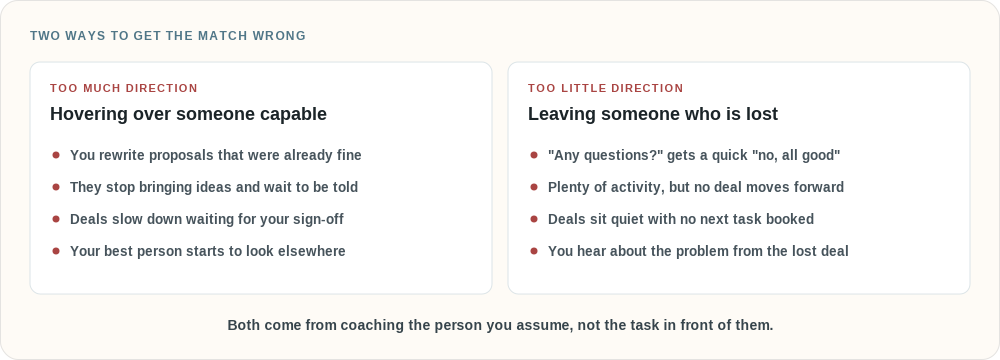
Hovering usually comes from an owner who used to do all the selling and still knows how every deal should be run. Each correction is small and well meant. The message the salesperson hears is "I do not trust you with this." Capable people respond by doing exactly what they are told and nothing more, and the best of them leave.
Abandoning usually comes from a busy manager who believes in giving people room. It feels respectful. To someone who does not yet know how, it feels like being set up to fail. They stay busy, because activity is the one thing they can control, and they hide the deals that are going badly.
It changes as people grow, and when they slip
The right approach is a snapshot, not a verdict. As a new hire gets a few good discovery calls behind them, explain more and instruct less. Step back one notch at a time, and say that you are doing it, so they know it is trust and not neglect.
People also move the other way. A run of losses, a new product, a change in pricing, a new kind of buyer, or trouble at home can knock the confidence or the performance of someone who was fine last quarter. When the evidence changes, move closer again for a while. It is not a demotion, and it helps to say so: "This market is new for all of us, so let us plan the first ten calls together."
Start this week
- 1List the five or six tasks that make up selling at your firm, such as prospecting, discovery, proposals, negotiating and renewals.
- 2For each person, pick the one task that matters most this quarter and answer two questions from evidence: can they do it, and will they?
- 3Decide who should lead your next conversation about that task, and tell the person what to expect: "I am going to be specific on this one" or "this one is yours, use me to think it through."
- 4Find one capable person you are hovering over and one task where someone has been left alone too soon. Change both.
- 5Put a date in the calendar a month from now to look at the evidence again and adjust.
Treating everyone the same feels fair, and it is the reason the new hire feels lost and the veteran feels watched. Fair is giving each person what the task in front of them needs, and changing it when they do.
More on this from The Center for Leadership Studies: Why leaders should assess performance readiness before assigning tasks
Also from The Center for Leadership Studies: Leader-directed or self-directed: which to use when