
In most small sales teams, the manager's week goes to whoever is behind. The new hire needs help with every proposal. Someone else has missed their number twice and needs a plan. The person who brings in the most gets a quick "keep doing what you're doing" in the corridor.
To the manager, that feels like respect. To the top seller, it can feel like nobody is paying attention. They have no one to think with, nobody notices what they do well, and nothing new is on offer. Then one day they resign, and the manager is the last to see it coming.
Why your best person gets the least of you
Nobody decides to ignore their best seller. It happens because problems ask for time and good results do not. A deal that is going wrong lands on your desk. A deal that is going well never does.
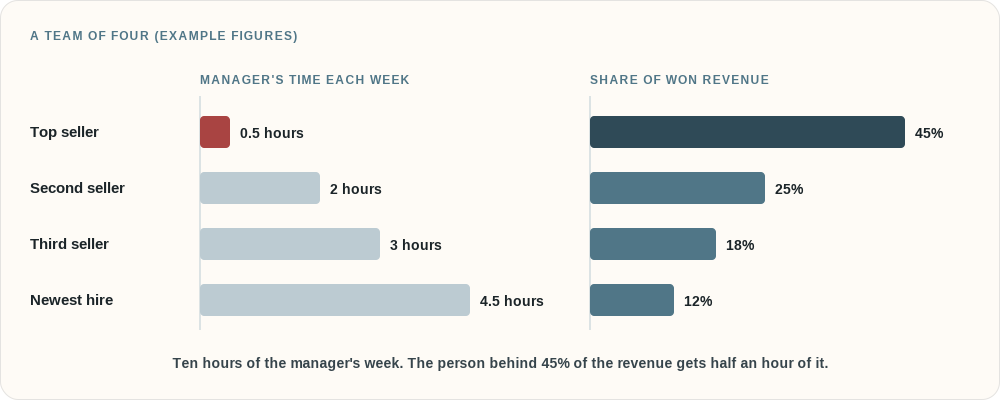
The new hire should get more of your hours. That part is right. What is wrong is the half hour at the top. A good seller does not need many hours, but they need some, and they need them to be about something other than a status update.
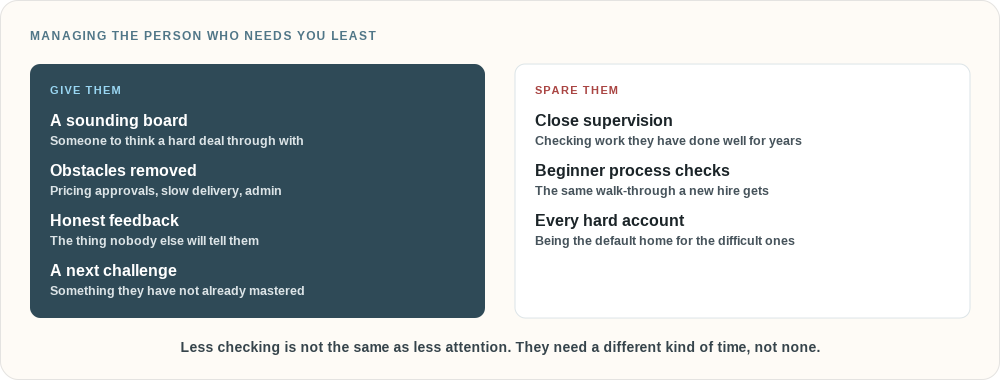
What a top seller still needs from you
- 1
A sounding board
Strong sellers work their hardest deals alone, because nobody else in the firm has handled anything like them. Offer to be the person they think out loud with. Asking "what would have to be true for this to close next month?" is often enough.
- 2
Obstacles removed
Ask what slows them down that has nothing to do with selling. A pricing approval that takes a week. A delivery team that is slow to scope work. Proposals they format by hand. An hour of your time clearing one of these is worth more than an hour of coaching.
- 3
Honest feedback
The better someone is, the less feedback they get. Colleagues defer to them and managers do not want to upset them. But most strong sellers are hard on themselves and want to improve. Tell them the one thing you have noticed, such as discounting too early or talking past a quiet person in the room, and be specific.
- 4
A next challenge
Someone who has done the same kind of deal fifty times is no longer learning from it. Boredom looks like calm from the outside. Keep one thing in front of them that they have not mastered yet.
What to spare them
- Close supervision. Sitting in on routine calls or reading every proposal tells them you do not trust work they have done well for years.
- The same process checks as a beginner. A new hire needs a deal-by-deal walk-through every week. Your best seller needs a short look at the two or three deals that are stuck or unusual.
- Every hard account. It is tempting to hand each difficult client and each rescue job to the person most likely to cope. Do that often enough and the reward for being good is a heavier, less pleasant job than everyone else has.
Three risks a small firm carries
- 1
Too much revenue in one person
In a team of four, it is common for one person to bring in a large share of the sales. If they leave, fall ill or just have a bad quarter, the firm feels it at once. Know the figure. You cannot reduce a risk you have not measured.
- 2
Their way of selling lives in their head
They know which clients are about to buy again, who really decides at each account, and what to say when price comes up. If none of that is written down, it leaves with them, and the rest of the team never learns from it.
- 3
Rules that bend for them
When the star is allowed to skip the weekly meeting or leave their deals out of date, everyone notices. The others either resent it or copy it. Both cost you more than the star's goodwill is worth.
Holding a star to the team's standards without a fight
Start by separating standards from methods. Standards are the few things everyone does because the firm depends on them: deals kept up to date, honest close dates, turning up to the pipeline review, treating colleagues decently. Methods are how a person runs a call or writes a proposal. Give your best seller wide freedom on methods and none on standards.
Then explain the standard by what it is for, not by rank. "I need your deals current because the forecast is mostly your deals" is a reason a good seller will accept. "Because those are the rules" is an invitation to argue.
- Raise it early and in private, the first or second time, before it becomes a pattern other people talk about.
- Name one specific thing. "Three of your deals have close dates that have passed" works. "You are careless with admin" does not.
- Ask what makes it hard. If updating records takes them an hour a week, that may be a real obstacle you can remove.
- Keep praise and the request apart. Praise used as a cushion for criticism stops sounding like praise.
Growth that is not management
In a small firm there is rarely a ladder to climb, and the only promotion on offer is often "sales manager." That is a different job. It trades the selling they are good at for meetings, coaching and other people's problems. Some great sellers want that. Many do not, and a firm that promotes one anyway can lose its best seller and gain an unhappy manager.
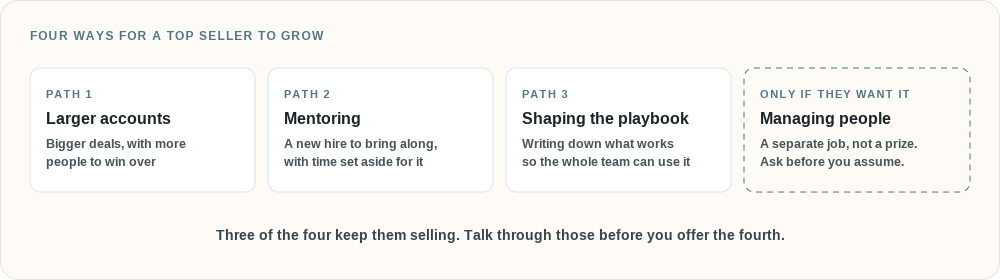
- Larger accounts. Give them the biggest opportunities, and take some smaller ones away to make room.
- Mentoring. Pair them with a new hire, and lower another demand on their time to pay for it.
- Shaping the playbook. Ask them to write down how they qualify, handle price and follow up, and make that the team's way of working.
On management, ask the question plainly: "Do you want to run a team one day, or do you want to stay close to clients?" Either answer is fine. If they are unsure, let them try a piece of it first, such as running the pipeline review for a month.
What to ask in their one-on-one
Keep the meeting, even when there is nothing wrong. Spend a few minutes on the deals that need a second opinion and the rest on the person.
- Which deal would you like to think through with me?
- What is getting in your way that I could fix?
- What part of the job do you enjoy most at the moment, and what part least?
- What would you like to be doing a year from now that you are not doing today?
- Is there anything about how the team works that you would change?
- What would make you start thinking about leaving?
The last question is uncomfortable, and it is the most useful one. Ask it while things are good. Write down what they say and act on at least one item before the next meeting, or the questions will stop getting honest answers.
Early signs they are drifting
A top seller who is losing interest rarely misses their number at first. Watch for a change from their own normal, not for a comparison with the rest of the team.
| What you notice | What it may mean | What to do |
|---|---|---|
| Fewer new deals added, while closing stays steady | They are living off existing pipeline and have stopped building the next one | Ask what would make prospecting worth their effort again |
| Quiet in meetings where they used to argue | They no longer think their opinion changes anything | Ask for their view directly, and act on something they said |
| Notes and records getting thinner | Less care for what happens after them, or simple overload | Raise it as a standard, and ask what is behind it |
| They stop helping colleagues | They feel taken for granted | Recognize the help openly, and protect time for it |
| More complaints about small things | A larger frustration they have not named | Ask the leaving question from the one-on-one list |
One sign on its own means little. Two or three together, lasting more than a few weeks, deserve a direct conversation: "You seem less engaged than you were. What has changed?"
Start this week
- 1Work out what share of last year's won revenue came from your top seller, and how many of your largest clients they hold.
- 2Put a regular one-on-one with them in the calendar, and bring three questions from the list above.
- 3Ask what one obstacle you could remove, and remove it before you meet again.
- 4Check whether any team standard bends for them. If one does, raise it in private with the reason behind it.
- 5Ask what they want to be doing in a year, and whether managing people is part of it.
Your best seller will not ask for your time, which is why it is easy not to give it. An hour of real attention every week or two costs far less than replacing them.
More on this from The Center for Leadership Studies: How to manage high performers