
Most people try a little harder when someone is keeping score. A sales contest uses that. Done well, it gets a team through a slow month, builds a habit that was not sticking, and gives people something to talk about besides the target. Done badly, it rewards the person who was going to win anyway and teaches everyone else to stop trying, or to stop helping each other.
In a team of two to ten people the difference is almost all in the design. This article covers when a contest is worth running, how to build one that most of the team has a real chance of winning, what goes wrong, and how to check afterward whether it did any good.
When competition helps, and when it harms
A contest helps when the thing you are short of is effort or attention on one specific activity, and when everyone believes they could win. It gives a short burst of energy and makes the activity visible. It works best for work that is simple to count and fully in a person's own hands, such as booking first meetings or following up old proposals.
It harms when the result is known before it starts, when the prize is large enough to be worth cheating for, or when winning means a colleague has to lose. It also does little for problems that are not about effort. If deals are lost on price, or the leads are poor, or one person needs training, a contest will not fix it and may hide it for a month.
- Good moment: a quiet season, a new habit you want to start, a neglected job such as asking clients for referrals.
- Poor moment: right after a pay dispute, during a reorganization, or when two people are already not speaking.
- Poor fit: a team where the work is shared on every deal, so that nobody can say whose number a win belongs to.
Design a contest most of the team can win
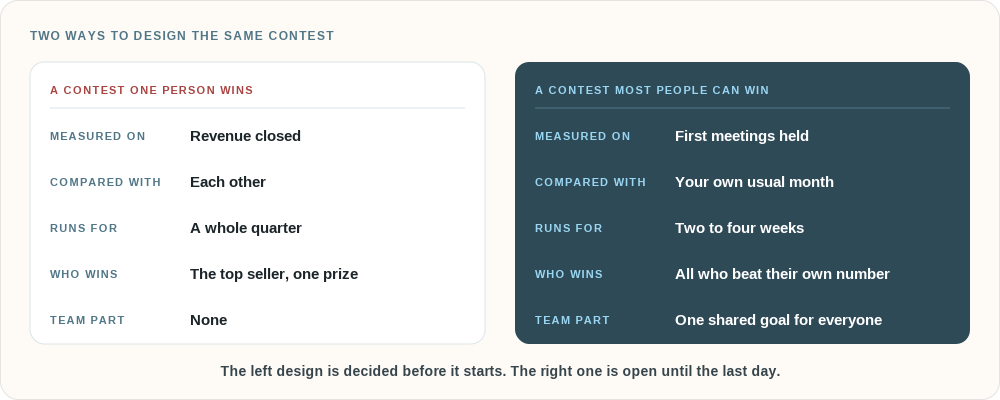
Four choices decide whether a contest lifts the whole team or only crowns its best seller: what you count, who each person is compared with, how long it runs, and how many ways there are to win.
- 1
Count something people control
Revenue depends on territory, on the size of the accounts a person inherited, and on luck with timing. Inputs do not. First meetings held, proposals sent, referrals asked for and old clients called are all things a person can decide to do more of tomorrow. Pick one input, and pick the one that most often leads to a sale in your firm.
- 2
Compare each person with their own past numbers
A new hire cannot out-sell someone with ten years of clients, but both can beat their own usual month. Take each person's average over the last three months as their starting line and score the improvement. The strongest seller now has to work for it, and the newest has a fair chance.
- 3
Keep it short
Two to four weeks is enough. In a longer contest the leader pulls away, the rest give up by the halfway point, and everyone forgets it is running. A short one also limits the damage if the design turns out to be wrong.
- 4
Add a goal the whole team shares
Set one number for the team as well, with a reward everyone gets if it is reached. It gives the strongest person a reason to help the weakest, and it means someone having a bad month still has something to play for.
- 5
Offer more than one way to win
Biggest improvement, most of the chosen activity, and the team goal make three. In a team of five, that is enough for most people to finish with something to be pleased about, without handing out prizes for turning up.
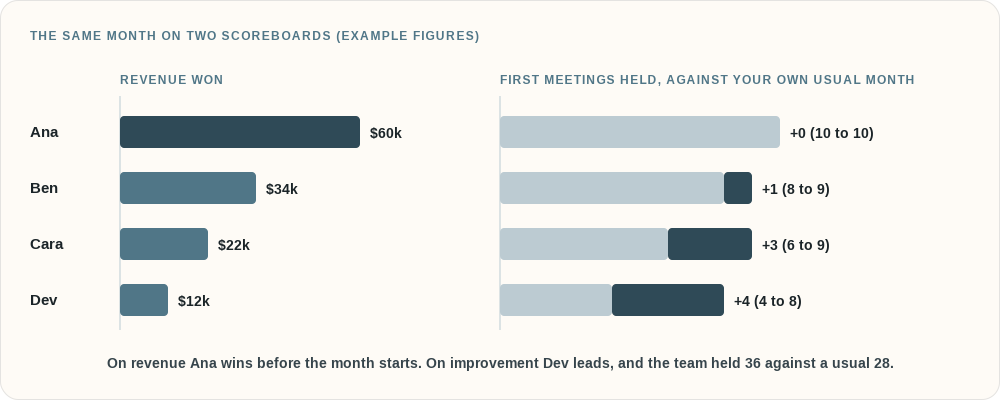
In this example the team goal might have been 34 first meetings against a usual 28. They held 36, so everyone shares that win. Dev takes biggest improvement, and Ana still held the most meetings. Three results, and nobody had to lose for someone else to win.
What goes wrong, and how to head it off
People do what the rules reward. If the rules reward the wrong thing, good people will do the wrong thing and feel fine about it. Read your own rules as if you wanted to win with the least possible work, and fix what you find.
| What happens | Why | How to head it off |
|---|---|---|
| The same person wins every time | The contest ranks people on results that depend on experience and accounts | Score improvement against each person's own numbers |
| Everyone but the leader gives up | One winner-take-all prize, and the gap is visible by week two | Several ways to win, a team goal, and a short run |
| Leads are hoarded | Passing a lead to the right colleague costs you points | Count a passed lead for both people, or leave lead handling out of the contest |
| Deals are held back or rushed | A deal that closes the day before the contest starts counts for nothing, so people delay it, or discount to close inside the window | Count activity, not closed deals, and look at close dates around the start and end |
| The count is padded | A two-minute call counts the same as a real conversation | Define what counts in one sentence before you start, and spot check a few records each week |
| Nobody helps anybody | Time spent coaching a colleague earns nothing | Make the team goal the biggest reward |
Two further rules save arguments. Write the rules down and do not change them once the contest has started. And decide in advance who settles a dispute, because there will be one.
Prizes that work without a budget
A large cash prize raises the stakes, and high stakes are what make people bend the rules. Small prizes keep it a game. For most small teams, recognition and a little freedom are worth more than the money you could afford anyway.
- First pick of the next batch of inbound leads, or of a shift nobody wants to lose.
- A Friday afternoon off, or a late start on Monday.
- Lunch chosen by the winner and paid for by the firm, eaten by the whole team.
- The owner takes over the winner's least favorite job for a week.
- A plain thank you in front of the team that says exactly what the person did.
Whatever you choose, make the team reward something everyone enjoys together, and hand prizes out within a few days of the finish. A prize that arrives a month later has lost its point.
The person at the bottom
In a team of four, someone comes last, everyone knows who it is, and they have to sit in the same room on Monday. Showing a full ranking makes that harder than it needs to be. Show each person against their own starting line and show the team total. If you want a ranking, show the top two or three and stop there.
Then talk to the person privately, and treat a low number as a question, not a verdict. It may be skill, in which case they need coaching. It may be a thin territory or a run of poor leads, in which case the contest was unfair to them. It may be that they dislike being compared, and work better without it. Some very good salespeople do. Let anyone opt out of the individual part and still count toward the team goal.
Afterward: did it work?
The contest month will almost always look good. The honest test is the month after. Compare three periods of the same length: before, during and after.
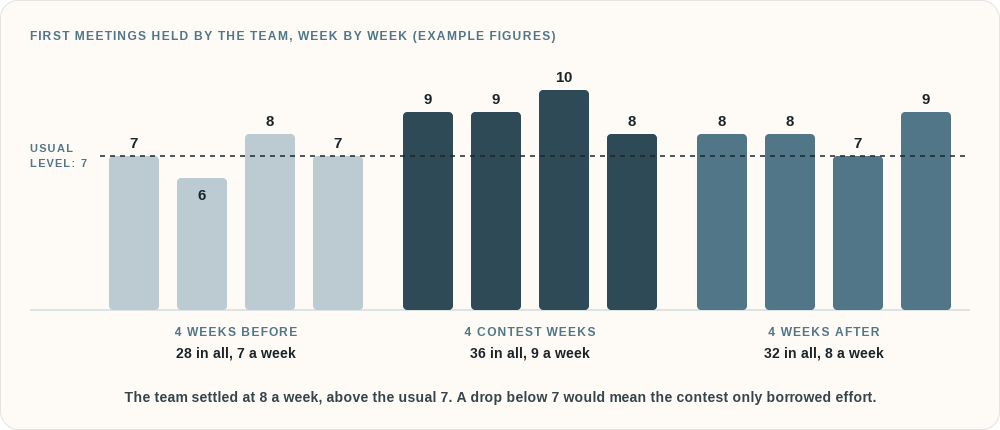
- Did the number stay up? Settling a little above the old level, as in the example, means a habit formed. Falling below it means the contest only pulled next month's work forward.
- Did the activity turn into results? More first meetings should show up later as more deals added and, in time, more won. If the count rose and nothing followed, the count was padded or you picked the wrong activity.
- Who improved? A good contest lifts the middle of the team. If only the top person moved, the design favored them.
- What did it cost? Look for deals that closed just inside the window, discounts given in the last week, and leads that sat with the wrong person.
- What does the team say? Ask each person whether they would do it again. A contest people dreaded will work less well the second time.
Start this week
- 1Pick one activity your team controls and does too little of, and write one sentence that defines what counts.
- 2Work out each person's average for it over the last three months. That is their starting line.
- 3Set a team goal a little above the combined usual number, and choose a reward the whole team shares.
- 4Announce a three-week contest with the rules on one page: what counts, the ways to win, the prizes, and who settles disputes.
- 5Put a date in the calendar four weeks after it ends to compare before, during and after.
A contest is a small tool for a small job: a few weeks of extra attention on one thing. Keep the stakes low, give most people a way to win, and judge it by what the team is still doing a month later.