
Every closed deal is a result with a cause. Most firms record the result and guess at the cause. A win is put down to good selling, a loss to price, and the next quarter is run the same way as the last one.
A win and loss review is the habit of finding out why deals actually ended, and changing something because of it. A small firm does not need a research project. It needs a reason on every closed deal, a short conversation with some of the buyers, and an hour each quarter to read the results together.
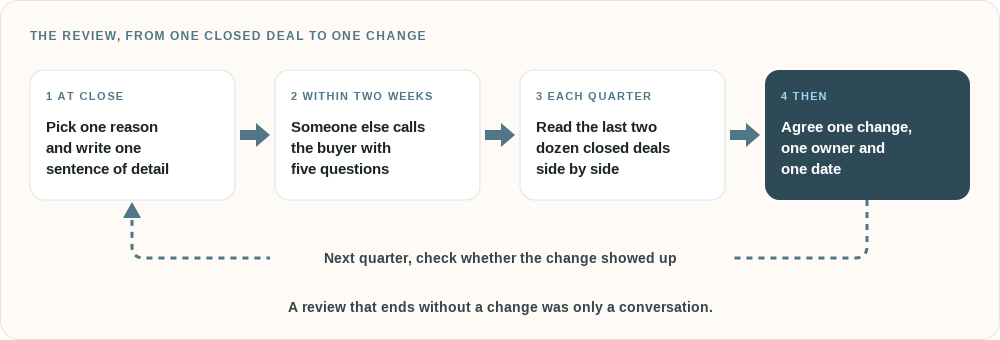
Record the reason on the day the deal closes
A week after a deal ends, the details have faded and a tidy story has taken their place. So capture the reason at the moment the deal is marked won or lost. Ask for two things: one reason picked from a short list, and one sentence in the salesperson's own words about what the buyer said or did. The list gives you something to count. The sentence gives you something to understand.
Why the first answer is usually "price"
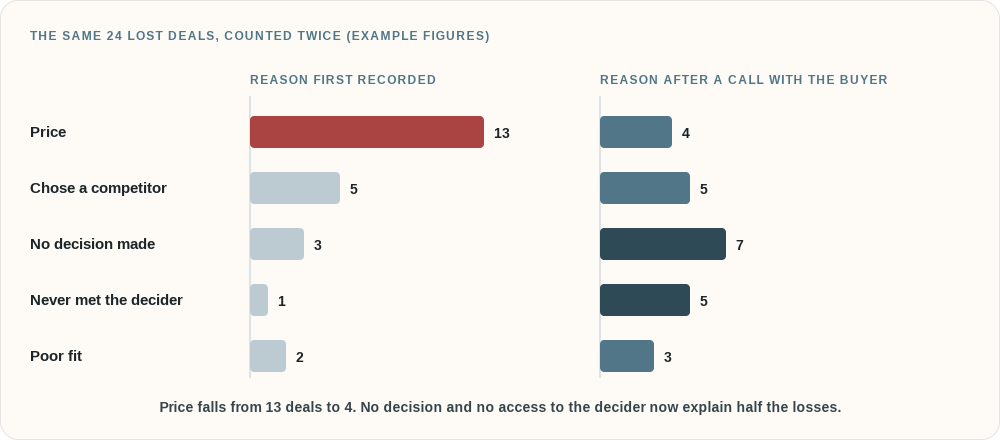
Price is the polite answer. It is easy for a buyer to say and easy for a salesperson to accept, because it makes the loss nobody's fault. Often it stands in for something else: the buyer did not see enough difference to justify paying more, the person who wanted you could not get it approved, or the problem was not urgent enough to spend on at all.
Treat price as the start of the answer. One follow-up question does most of the work: "If the two prices had been the same, would you have chosen us?" A yes means the loss really was about price. A pause, or a no, means there is another reason underneath, and that is the one to record.
A reason list people will actually use
A list of twenty reasons gets one of them picked at random. Keep it to six or eight, make each one clearly different from the others, and make sure each points at something you could change. Leave out "Other" if you can, because it becomes the place every awkward loss goes. Keep a separate short list for wins. This example is for losses.
| Loss reason | Use it when | What a pattern would point to |
|---|---|---|
| Price | The buyer wanted you and could not pay the difference | Pricing, packaging, or a smaller first project |
| Chose a competitor | They bought from someone else, and you know who | How you explain what makes you different |
| No decision | They bought from nobody and carried on as before | Qualifying: urgency, and access to whoever decides |
| Poor fit | They needed something you do not really do | Who you target and what your marketing promises |
| Did it themselves | They gave the work to their own staff | Showing the true cost of doing it in-house |
| Timing | A real event moved the need to a known later date | A follow-up task for that date, not a lost cause |
| Went silent | Replies stopped and you never learned why | Following up, or deals opened too early |
Ask the buyer
The reason in your records is your side's view of the deal. The buyer holds the other half, and most will share it if asked well. A fifteen-minute call a week or two after the decision is enough. Ask after wins as well as losses, and ask the people who went silent. Some will not answer. The ones who do are worth the effort.
Who should make the call
Preferably not the person who ran the deal. Buyers tend to be kind instead of candid with the salesperson they just turned down, and the salesperson is tempted to reopen the sale. The owner, a partner or a colleague from delivery will usually hear more. In a two-person firm, swap deals with each other. If you work alone, make the call yourself and say in the first sentence that the decision is final and you are only trying to learn.
| Question | What you are listening for |
|---|---|
| What was happening that made you look for help when you did? | The trigger. It tells you when the next buyer like this will be ready. |
| What else did you consider, including doing nothing or doing it yourselves? | The real alternatives, which are often not the competitors you expected. |
| What mattered most when it came to deciding, and who was involved? | The criteria, and people on their side you never met. |
| Where were we strong, and where did we fall short? | Specific moments: a slow reply, an unclear proposal, a meeting that went well. |
| If you could change one thing about how we handled this, what would it be? | The one thing they have been too polite to mention. |
- Say why you are calling and how long it will take. Keep to the time.
- Do not correct, explain or defend, even when you think the buyer has it wrong. Their impression is the finding.
- When an answer is vague, say "tell me more about that" and wait.
- Write down their words, not your summary of them.
- Thank them and leave it there. No new offer on this call.
Read the patterns across a couple of dozen deals
One deal is a story. Twenty or thirty closed deals start to show a pattern, and for a small firm that may be a quarter's worth or half a year's. Lay them side by side and cut the same deals five ways.
- By reason. Which reasons come up most, and does the buyer's version match what was first recorded?
- By competitor. Do you keep losing to the same firm, and on what?
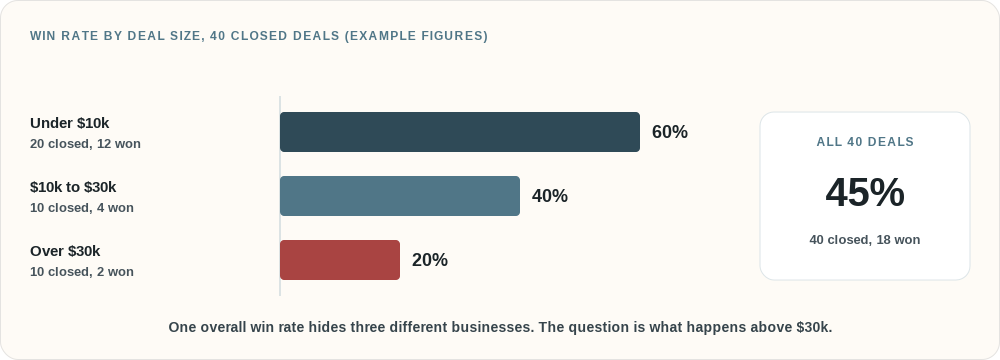
- By deal size. Is your win rate the same for small and large deals?
- By source. Do referrals, your website and outreach close at different rates and for different reasons?
- By the stage the deal reached. Losses after a first meeting point at targeting. Losses after a proposal point at the proposal, the price or the people who decide.
Study the wins as carefully as the losses
Losses get an inquest. Wins get a celebration and no questions. Yet a win tells you what to repeat: who bought, how they found you, what they compared you with and what settled it. If most of your wins share a kind of client and a way of arriving, that is your target for next quarter, written by your own results.
Wins also hide luck. A client who came to you because their last supplier let them down did not choose your pitch. Ask won clients the same five questions. They are easier to reach, and their answers often give you the exact words to use with the next buyer.
"No decision" is an outcome too
Many lost deals are not lost to anyone. The buyer simply carried on as before. Give this its own reason instead of filing it under timing or price, because the fix is different. A deal that ends with no decision was usually weak early on: the problem was not costing the buyer enough, nobody with authority was in the conversation, or there was no date by which something had to happen.
So the lesson is rarely about closing or pricing. It is about what you check before writing a proposal. It also helps to agree a rule for ending these deals, such as closing after three unanswered follow-ups, so they do not sit open for months.
One change per quarter
A review that produces ten findings usually produces no change. End each one by agreeing a single change, who owns it and the date you will look again. Change three things at once and you will not know which one worked.
| What the review showed | One change to try |
|---|---|
| Most no-decision deals never included the person who signs | No proposal goes out until that person has been in a meeting |
| Large deals are won far less often than small ones | A second, senior person joins every deal above a set size |
| Buyers who chose one competitor all mention a faster reply | Proposals are sent within two working days |
| Wins come mostly from referrals in one industry | Ask each client in that industry for one introduction |
Start this week
- 1Write a list of six to eight loss reasons and four or five win reasons, and make a reason compulsory when a deal closes.
- 2Go back over your last ten closed deals and add a reason and one sentence of detail to each.
- 3Pick three of them, including one win, and have someone other than the salesperson call the buyer with the five questions.
- 4Put a one-hour review in the calendar for the end of the quarter, and decide now that it will end with one change.
You will not win every deal, and you do not need to. You need to stop losing the same deal twice, and to know which wins you can count on getting again.