
The best salesperson in the firm gets made sales manager. It is the most common promotion in sales, and it makes sense on the day: they know the clients, they know the product, and everyone respects their numbers. It is also the most common way to lose a good salesperson and gain a struggling manager in a single move.
This article is written mainly for the person who has just been promoted. There is a short section near the end for the owner who promoted them.
It is a different job, not a bigger one
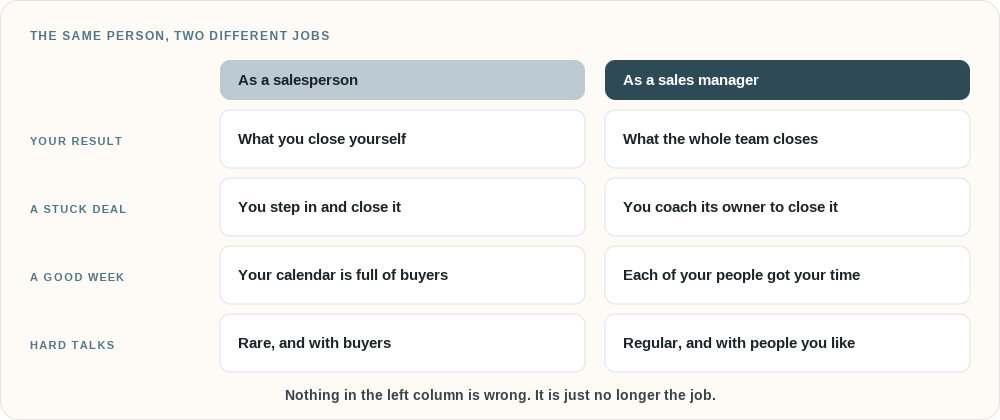
As a salesperson, your result was what you closed. As a manager, your result is what other people close. That sounds like a small change of wording. It changes almost everything about how you should spend a day.
The awkward part is that the habits that made you good can now work against you. You are a strong closer, so when a deal wobbles you want to take the call yourself. You are persistent, so you chase your people the way you chased buyers. You always did it yourself, so explaining it to someone slower feels like a waste of an afternoon. Each of those instincts wins a deal this month and leaves the team no better next month.
The first conversations with former peers
Last month you complained about the boss together. Now you are the boss, and everyone knows it, and nobody has said it. If you leave it unsaid, each person will guess what has changed, and they will guess differently. Have one short conversation with each person, alone, in your first two weeks. Cover three things.
- 1
What has changed
Say it out loud. "I am now responsible for the team's number, and that means I will be looking at your pipeline and asking questions I never used to ask." It is far less awkward than raising your first problem with no warning.
- 2
What stays the same
You still respect their work. You will still have lunch. You still know how hard the job is because you were doing it a few weeks ago. Say that too, so the reset does not sound like a withdrawal.
- 3
What you will now have to do
Be specific about the parts they may not like: decide who gets which leads, tell them when a deal does not belong in the forecast, and bring up a missed commitment the week it happens. Then ask what they want from a manager, and write the answer down.
After that conversation, change how you ask for things. Between peers, "can you look at that proposal when you get a chance" was fine. From a manager it leaves the person guessing. Say what you need and by when.
Friendly, and still able to say hard things
New managers tend to fall off one of two sides. Some go cold: they stop joining in, speak in formal sentences, and hide behind the title. Others stay everyone's friend and never say anything difficult. The first loses the trust that made the team work. The second loses the team's respect, because everyone can see the problems that are being left alone.
You do not have to choose. What you need is a standard that has nothing to do with who you like. Agree a few plain expectations with the whole team: deals are kept up to date, every open deal has a next task, a commitment made in the pipeline review is kept or explained. When the standard is the same for everyone and was agreed in the open, raising a miss is about the work, not about the person.
When one of the team is a close friend
The rest of the team is watching how leads, good accounts and praise are handed out. Give leads by a rule everyone knows, such as in turn or by territory. Praise results that anyone can check. Do not discuss other team members with your friend, and do not let them hear news before the others do. If anything, a friend should find you slightly harder to impress. Tell them why. A real friend will understand that you being seen as fair protects them as well.
Five traps
- 1
Taking over deals
You join a call to help and end up running it. The deal closes, the salesperson learns that hard deals get taken away, and the buyer now wants to deal with you. Join to watch, agree your role before the call, and coach afterward.
- 2
Staying the top seller
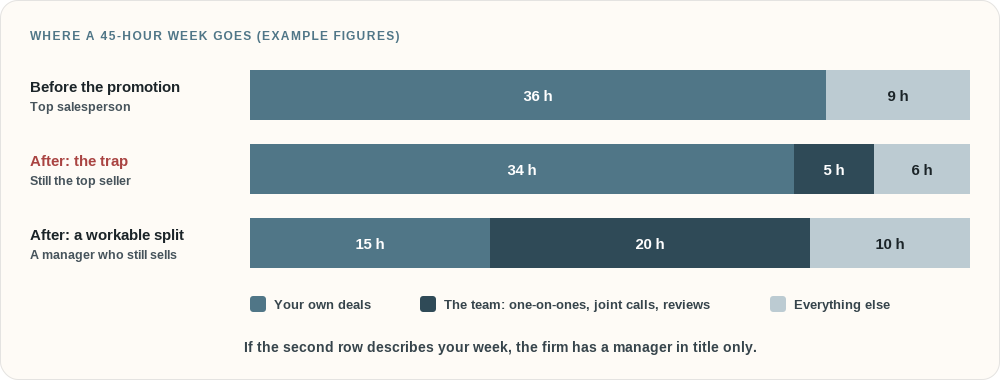
Your own deals feel urgent and you are good at them. The team's problems feel slow and you are new at them. Left alone, your week will drift back to selling.
- 3
Putting off the first hard conversation
Everyone is waiting to see what happens the first time someone misses a commitment. If nothing happens, that becomes the standard. Raise it early, in private, about the work, while it is still a small thing.
- 4
Wanting to be liked
You were liked as a peer and you will miss it. Aim to be fair and clear instead. Most people come to like a manager who is both.
- 5
Changing everything in week one
You have had opinions about how the team should run for years. Hold them for a month. Ask first, change one thing at a time, and explain the reason for each change.
Do you keep your own accounts?
In a small firm, usually yes, some of them. The firm often cannot afford to lose its best seller's revenue overnight, and staying close to real buyers keeps your coaching honest. The question is how many. A rough guide: with two or three people to manage, you might keep about half of what you carried. With six or more, keep a handful of key clients and hand over the rest. Keep the accounts where your relationship is hard to replace. Hand over the ones that would stretch someone on the team, and introduce that person to the client yourself.
Your first 30, 60 and 90 days
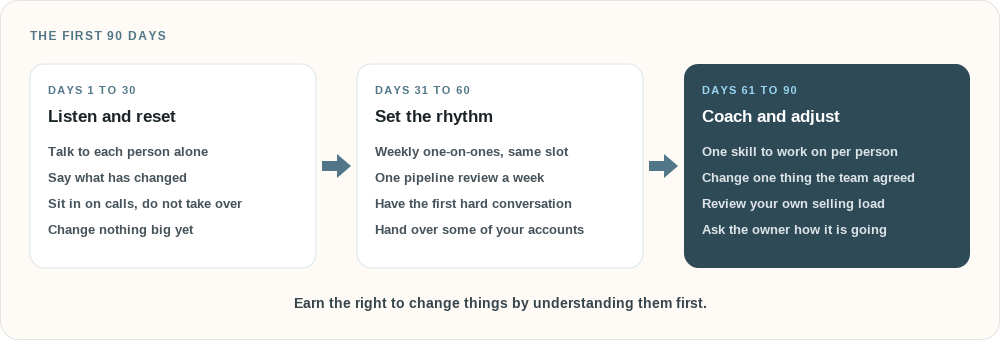
- Days 1 to 30. Have the reset conversation with each person. Sit in on calls and read through each pipeline to learn how each person actually sells, which is rarely how you sold. Make no large changes.
- Days 31 to 60. Put a weekly one-on-one with each person in the calendar and keep it, even in a busy week. Start one short team pipeline review a week. Deal with the first missed commitment when it happens. Begin handing over accounts.
- Days 61 to 90. Agree with each person one skill to work on, and coach to it. Make the one change the team most agreed was needed. Look honestly at how many hours you are still selling, and ask the owner for a plain review of how it is going.
If you are the owner who promoted them
Whether the promotion pays off depends largely on what you do next.
- Say what the role is. Write down what the manager decides, what stays with you, and how you will judge them. Tell the team the same thing, in the same words, with the new manager in the room.
- Reduce the selling load. If their personal target stays where it was, they will sell, because that is what is being measured. Lower it, and pay them on the team's result.
- Give them time and a coach. Nobody taught them to run a one-on-one or have a hard conversation. Meet them weekly for the first three months, or find them someone outside the firm who has managed salespeople.
- Offer a respectable way back. Agree at the start that after six months either of you can say this is not working, and that returning to a senior selling role is a good outcome and not a demotion. Some excellent salespeople do not want to manage, and it is far better to find that out and keep them.
Start this week
- 1Book a private conversation with each person on the team and cover the three points: what has changed, what stays the same, and what you will now have to do.
- 2Block the team's time in your calendar first: one one-on-one per person and one pipeline review.
- 3List your accounts and mark each one keep or hand over, with a name beside each handover.
- 4Ask the owner to put in writing what you decide, how you will be measured, and what your own selling target now is.
- 5On the next deal that wobbles, ask its owner three questions before you offer to make a call yourself.
The promotion did not make you a manager. It gave you the chance to become one. The people who manage it well are rarely the ones who sold the most. They are the ones who accepted early that the job had changed, said so to the team, and put their best effort into other people's deals.
More on this from The Center for Leadership Studies: From peer to leader: building respect without losing rapport
Also from The Center for Leadership Studies: Navigating the gray zone between boss and friend