
Many small firms have one. A salesperson everyone likes, who works reasonable hours and always has two large deals that are about to land. They were about to land last quarter too, and the quarter before. The number never quite arrives, and the owner decides, again, to give it one more quarter.
This article is about what that waiting costs, how to tell a person who is still finding their feet from one who is not going to get there, and how to settle the question fairly. Fair means two things here: the person gets a real chance, and the plan ends in a decision.
Why the decision keeps getting put off
None of the reasons are foolish. That is what makes them hard to argue with.
- You like them. In a team of five, this is someone you eat lunch with and whose family you have met. A hard conversation feels like a betrayal.
- Hiring again is slow and risky. It takes months to find someone and months more before they sell, and the next person may be no better.
- The pipeline always looks about to close. There is a large deal in a late stage with a close date next month. Deciding now feels like giving up just before the payoff.
- One good month resets the clock. A single win arrives, everyone is relieved, and the pattern of the last year is forgotten.
- Some revenue feels better than none. An empty seat sells nothing, so a seat that sells a little looks like the safer choice.
Each reason is sensible alone. Together they produce a year of waiting. And waiting is not as kind as it feels. A person kept for a long time in a job they are failing at usually knows it, and nobody is telling them the truth.
What it costs that the payslip does not show
The salary is the visible cost, and it is usually the smallest one.
- 1
Leads and accounts someone else would have won
Every enquiry handed to this person is one that was not handed to a colleague. A lead that is handled poorly is rarely available to try again, and an account that is neglected tends to leave without saying why.
- 2
Your own time
Extra pipeline reviews, joining calls to rescue a deal, rewriting proposals, calming a client. It is time taken from your best people, who would have turned the same attention into more.
- 3
What the rest of the team concludes
People watch what is tolerated, not what is said. If missing the number for a year has no consequence, that becomes the real standard. Your strongest people notice first, and they are the ones with the most options elsewhere.
- 4
Forecasts built on deals that never close
Hiring, spending and your own pay are planned on the forecast. A pipeline full of deals that slide from month to month makes every one of those plans a little wrong.
A small example with invented figures. Three salespeople each receive 60 qualified leads a year, and the average deal is worth 10,000 dollars. Two of them win 30 percent: 18 deals, or 180,000 dollars each. The third wins 10 percent: 6 deals, or 60,000 dollars. The gap is 12 deals, which is 120,000 dollars a year from the same leads. Add 3 hours a week of your time over 48 working weeks, which is 144 hours, and a forecast that says 45,000 dollars a quarter and delivers 15,000.
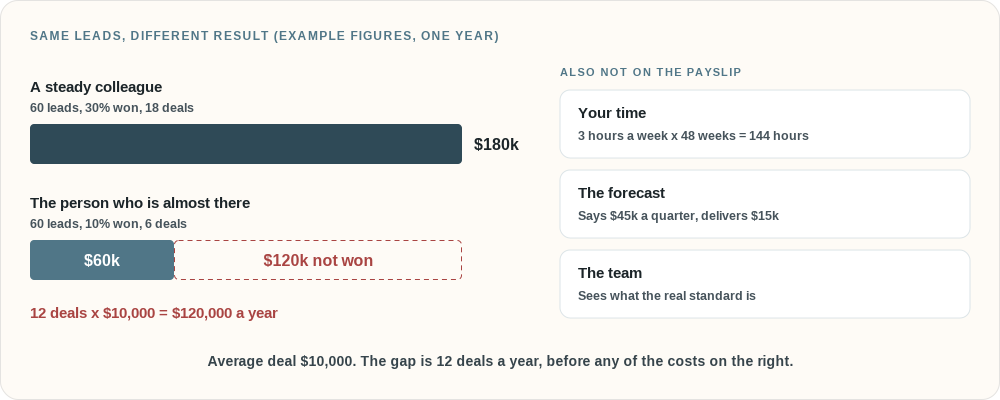
Be honest with the sum in both directions. A replacement will not win 30 percent in their first month, and the seat may be empty for a while. But even a person who settles halfway, at 20 percent, wins 12 deals and closes half the gap. The point is not the exact figure. It is that the cost of waiting is a real number, and most owners have never worked it out.
A slow start, a bad patch, or a pattern
Revenue alone cannot answer this, because it arrives late and in lumps. A new hire can do everything right for months before the first deal closes. An experienced person can coast on old relationships while doing very little. Look at three things together, over several months: the activity they put in, how much of it converts to the next step, and only then what was won.
| What to look at | Ramping, or a bad patch | Not going to make it |
|---|---|---|
| Activity | Steady or rising, even when results are thin | Low, or busy with work that is not selling |
| Conversion between steps | Improving month by month, or it dipped after being good | Flat at the same weak point, whatever is tried |
| The pipeline | Deals move, and dead ones get closed | The same deals sit for months with dates that keep moving |
| Response to coaching | Tries the suggestion and reports back | Agrees in the room, then nothing changes |
| The explanation | Specific, and different each time | The same reason every quarter: the leads, the price, the timing |
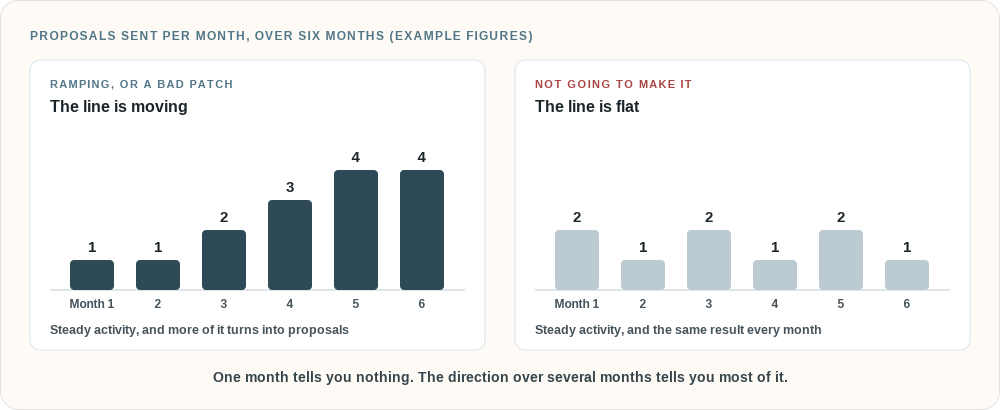
It also helps to ask two separate questions about each part of the job: can they do it, and are they willing to do it? Someone who works hard at prospecting but loses every negotiation needs teaching and practice. Someone who knows how and has stopped trying needs a frank conversation about why. Treating one as the other wastes months.
Check your own part first
Before you conclude anything about the person, answer these honestly. If several answers are no, the first plan to write is your own.
- Was the expectation clear? A number, a period and the activity behind it, written down, not a general hope that they would do well.
- Did they get coaching? Regular one-on-ones about real deals, not only a monthly look at the total.
- Did they get decent leads? Compare the number and the kind of leads they received with what their colleagues received.
- Did they have the time to sell? Someone who also does delivery, support and the newsletter is not a full-time salesperson.
- Have you said it plainly before? If this would be the first time they hear there is a problem, it is too early to decide.
A fair plan with an end date
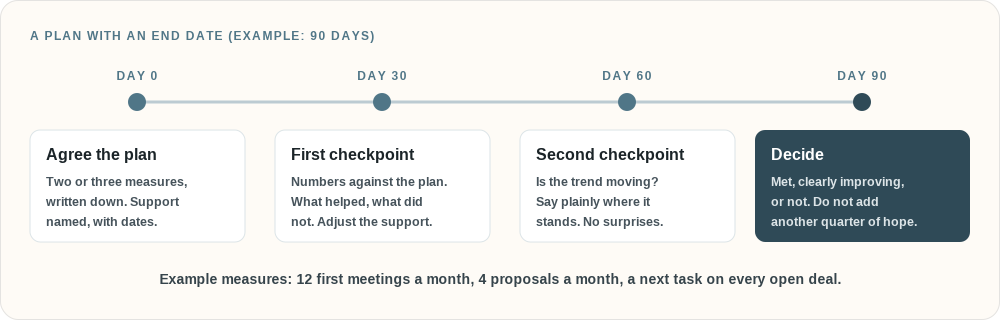
An improvement plan is only fair if both outcomes are possible. If you have already decided, do not put the person through a plan for show. If you have not, give it a fixed length. Ninety days suits many small firms, but a long sales cycle may need more.
- 1
Say it plainly
Tell them the results are not where the job needs them to be, that you want it to work, and that you are both going to find out by a set date. Vague concern is not kinder. It only delays the day they understand.
- 2
Agree two or three measures
Choose measures the person controls and that lead to revenue, such as first meetings held, proposals sent, and every open deal having a booked next step. Add a result measure if your sales cycle fits inside the plan. Write them down and both keep a copy.
- 3
Put in real support
Name what you will do and when: a weekly one-on-one, sitting in on two calls a month, a fair share of new leads, help with the one skill that is weakest. A plan with measures and no support is only a countdown.
- 4
Review on fixed dates
Meet at each checkpoint with the numbers in front of you. Say where things stand in plain words, so the final conversation holds no surprise for either of you.
- 5
Decide at the end
The measures were met, they were not met but the trend is clearly up, or nothing moved. Only the middle case earns more time, and then a short, stated amount.
Deciding, and doing it decently
If the plan worked, say so clearly, and keep the one-on-ones going. If it did not, consider whether another job in the firm truly fits them, such as looking after existing clients. Offer it only if the job is real and you would have hired them for it.
If you are parting ways, do it soon and in person. Give the honest reason in a few sentences, without a list of every failure. Be as generous as you can afford with notice, pay and a reference for the things they did well. Tell the team the same day, briefly and with respect, and reassign the person's deals, accounts and open tasks straight away so no client is left waiting. Employment rules differ by place, so check the ones that apply to you before you act.
Start this week
- 1Work out the sum for your own firm: leads received, win rate and average deal for each person, over the last twelve months.
- 2Pull six months of activity and conversion for the person you are worried about, and look at the direction, not the latest month.
- 3Answer the five questions about your own part, in writing.
- 4Book the plain conversation, and go in with two or three measures and the support you will give.
- 5Put the checkpoint dates and the decision date in both calendars before the meeting ends.
The salesperson who is always almost there is rarely a bad person, and the owner who keeps them is rarely a weak one. What the situation needs is an end date, a fair chance of meeting it, and an owner prepared to act on the result.
More on this from The Center for Leadership Studies: Regrettable retention: what keeping low performers is costing you