
Ask a room of salespeople who among them is a good listener and nearly every hand goes up. Ask their buyers and you get a different count. Listening feels like something you do automatically, the way you breathe, so almost nobody practices it.
On a sales call it is anything but automatic. You are tracking the time, your list of questions, the proposal you hope to send and whether the buyer likes you. Each of those pulls attention away from the one thing that decides how the call goes: what the buyer is actually telling you.
What active listening is, and what it is not
Active listening is giving the buyer's answer your full attention, then proving you heard it by what you do next. The proof is the important part. A follow-up question that could only have come from their last sentence, or a summary they agree with, shows you listened. Nodding does not.
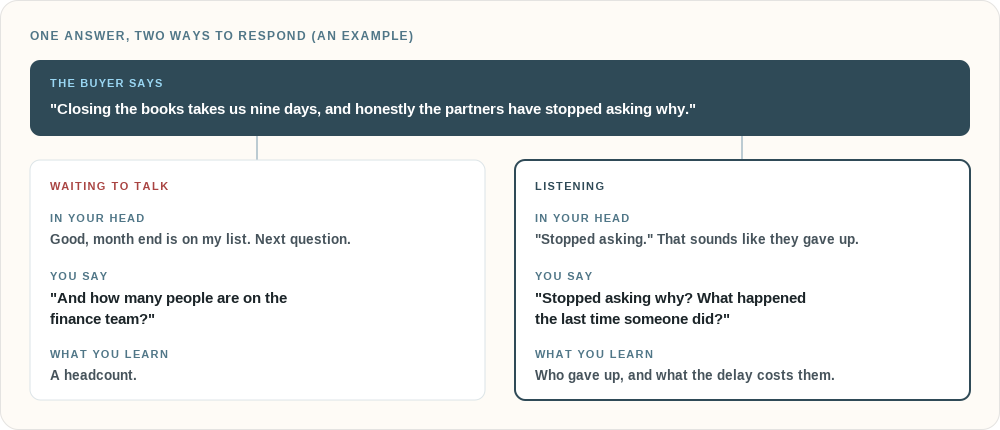
It is not staying quiet while you wait for your turn. A person can be silent for a full minute and take in nothing, because that minute went into choosing the next thing to say. It is also not agreeing with everything, or saying "I hear you" between your own points.
The evidence that this skill is commonly weak
Objective Management Group, a firm that assesses salespeople, publishes findings from its assessment data. Its research found that 62% of salespeople are not proficient in active listening, which leaves only 38% who are. It also reports that the average score on this skill has held steady at 77% to 78% for six consecutive years.
Two things in those findings are worth a small firm's attention. First, an average that sounds comfortable can sit on top of a majority who fall short, so "we are probably about average" is no reassurance. Second, a score that does not move for six years suggests that time on the job does not fix this by itself. Their research treats listening as something to be coached and practiced, and ties it to staying composed when a conversation gets tense. That matches what most sales managers see: people stop listening at exactly the moment the buyer says something they did not want to hear.
Five habits that get in the way
- 1
Planning your next question
While the buyer answers question three, you are wording question four. You catch the start of the answer and miss the end, which is where people put the part they were unsure about saying.
- 2
Jumping to the solution
The buyer mentions a problem you have solved many times and you start solving it. Their version of the problem may differ from the one you know, and now you will not find out how.
- 3
Filling silences
A pause after your question feels like a failure, so you rephrase it, offer options or answer it yourself. The buyer was thinking. You just told them they did not need to.
- 4
Hearing what you hoped to hear
"That could work for us" becomes "they are in" by the time it reaches your notes. Hopeful listening is the main reason a deal looks further along in your records than it is in the buyer's mind.
- 5
Taking notes instead of listening
Writing full sentences keeps your eyes down and your attention on the page. Write a few of the buyer's own words as keywords during the call and write the note properly afterward.
Seven behaviors you can practice
Each of these is something another person could watch you do or not do. That is what makes them easier to work on than "listen better".
- 1Ask one question at a time. Two questions joined by "and" get one answer, usually to the easier half.
- 2Let the answer finish. Wait for the full stop, then one beat more. People often add the real point after they seem to be done.
- 3Follow up on what was just said. Your next question should come from their last answer, not from the next line of your list. The list is there so you can check it at the end.
- 4Play back in the buyer's own words, then check. "So month end takes nine days and the partners have given up asking. Have I got that right?" Use their words, not your tidier version of them.
- 5Notice what was not said. They described the problem but never the cost. They named a colleague but not who decides. Ask about the gap.
- 6Leave a pause. After an answer that matters, count to three before you speak. It feels long to you and normal to them.
- 7Summarize before you propose. Before any solution, state the situation as you understand it and ask what you missed. A proposal built on a summary the buyer corrected is a different proposal.
A routine for one call
Listening is hard to switch on by willpower in the middle of a call. It is easier to set up beforehand and to check afterward.
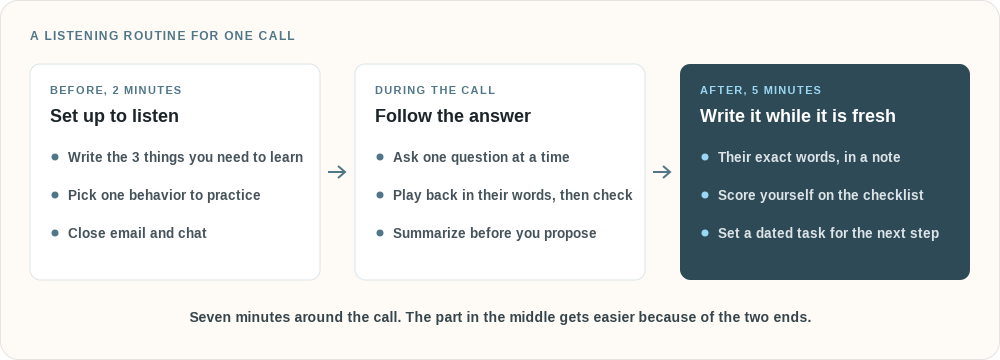
- Before. Write down the three things you need to learn, not the fifteen questions you could ask. Three things leave room to follow an answer wherever it goes. Choose the one behavior you are practicing and close everything else on your screen.
- During. Keep your notes to keywords in the buyer's words. When you feel the urge to explain your service, treat it as a signal to ask one more question first. Near the end, summarize and agree the next step out loud, with a date.
- After. Within five minutes, write what the buyer said in the words they used, including anything they hesitated over. Then score yourself.
Score yourself after the call
Give each of the seven behaviors a 0, 1 or 2: not at all, some of the time, or most of the call. Be strict. If you cannot remember playing anything back, that is a 0.
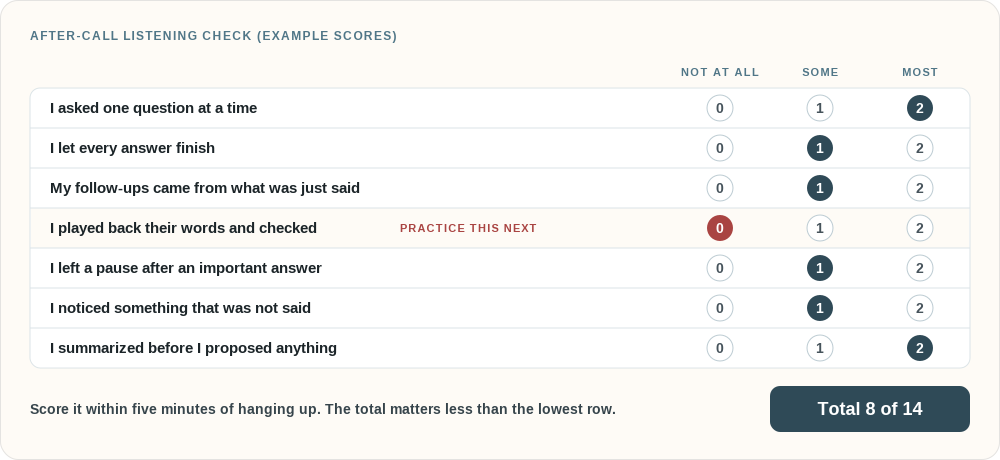
The total is only useful as a trend across several calls. What helps on the day is the lowest row, because it names the one thing to work on next. In the example above, that is playing back.
How to practice
- 1
One behavior a week
Trying all seven at once turns the call into a performance. Take the lowest row from your checklist and make it the only thing you practice on every call that week. Move on when it scores a 2 without effort.
- 2
A colleague sitting in
Ask someone to join a call and watch for one thing only, such as how often you spoke before the buyer had finished. A count is easier to hear than an opinion. Return the favor on one of their calls.
- 3
Listening back
On a video call, ask permission to record, say what it is for, and accept a no. In some places the law requires that consent. Then listen to ten minutes of it and mark each time you interrupted, stacked two questions or moved on from something worth following. Most people find this uncomfortable once and useful ever after.
How good listening shows up later
You will not see the result on the call itself. You see it in what happens afterward.
- Fewer surprises in the proposal. The buyer reads it and recognizes their own situation, in their own words, so the reply is about details and not about whether you understood.
- Objections surface earlier. A buyer who has been played back accurately tends to correct you on the spot, and a worry raised in the first call is far cheaper than the same worry raised after the proposal.
- Shorter calls later on. You do not have to ask again for something they already told you.
- More honest records. When you write down what was said and not what you hoped, a deal's stage matches where the buyer really is.
Start this week
- 1Before your next call, write the three things you need to learn and put the question list to one side.
- 2On that call, play back at least once in the buyer's own words and ask whether you got it right.
- 3Within five minutes of hanging up, score the seven behaviors from 0 to 2 and write the buyer's words into a note.
- 4Take your lowest row and practice only that on every call for a week.
- 5Ask one colleague to sit in on a call and count how often you spoke before the buyer had finished.
Buyers rarely remember the questions you asked. They remember whether the person on the other end understood them. That is a skill, and like any skill it improves when you practice it deliberately.
This article draws on research by Objective Management Group. Read more in their research