
A full pipeline is the most comforting thing in sales, and one of the least reliable. The number at the bottom of the forecast looks healthy right up until the last week of the quarter, when half of it quietly moves to next quarter.
Most teams try to fix this with better judgment: tougher deal reviews, more pointed questions, a sharper gut. I think that is backwards. The evidence that a deal is real or not is usually already sitting in the CRM. It is in the close date history, the calendar, the contact list and the email thread. You just have to know where to look.
Here are nine red flags I look for. Each one is something you can check in a few minutes, not a feeling you have to argue about.
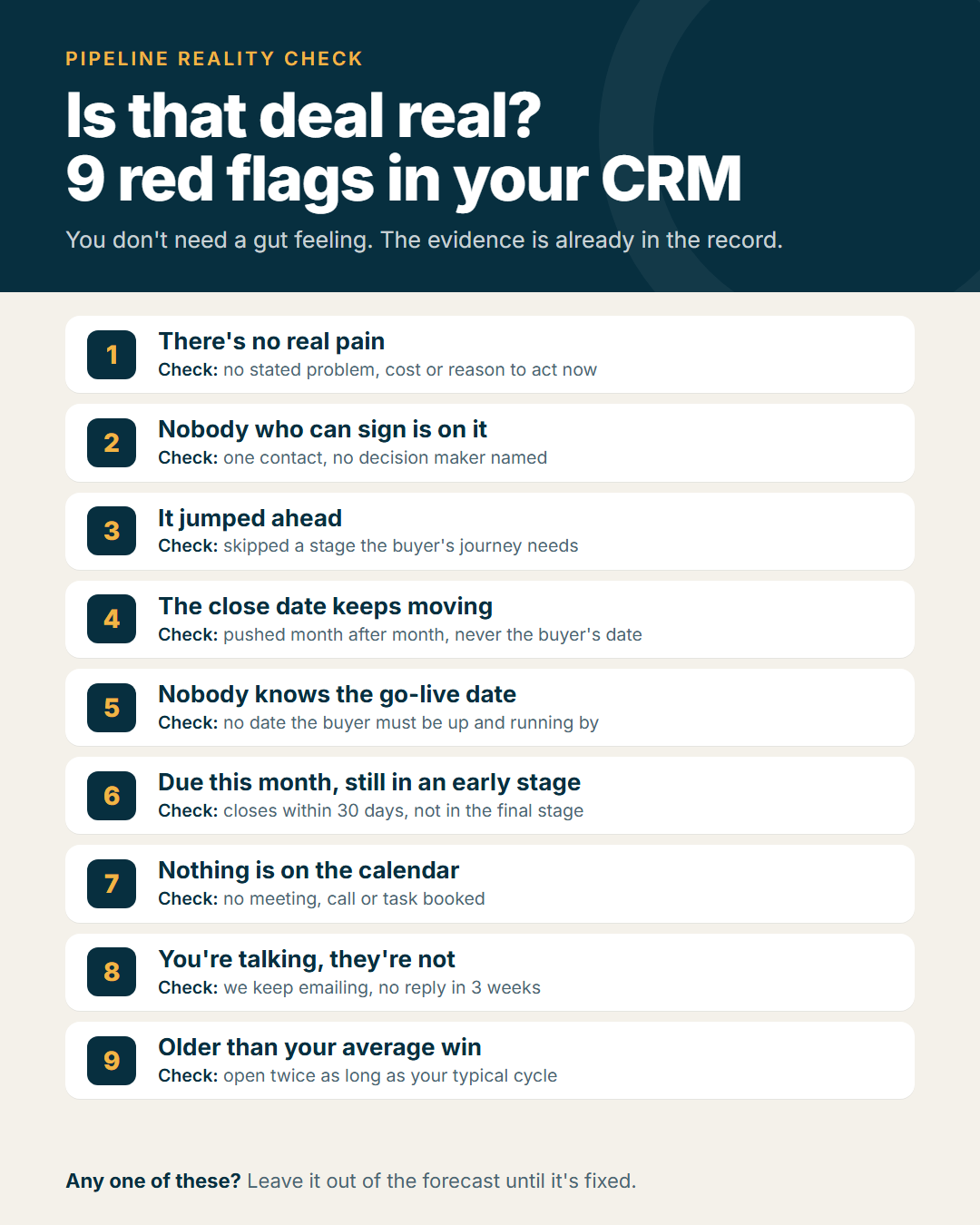
The nine red flags
They run in the order a deal usually goes wrong: first the qualification, then the discovery, then the dates, then the momentum.
1. There is no real pain
A buyer who is curious is not a buyer who is hurting. Plenty of deals enter the pipeline because someone took a meeting, liked the demo or asked for a price. None of that is a reason to buy. Without a real problem, one that costs the buyer money, time or risk every month it stays unsolved, nothing pushes the deal forward, and it loses to the status quo.
This is where qualification happens or doesn't. A qualified deal has a problem the buyer has stated in their own words, a cost they have put a number on, a reason it has to be solved now, and someone with the authority and budget to solve it. Miss those, and every later stage is built on sand.
The check: can the rep write down, on the deal, the buyer's problem, what it is costing them and why they need to fix it now? If those are empty or vague, the deal is not qualified, whatever stage it sits in.
2. Nobody who can sign is on it
One friendly contact who loves the product is a great start and a weak forecast. If that person cannot approve the spend, someone you have never met can stop the deal.
The check: deals with only one contact, or no contact marked as the decision maker. In the later stages, treat this as urgent.
3. It jumped ahead
Good pipeline stages mirror the buyer's journey: how they recognize a problem, explore options, build a business case and get approval. Buyers rarely skip those steps. So when a deal jumps from first call to proposal, the buyer did not skip anything. We did. The discovery, the stakeholder meetings and the business case never happened, and they come back later as objections, delays or silence.
The check: deals that skipped a stage, or reached a late stage with no meeting held in the stages before. If you cannot point to the conversation that earned the stage, move the deal back to where the evidence puts it.
4. The close date keeps moving
When a close date slides from March to April to May, the deal did not get delayed. The date was never real. Nobody on the buyer's side committed to it; we picked it because it fit our forecast.
A date that keeps moving is a symptom of thin discovery. A real close date is tied to something in the buyer's world: a contract that expires, a budget that resets, a launch they have to hit. If the team cannot name that event, they do not yet understand the client's situation, who approves the spend, or how the buyer makes decisions. They are guessing, and every push is a new guess.
The check: any open deal whose close date has moved more than twice in 90 days. Then ask the rep two questions: what happens on the buyer's side on that date, and who told us? If there is no answer, go back and do the discovery before you forecast it again.
5. Nobody knows the go-live date
For many deals, the date that matters to the buyer is not when they sign. It is when they need to be up and running: before peak season, before a contract runs out, before a new team starts. Work backward from that date, through onboarding and implementation, and you get a close date the buyer actually needs to hit.
When the rep does not know the go-live date, the close date has nothing to stand on. It also means the conversation never got past the purchase to what the buyer is trying to achieve.
The check: on deals where it applies, no go-live date on record, or a close date that leaves no room to implement before it. Ask the buyer when they need this working, and why then.
6. Due this month, still in an early stage
A deal set to close in three weeks that is still in an early stage is almost certainly going to slip. Proposals, legal review and procurement all take time that the calendar does not have.
The check: close dates in the next 30 days on deals that are not yet in the final stage. If nobody has touched the deal in two weeks either, put it at the top of the list.
7. Nothing is on the calendar
Deals move in meetings. A deal with no next step booked is waiting for something to happen, and in sales, things rarely just happen.
The check: open deals with no future meeting, call or task. The fix is one sentence: book the next call before you hang up the last one.
8. You are talking, they are not
This is the one most dashboards miss. A rep can log ten emails a week on a deal and look very busy. But activity counts what we send, not what comes back.
The check: deals where we have emailed in the last two weeks but nobody at the buyer has replied in three. Busy is not the same as engaged.
9. Older than your average win
Every team has a typical sales cycle. A deal that has been open twice as long as your average win is not a long deal. It is usually a lost deal nobody has closed out.
The check: open deals older than twice your average cycle. The question for each one is simple: commit to a plan this week, or close it out.
Turning the red flags into a weekly habit
None of this works as a one-time cleanup. Pipelines drift back within a month. What works is a short routine, run every week, that sends each finding to the right conversation.
- 1
Rep cleanup, 20 minutes on Monday
Each rep gets their own list: dates to fix, next steps to book, contacts to add. These are fixes, not judgments, so keep them out of the team meeting.
- 2
One-on-ones for the patterns
If one rep has most of the silent deals or most of the stale ones, that is a coaching conversation, not a data problem.
- 3
The sales meeting for the money
Only the deals that move the forecast belong here: the big ones, the ones due this month, and any deal in this month's forecast that shows even one red flag.
The bottom line
A forecast built on hope feels fine until it doesn't. A forecast built on evidence lets you see the miss coming early enough to do something about it. Run these nine checks on your own pipeline this week and count how many deals in your forecast show even one. Any one of them is reason enough to leave a deal out until it is fixed. That number is usually the gap between the forecast you have and the one you will hit.
Which red flag do you see most often on your team? I would like to hear the ones I missed.